Archive for Budget

COUNTY WILL COLLECT $58,240,800 IN PROPERTY TAXES IN 2025- 2026 FOR YAVAPAI COMMUNITY COLLEGE

College unable to provide Sedona and Verde valley tax contribution data during May 27 budget hearing

Yavapai County residents will pay an estimated $58,240,800 in property taxes to support Yavapai Community College in fiscal year 2025–2026. However, at the College’s public budget hearing held on May 27, College officials were unable to answer a key question: how much of that total comes from taxpayers living in Sedona and the Verde Valley.

District 1 Governing Board member William Kiel requested a breakdown of property tax contributions and expenditures specific to the region. In response, Dr. Clint Ewell, the College’s Vice President of Administration and Finance, admitted, “Unfortunately, I don’t know the answers to either of those questions.” He added that the 125-page budget document provided to the Board does not “split apart the budget,” concluding, “I don’t have a way of answering that question today.”

Kiel noted that this was a repeated request, saying, “It’s a question I’ve asked in the past that I’d like an answer to.” Dr. Ewell responded, “I think in the past when you asked, we did answer it, but I had no warning today that you would ask that question again.”

Kiel further stated that he had requested a meeting with Dr. Ewell prior to the hearing to discuss the budget in detail but received no reply. “I was hoping somebody would have researched it by now,” he said.

Board Chair Deb McCasland, who appeared intent on limiting Kiel’s line of questioning, interjected that she believed the percentage from Sedona and the Verde Valley was approximately 28 percent, a figure Dr. Ewell tentatively agreed might be correct.

The inability—or unwillingness—of College leadership to provide a clear accounting of how much Sedona and Verde Valley residents contribute in property taxes, and how those funds are reinvested locally, continues to raise concerns about transparency and equity. For residents who supply a substantial portion of the College’s annual revenue, the lack of detailed financial accountability reinforces longstanding frustrations about underrepresentation and marginalization in institutional planning and decision-making. As calls for greater fiscal clarity grow louder, the question remains whether Yavapai College will deliver the answers its rural taxpayers deserve.


EFFORT TO RESTRICT BOARD MEMBER KIEL’S BUDGET QUERIES HIGHLIGHTS TROUBLING POWER PLAY AT MAY 27 MEETING

Deeply troubling—if not outright alarming—to witness how Yavapai Community College District 1 Governing Board Representative William Kiel was treated during the May 27 public budget hearing

Robert E. Oliphant

Opinion: It was deeply troubling—if not outright alarming—to witness how Yavapai Community College District 1 Governing Board Representative William Kiel was treated during the May 27 public budget hearing. Rather than an open exchange about questions involving  $120 million in the mostly taxpayer funded budget the Board was being asked to approve, the meeting resembled something like a scripted stage production—where the Chair appeared determined to silence meaningful inquiry and bend the process to her will.

From the outset of the meeting, Chair Deb McCasland unilaterally imposed a five-minute time limit on Board members wishing to raise questions and discuss the budget. This arbitrary cap was never discussed or approved by the full Board—yet Ms. McCasland was determined to enforce the limit with the vigilance of a sentry guarding the walls against unwelcome scrutiny.”

Mr. Kiel, rightly concerned about the limitation, voiced his objection and asked for more time. McCasland offered a vague concession: perhaps there would be a second round of questions “if time allowed.” Unsurprisingly, she later declared there was no need for a second round, thereby eliminating any further opportunity for scrutiny of the budget.

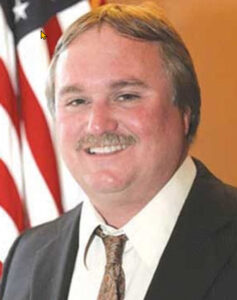
Mr. Kiel at meeting showing time left to speak on stopwatch.

As Kiel pressed forward during his allotted minutes—armed with a stopwatch, no less—McCasland repeatedly interrupted him, declaring his time had expired. Kiel protested, and the Governing Board’s attorney intervened in his defense, affirming that time remained. Even then, McCasland continued to cut him off, only to be overruled by the attorney once again.

This was no mere misunderstanding. It resembled a calculated effort to muzzle a Board member charged with asking hard questions on behalf of the public. The imagery was striking: one lone voice attempting to speak truth in a room determined to turn down the volume.

Equally disconcerting was Mr. Kiel’s assertion that he had reached out prior to the meeting to the College’s Vice President of Finance and Administration for help with budget questions, only to be ignored. When this was raised, College President Dr. Lisa Rhine interjected, denying receipt of such a request. However, Kiel clarified that the request had been sent to the Board Chair. McCasland vaguely acknowledged the request was made at a previous meeting but offered no explanation as to why it was not acted upon. The tone, in my judgment, from both the Chair and the President, in that moment, could only be described as dismissive—if not somewhat overtly hostile.

That a duly elected Board member would be treated in such a fashion—during a public meeting about how to spend $120 million in public funds—should alarm every citizen of Yavapai County. What we witnessed was not transparency. It was a power play—an attempt to micromanage discourse and limit oversight. For some, it bordered on a suppression of free speech. For others, it was simply a disgrace.

In either case, it was a poor performance from those entrusted to lead. Public institutions are not private kingdoms. When dialogue is silenced and accountability sidestepped, it’s not just one Board member who suffers. It’s the public trust that takes the blow.

It is worth noting that during the Board’s regular business meeting, which immediately followed approval of the budget, Representative Kiel requested that the draft minutes of a prior meeting explicitly reflect that Board members were limited to “two minutes” to ask questions. Although the statement was factually accurate, his motion was defeated in a 3-2 vote. The majority contended that the meeting’s video recording sufficiently demonstrated the time constraint, rendering the amendment unnecessary. Mr. Kiel remarked that every motion he has made has been consistently rejected by the same three Board members. (See video clip.)

You may view clips of Mr. Kiel struggling with the time issue at the May 27 meetings below:

YAVAPAI COMMUNITY COLLEGE ANTICIPATES REVENUE DECLINE BY 6.6% IN DRAFT 2025–2026 BUDGET PRESENTED TO DISTRICT GOVERNING BOARD AT APRIL MEETING

Although various factors affected the reduction, the reduction was mainly due to the expected withdrawal of federal funding for several programs and the approval of only a few new capital projects, which eliminated the need to draw down money from a revenue bond to support a larger number of projects

Yavapai Community College’s total revenue is projected to decline in the 2025–2026 draft budget. According to information presented to the District Governing Board at its April meeting, revenue is expected to fall from approximately $126.8 million in 2024–2025 to around $118.4 million in 2025–2026—a decrease of $8.4 million (6.6%).

Although there are several factors that may affect the reduction, this revenue drop appears primarily to stem from a $2.3 million reduction in federal support and a $6.1 million decrease in new capital project funding. The decrease in capital projects meant that money was not needed to be taken from an existing $16 million revenue bond and added to the budget.

At this stage, the draft capital improvement budget includes only four new projects for the coming year, all located on the west side of Yavapai County, specifically at Prescott-area campuses and centers. The proposed projects include:

  • $1,330,000 for upgrades to the Community Room on the Prescott Campus
  • $45,000 for improvements at the Career and Technical Education Center (CTEC)
  • $147,300 for renovations to the Prescott Campus cafeteria
  • $28,500 for an EMS carport

Additionally, a contingency fund of $160,000 is included in the draft budget.

The final budget will be presented to the District Governing Board at the May 27 Budget Public Hearing and Adoption Business Meeting, where most anticipate it will receive approval.

The link below takes you to a video clip of the explanation given at the April Board meeting and may be helpful in further understanding the reduction. Please click here.

TWELVE PERSON (NOW 16) PREFABRICATED APARTMENT BUILDING APPROVED IN MAY 2024 FOR VERDE CAMPUS GETS ANOTHER LOOK AT MARCH 2025 MEETING

College now says pre-fab building to be ready for fall 2025; tiny houses to follow in 2026 ($27 million for possible Verde Campus capital improvement recommended by experts in 2022-23 cut to $2 million)

At its March meeting, the Yavapai Community College District Governing Board received an update on the College’s student housing expansion plans. Dr. Clint Ewell, Vice President of Finance and Administrative Services, reported that among the plans now moving forward,  the College intends to construct a prefabricated building to accommodate 16 students as a pilot project on the Verde Valley Campus this summer. It will also locate several small houses built by students on the campus in spring 2026.

Dr. Ewell did not provide an updated specific cost estimate with details for the project, which was originally approved in May 2024. At that time, the planned pre-fabricated structure was expected to be approximately 3,000 square feet, with an estimated cost of $200 per square foot for purchase and installation—bringing the total to around $600,000. One suspects the additional funding stated in the revised budget of $2 million for Verde housing  includes creating  the infrastructure for the project.

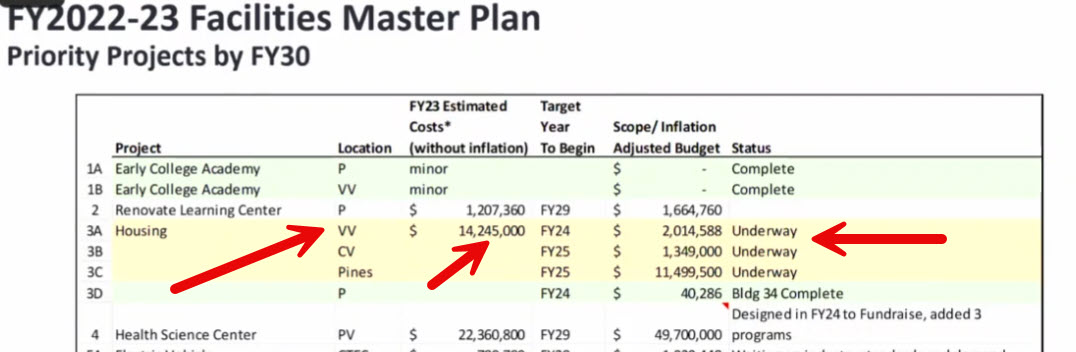
At the March 2025 meeting Dr. Ewell indicated that the College had anticipated spending around $14 million for student housing on the Verde Campus back in 2022-23.  (See his estimate below.) However, that figure dropped to $2 million, which was to cover the costs associated with the pre-fab apartment complex and the 10 student trailer park.

It is noteworthy that the College abandoned  the $14 million housing project intended for the Verde Valley Campus, and dumped the previously approved $12 million Craft Brewing and Distilling program plus the $608,000 Commercial Driving program. The almost $27 million intended for these discontinued initiatives has apparently been redirected to support several newly approved, high-cost projects on the west side of Yavapai County on the Prescott Campus and Chino Valley Center. (Except for $2 million for Verde Housing).

You may view Dr. Ewell’s report on video below:


YAVAPAI COMMUNITY COLLEGE DISTRICT FOUR REPRESENTATIVE GIVES “NO” VOTE ON TAX RATE INCREASE WHILE REPEATEDLY LAUDING COLLEGE AND PRESIDENT RHINE

Some wondered  whether the fact he is running for Yavapai County Supervisor may have influenced his  vote but his stance is consistent with opposition to last year’s 5 percent Community College property tax rate increase that was approved by a majority of the Board

Chris Kuknyo

If there’s one definite “no” vote on a tax rate increase for Yavapai Community College, it’s District Four representative Chris Kuknyo. He voted “no” in a 4-1 decision last year when the property tax rate increased by five percent. This year, he again voted “no” in opposition to a 3.4% property tax rate increase.  The rate increase  was approved 3-2 by the Governing Board.

For some observers, Mr. Kuknyo’s position was somewhat puzzling. For example, he strongly supported the College’s purchase of the 42-acre church camp located near his district. The College used $5 million of taxpayer dollars it had in reserve to purchase the property, plus an additional $6 million of new taxpayer funds in the 2024-2025 budget to renovate and equip the facility. In addition to this project, Mr. Kuknyo supported the construction of the $20 to $40 million health science facility in his district, with the only caveat being that a third-floor convention center should not be included (which it appears it is not). Moreover, as you will see from his speech prior to casting his “no” vote at the Truth in Taxation hearing, he lauded the work of President Rhine and various programs offered by the College.

His extremely brief statement, after four minutes or more of praising the College, came quickly at the end of his speech when he said, “I do think we could maybe make do where we’re at, and that’s why I’m voting no on the tax rate increase.” He never provided an analysis to support this conclusion.

Some observers, puzzled by his speech, attributed his “no” vote to the upcoming election for District Four County Supervisor. Mr. Kuknyo is among the Republican candidates vying for that position. Other observers noted that this vote is consistent with his “no” vote cast last year when he opposed increasing the Community College property tax rate by five percent.

It is also noteworthy that he voted “no” on the College budget for 2024-2025.

You may view and hear all of Mr. Kuknyo’s speech made just prior to casting a “no” vote on the property tax rate increase by clicking on the video below.

SIGAFOOS, RUNNING FOR RE-ELECTION, JUSTIFIES “YES” VOTE ON TAX INCREASE SAYING COMMUNITY COLLEGE IS SERVING WIDE VARIETY OF ESSENTIAL COMMUNITY NEEDS

Suggests inflation and student success are key factors justifying imposing a total  8.4% property tax rate increase in two years

Ray Sigafoos  is the longest serving member of the Yavapai Community College District Governing Board with 18 years of service. He is running once again for the position in November.

During the public portion of the Truth in Taxation Hearing May 21, 2024, Sigafoos’ opponent in the November election, William Kiel,  spoke forcefully against the 3.4% property tax rate increase. Sigafoos’ just as forcibly spoke in favor of the tax increase and voted to approve  it.

When explaining his vote, Sigafoos’ listed the wide variety of needs the Community College was serving in Yavapai County. He also alluded to inflation and student success as a significant reasons for approving a total of 8.4 percent tax rate increase during a two-year period. He also voted to approve the 2024-2025 budget.

Please click below to hear Mr. Sigafoos making his statement just prior to the vote explaining his position on increasing the tax rate. (Mr. Kiel’s statement to the Board via video was posted in last week’s Blog.)

GOVERNING BOARD APPROVES 3.4% PROPERTY TAX INCREASE FOR 2024-2025 IN CLOSE 3-2 VOTE DESPITE $22.2 MILLION IN SAVINGS ACCOUNT IN ADDITION TO $15.1 MILLION IN BOARD DESIGNATED MINIMUM RESERVES

Lack of clarity on future allocation of $22.2 million in  savings leaves community members puzzled and questioning tax increase

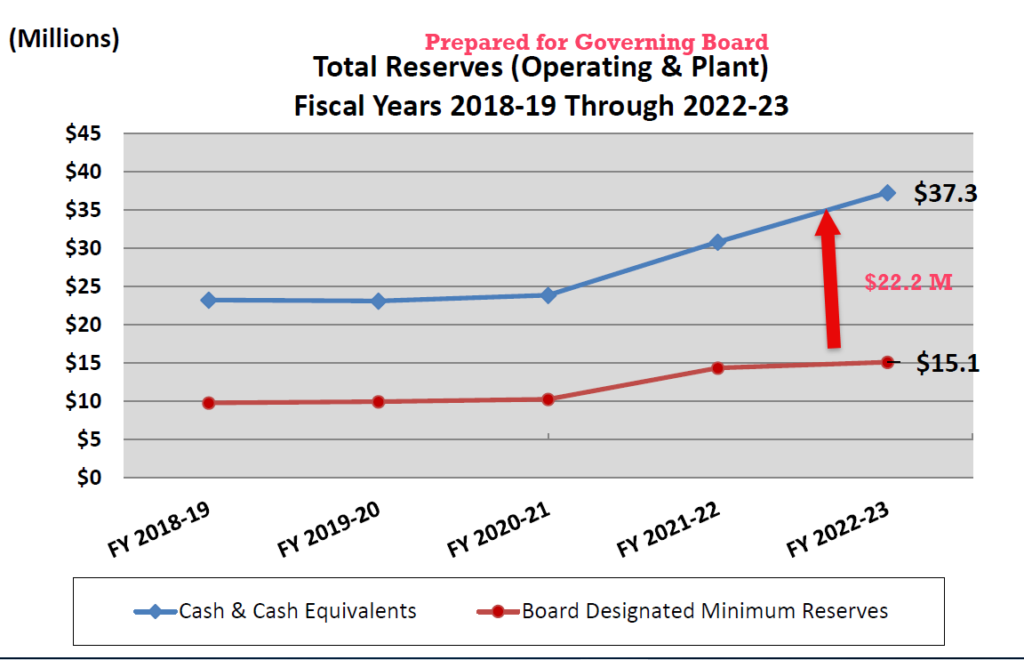
In its budget book, prepared for the May 21, 2024, meeting, Yavapai Community College included a graph illustrating its savings across two of its five funds. The graph revealed that, by the end of 2023, the college had accumulated $22.2 million in cash reserves. This was in addition to $15.1 million that are Board designated minimum reserves (total $37.3 million).

Third District Governing Board member Toby Payne was the only Board member to question the substantial amount of money in reserves with no apparent clear designated purpose. When he inquired about the chart and the $22.2 million, Vice President Clint Ewell responded that it represented “savings” but did not provide any further explanation.

This raises several important questions: How much of the $22.2 million remains in savings? Was part of it, specifically the $5 million, used secretly to pay a developer for purchase of the 42-acre Prescott Pines Camp taken from those reserves? Why is there a proposed 3.4% tax increase, projected to generate approximately $1.8 million, when the college already has $22.2 million in reserves?

Answers to these questions remain elusive. Aside from Mr. Payne, only Mr. Ray Sigafoos showed interest, speculating that the funds might be reserved for future capital purchases.

DISTRICT ONE GOVERNING BOARD CANDIDATE KIEL UNABLE TO PERSUADE BOARD THAT TAX INCREASE WAS NOT WARRANTED

Says  in last three years Community College budget has increased by 155% (about $41 million); claims per student cost around $74,588; estimates President’s Rhine’s current salary around $350,00; questions cost/benefit while agreeing College has done many good things

Yavapai Community College District one  candidate William Kiel, while addressing the Governing Board at the May 21, 2024, public tax hearing, was unable to persuade its members to reject the 3.4 percent primary property tax increase it was considering. The property tax rate was approved by a 3-2 vote.
The 2024-2025 increase will add about $1.8 million annually to the budget. The 5% rate increase approved last year provided around $2.55 million in new annual revenue. The result is a total of $4.3 million of new revenue coming from property taxes each year to the budget. The Board could have approved a 1.4 percent increase without public input.

County property taxes alone, paid mostly by homeowners,  provides  the College with about $56.5 million annually.

Mr. Kiel expressed concern to the Board about raising the tax by 3.4 percent after it had already been increased by 5 percent last year. He also highlighted that the College’s budget has increased by around 155 percent (about $41 million) in just three years. He suggested the per student cost was somewhere around $74,588.He mentioned the President’s salary, which he estimated to be the highest in the county at around $350,000. He asked the Board to consider a cost/benefit analysis before going ahead and approve the tax rate increase.

It is noteworthy that District one appears to have three candidates interested in the seat, including current Board member Ray Sigafoos, Mr. Kiel, and George Joeger. Mr. Sigafoos wrote an opinion column supporting the property tax increase, which appeared in several local newspapers.

To check on the accuracy of his posting, please listen to Mr. Kiel’s presentations, which were restricted due to Board time limits, by clicking on the video below.


YAVAPAI COMMUNITY COLLEGE DISTRICT GOVERNING BOARD TO HOLD A (1) TRUTH IN TAXATION PUBLIC HEARING, (2) A TRUTH IN TAXATION PUBLIC SPECIAL MEETING, AND (3) A BUDGET PUBLIC HEARING TUESDAY, MAY 21, 2024, AT THE ROCK HOUSE ON THE PRESCOTT CAMPUS

The hearings and meeting are scheduled to begin at 1:00 p.m. Residents may address the Board at the public hearings and the hearings will  be live-streamed
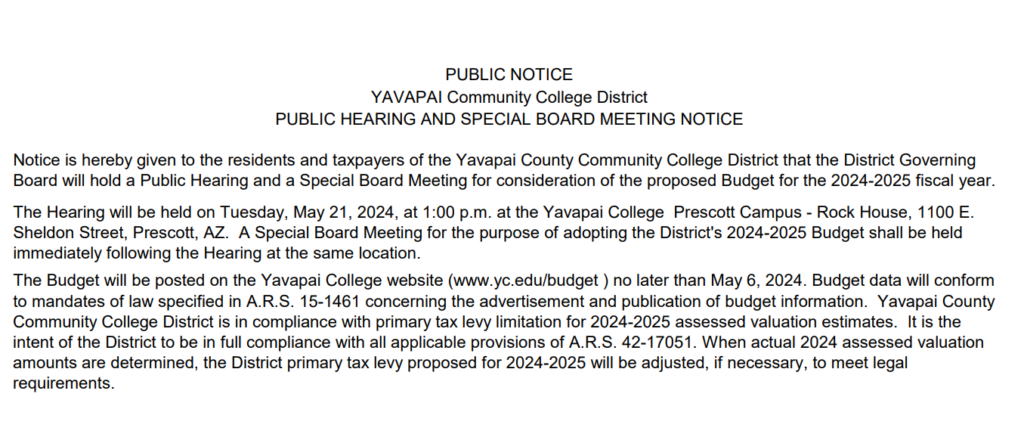
The Yavapai Community College District Governing Board will hold a (1) Truth In Taxation Public Hearing, (2) a Truth In Taxation Public Special hearing, and (3) a Budget Public Hearing,  Tuesday, May 21, 2024, at the Rock House on the Prescott Campus. A business meeting will follow the Budget Public Hearing.

The event is scheduled to begin at 1:00 p.m. The budget hearing and business meeting may extend the event to around  4:00 p.m. It will be held at the Rock House on the Prescott Campus.

The public may address the Governing Board at the public hearings for an anticipated three minutes. (You can register at the door to speak.)

Under Arizona law, a citizen has a right to attend, listen, tape record, or videotape all of these meetings. The public may not disrupt, but may speak during the Call to the Public at the beginning of a meeting if the call is on the agenda. See Ariz. Att’y Gen. Op. No. I78-001.

You may access the agenda for this meeting at the District Governing  Board’s website when it is eventually posted. (It is normally sent to the Governing Board by Friday prior to a meeting but is usually withheld from public posting on the Governing Board’s website until the day before the meeting.)

It is anticipated the some of the items to be discussed and possibly approved at the hearings are a County property tax increase and issuance of a $16 million dollar revenue bond.

SMALL GAZEBO ADDED TO TRAILER PARK ON YAVAPAI COMMUNITY COLLEGE VERDE CAMPUS

Project a part of improving student/staff/faculty  facility

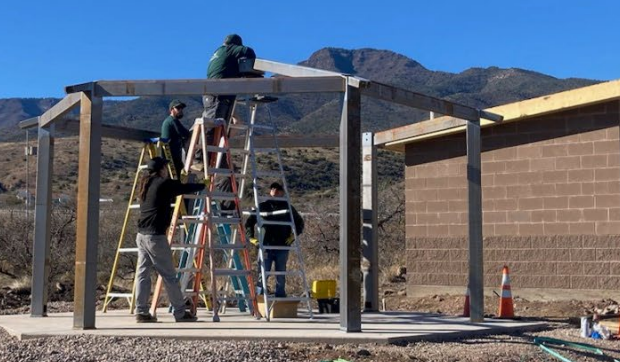
Work has almost been completed by the Facilities management team on constructing a small gazebo for the trailer park on the Verde Campus.  The photo below (cut from the Community College Facilities Management March 2024 Newsletter) shows the staff at work on the gazebo earlier this year.

Facilities Management crew at work on constructing gazebo.