Archive for Budget – Page 8
CHINO VALLEY CENTER: The Board will authorize $55,000 for the Chino Valley Center for various maintenance projects.
Capital spending inequity between the east and west sides of Yavapai County continues
The College reviewed its tentative 2017-18 capital development budget with the District Governing Board on March 7, 2017. It appears that the Board will approve spending a total of $5,547,000 on capital projects in 2017-18.
The revenue for the projects will come primarily from property taxes, Proposition 301 sales taxes, and income from investments. About 24% of the expenditure is on the East side of the County for the Sedona Center. The remaining 76% will be spent on the Prescott Valley Center and improvements on the Prescott Campus.
Here is the breakdown:
-
Prescott – building one – visual arts phase 2: $304,500
-
Prescott – building 15 – arts/music design, construction $1,692,400
-
Prescott – open space improvements – $320,000
-
Prescott Valley – renovation design, const. $1,086,000
-
Prescott Valley – land adjacent to building 40 $460,000
-
Prescott Valley – building 40 – second floor $180,000
-
Sedona Center renovation and construction – $1,345,000
-
On-campus signage – campus unknown – $160,000
-
Total capital projects: $5,547,900
The discussion during the District Governing board meeting on March 7, 2017 that focus specifically on capital development spending is reproduced below.
Property taxes and tuition pay for about $500,000 in expense gap for various public service programs
Second District Representative Deb McCasland asked the Governing Board to reflect on expending $1.1 million dollars on public service projects, especially if the budget became “tight.” She also asked that in light of the mandate to the Board that spending money on public service projects be “reasonable” that in the future it consider whether such a large expenditure that must be subsidized is reasonable.
Vice President Clint Ewell explained that public service programs that are being subsidized include the Regional Economic Development project, the Performing Arts Center, and other external non-student related projects.
The Governing Board discussion regarding the subsidy for public service may be viewed below.
——————————————————————————————————————————-
Governing Board Modifies past budget but provides County property taxpayers no relief
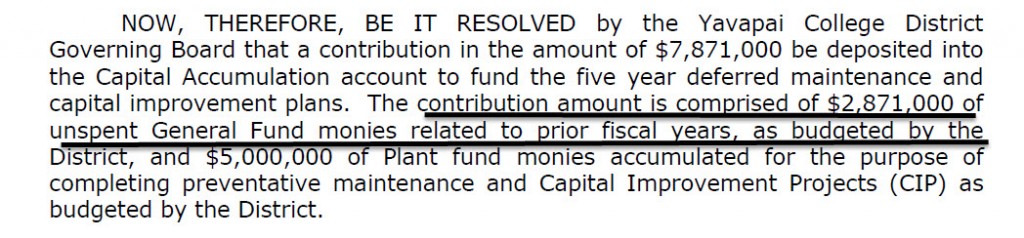
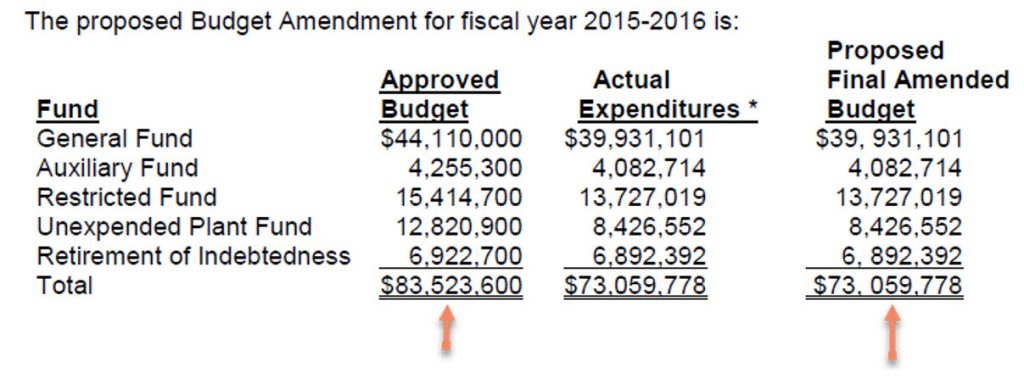
It is hard to believe that the College over budgeted in the fiscal year 2015-16 by ten million dollars. However, that is what it reported to the Governing Board at its January meeting. In the agenda for that meeting, the College reported in writing it did not spend $3.9 million of its 2015-2016 budget. However, that figure exploded without explanation to $10 million during the College’s presentation to the Board.
Apparently, the College didn’t need the 2015-16 revenue (but said nothing about this during 2015-16) because: (a) It failed to quickly fill employee vacancies during that period, (b) Contingency revenue was not needed, and (c) It had already spent money in 2014-15 for a number of construction projects that were completed or partially completed in that fiscal year but showed up in the 2015-16 budget.
A short three minute edited videotape of the discussion at the Board meeting in January follows below.
College has $23 million in reserves; didn’t spend over $2 million in general fund money
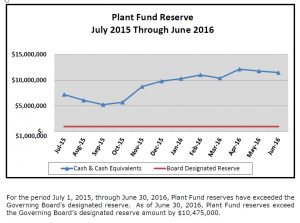
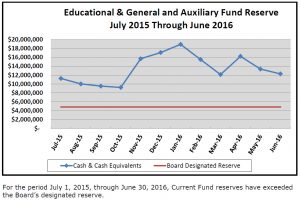
The year-end report given to the District Governing Board at the August 9, 2016 meeting confirmed the College ended the year with huge reserves and excess general revenue. According to the data furnished the Board, the College had $11.457 million in the Plant Fund Reserve fund; $12 million in the Educational and General and Auxiliary Fund reserve), and $2 million in unspent revenue in the General Fund budget.
Following below are the graphs produced by the College showing the reserve amounts and the statement regarding the net revenue surplus issued by the College.

ENDS BUDGETED YEAR WITH OVER $5 MILLION IN UNSPENT FUNDS
The College Administration will report to the Governing Board at its meeting on Tuesday, August 9, 2016 that it ended the 2015-16 (twelve months ended June 30, 2016) academic year with over $5 million dollars in surplus revenue. This is revenue that was budgeted but not spent in the 2015-16 budget.
 The College Administration will report excess revenue in the General Fund Budget of $2,208,713. It will also report revenue in the Unexpended Plant Fund in excess of $2,770,000. Finally, it will report excess revenue in the Auxiliary budget of $123,621.
Given all the excess revenue, why did it demand in June, 2016 a fee barrier be erected for qualified students in the County-wide dual enrollment program? Recall that in June, 2016 the College indicated it needed to assess a per credit fee on qualified high school students taking dual enrollment classes and got the Governing Board to approve the increase so it could get around $100,000 in new revenue from the high schools.
Also recall that in presenting its request for a per credit fee for the dual enrollment program in December, 2015 and January, 2016 it never mentioned a budgetary need. By the way, the new fee imposed by the College may prevent poor high school students from taking dual enrollment courses. The College does not seem to care.
The only conclusion one can reach is that the priorities of this Administration are on buildings; not education.
Reports that it now employs 564 employees using a full-time equivalent basis
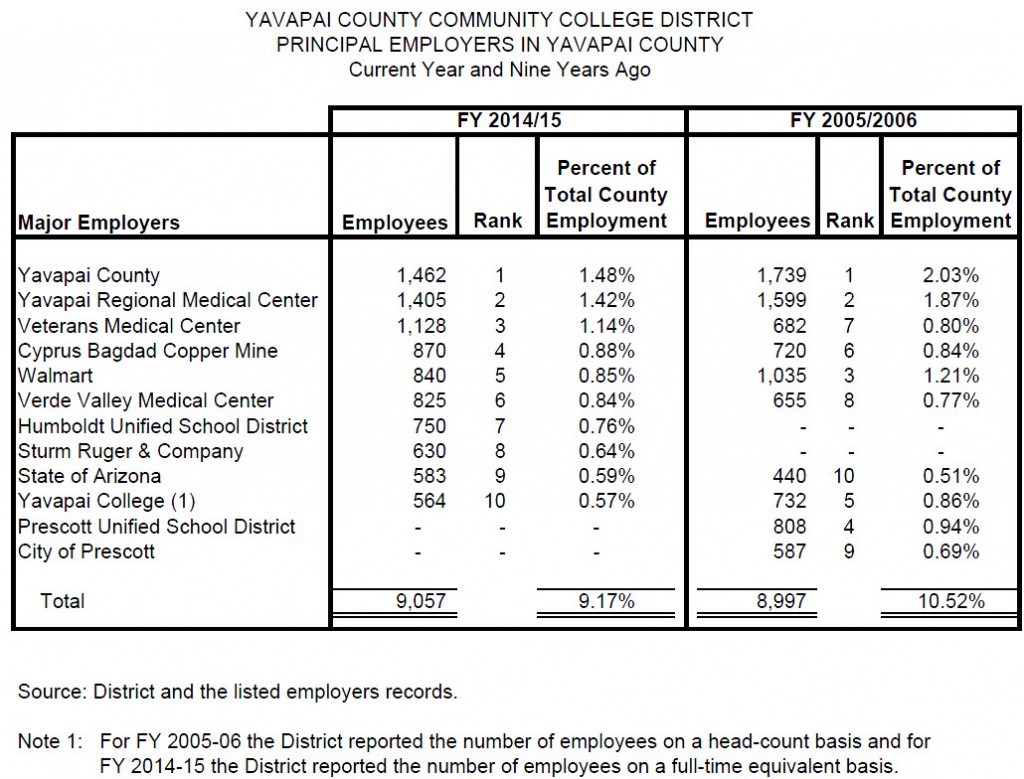
Yavapai College is now the tenth largest employer in Yavapai County. In a February, 2016 report given to the Governing Board, there was the equivalent of 564 full-time employees working for the College.
It has become a major economic engine on the West side of the County and is pumping millions of dollars into the economy over there.
Alth0ugh the College has not released the data, it is estimated that from 85 to 90 percent of the full-time employees work on the campuses located on the West side of the County.
$3 Million for Soccer field; $5 Million for Events Center
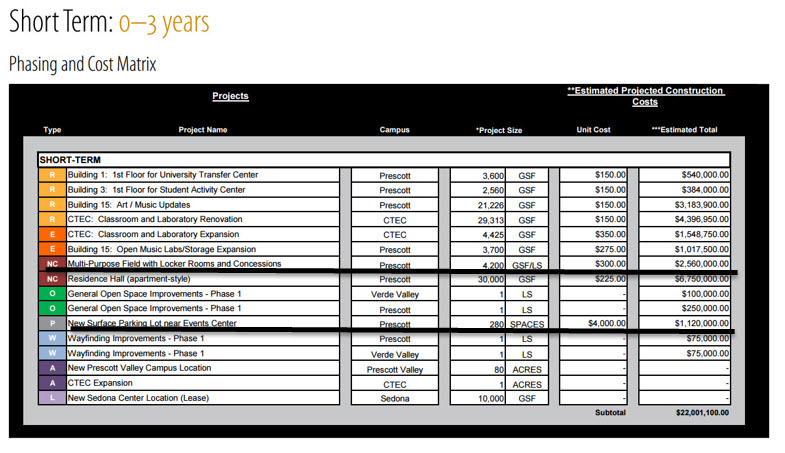
The Wills’ administration has included in its most recent five-year capital development plan expenditures of at least $3 million for a “multi-use field” and $5 million for an Events Center. There is no suggestion that the College “needs” to expend this money. It is simply a “want” and the Wills’ folks have their hands on the money. They don’t know where else to use all this money other than to put it into more and more buildings and athletic fields.
Vice President Clint Ewell tried to justify the multi-use field at the February 9 Boar meeting as necessary to hold graduation ceremonies. This, of course, is nothing more than an effort to disguise the real reason the College wants this field, which is for its soccer team. The College now leases two soccer fields: one in Prescott and the other in Prescott Valley.
As further proof of the deception, one needs only to look at phase one of the Master Plan where you find the following: “Multi-Purpose Field with Locker Rooms and Concessions.” This is consistent with the real plans to build a field for the soccer team—something Wills’ has publicly supported.
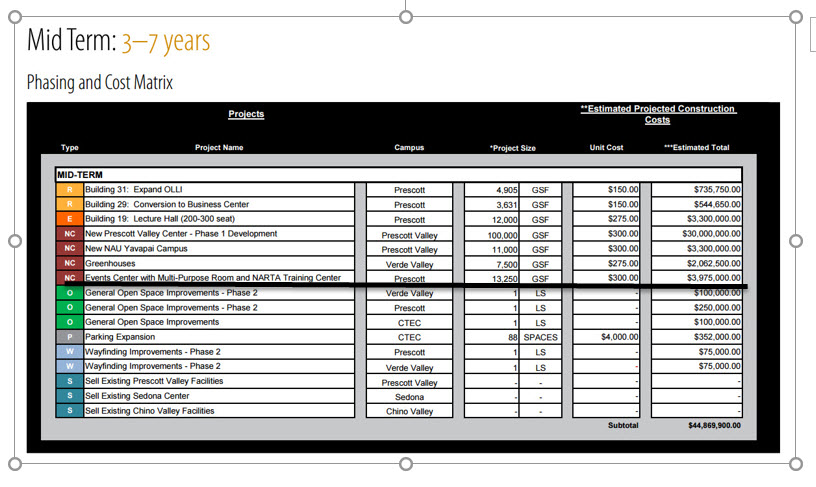
Apparently, the subsidized Perform Arts Dinner theatre, with 1,000 seats is not a sufficient venue for special events, at least in the eyes of the Wills’ administration. It intends to spend another $5 million on a new facility.
Board representative Deb McCasland pointed out that the baseball field was originally created out of a grant that promised it would be a “multi-use field.” President Wills’ made no response to that statement at the Board meeting.
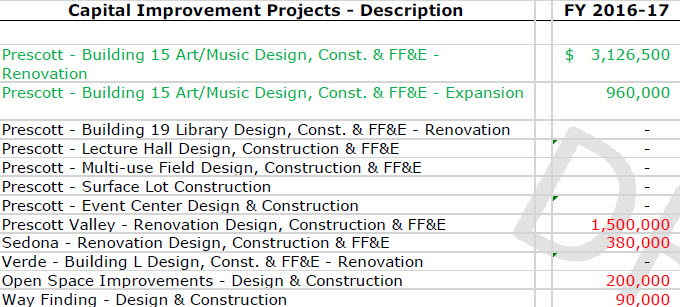
Reduces allocation to Sedona Center to $380,000; inserts $1.5 million for PV Campus
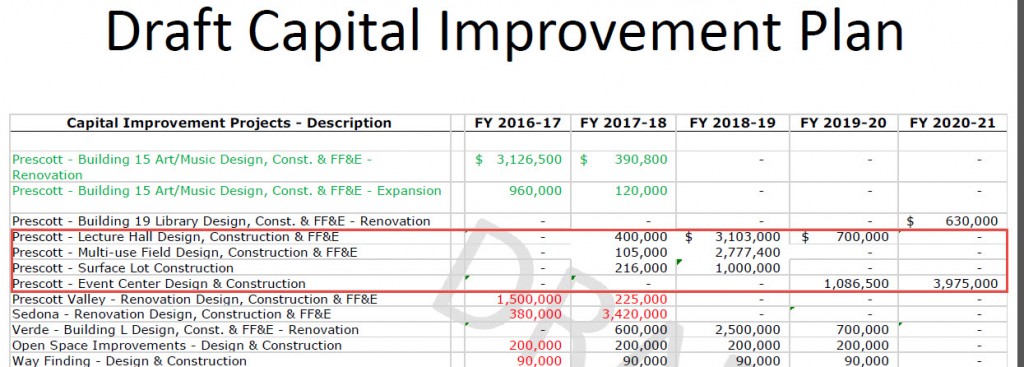
The draft budget presented by the Wills’ administration at the February, 2016 Board meeting listed $5,586,500 to be spent on new construction projects in 2016-17. A little less than seven percent of that money is to be spent in the Verde Valley with $380,000 allocated to the renovation of the Sedona Center.
The College also intends to spend $90,000 on signage and $200,000 on open space improvements.

The changes in direction from the capital budget rolled out a year ago are significant. In that budget no capital construction was was planned for Prescott Valley. The decision to suddenly invest $1.5 million is a part of the Administration’s plan, no doubt, of accelerating the movement toward a Regional Allied Health campus. It is also appears as a response to pressure put on it by Prescott Valley politicos who appeared at the January Governing Board meeting and urged acceleration of the ten-year plan.
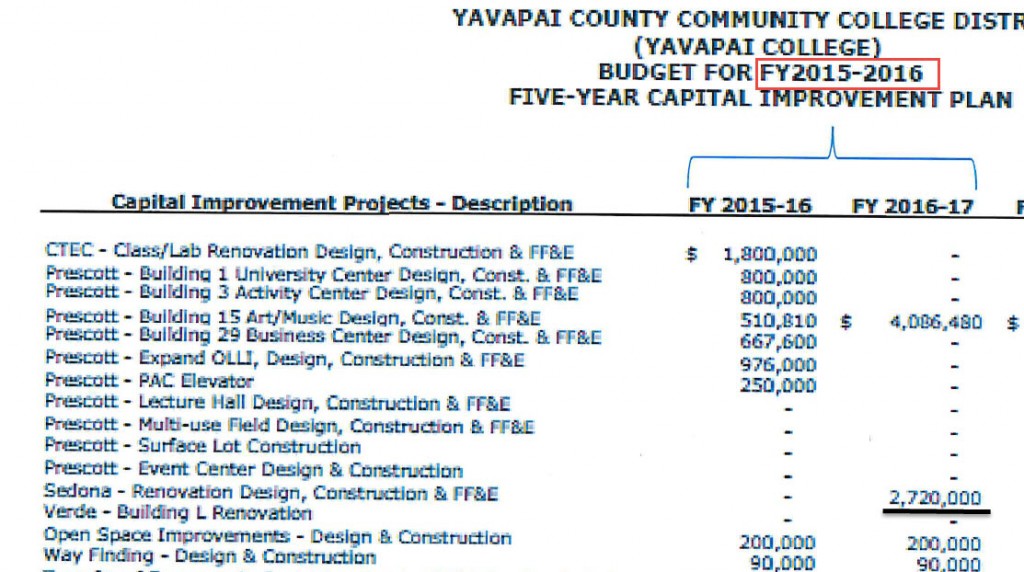
Last year’s budget contemplated spending $2.720 million renovating the Sedona Center in 2016-17. That money was reduced to $380,000 this year and the remaining revenue shifted to begin construction on the Prescott Valley Campus. The College said at the February meeting that it was impossible to move any faster on the Sedona project.
Set out below are last year and this year’s budget proposals.
Another reason property tax increase was not warranted
Thanks to Board Representative Deb McCasland, we now know much more about where the College is getting all the money to fund its multi-million dollar building program. The newest discovery of a source of revenue came during the February 9 District Governing Board meeting. At that meeting Ms. McCasland was unwilling to let a resolution transferring almost $2.9 million from the general revenue fund to the Capital Accumulation account as a part of the “consent agenda” pass without question. Consent agenda items are usually approved without discussion and Ms. McCasland asked that this item be pulled from the consent agenda. The Capital Accumulation account is used to pay for construction projects.
While questioning Vice President Clint Ewell, Ms. McCasland discovered that the policy of the current administration, and one followed for at least the last seven years, is to take any budgeted but unspent year-end revenue in the General Fund and put it into the Capital Accumulation account, where it is used for capital projects.
The fact that there was $2.9 million excess revenue not needed to meet items in the 2014-15 general budget was not disclosed to the Governing Board in June, 2015 when the College administration asked for a property tax increase. Had it been disclosed, or a reasonable estimate of the unspent revenue provided the Governing Board, it is hard to believe that the three-member West County block of representatives would have supported the request to increase taxes.
The brief discussion in response to Ms. McCasland’s inquiry can be viewed by clicking here.