Outstanding new Electrical Utility Technology Program not available to high school students in Eastern Yavapai County; open to high school students on the West side of the County
If you want to see educational opportunity discrimination against the East side of Yavapai County at work, take a look at the new Electrical Utility Technology program based on the West side of the County at CTEC on the Prescott airport.
 As you know, if you are a regular reader of this Blog, Yavapai Community College offers Career and Technical Education training at CTEC, a state-of-the-art facility. It houses courses designed to confer certificates and AAS degrees in 12 different job-training areas. One of the newest tech ed offerings is the lineworkers program.
Unfortunately, all of the CTEC programs, including the lineworker program, completely leave out high school students on the East side of the County while providing learning opportunities for high school students in the Prescott/Prescott Valley area. While both sides of the Mountain appear to point the finger of blame at each other, the real losers are high school students in Sedona and the Verde Valley who are victims of the County Community College bureaucracy, which has refused to effectively deal with the problem.
The fact that only high school students in the Prescott/Prescott Valley area have the opportunity to enroll in CTEC courses is, of course, completely unfair to the East side of the County. However, no one is doing much about it. It is a condition that has existed for years without anyone coming forward for the children of the County. Read More→
 Aviation Technologies is a two-year program. Year one is devoted to fixed-winged flight, with students completing simulation labs in take-off, landing, and maneuvering an airplane in real-world situations. This past summer, Yavapai College completed its new helicopter simulator lab, and as a result MIJTED’s year-two aviation students are focusing on helicopters and utilizing the new facility, which features simulators that react as if the students are in flight, including realistic sound, motion and vibration.
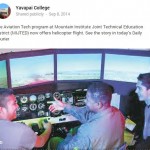 Students also have the opportunity to take classes in air-traffic control. Though they are in different rooms, students in the air-traffic control lab can send voice commands to students in the fixed-wing or helicopter simulators. This technology enables them to realistically direct aircraft to take-off, land, or go into a holding pattern, and enables the students in the flight simulators to become experienced in processing air-traffic control commands.