Yavapai County lags far behind the rest of Arizona and the nation when it comes to numbers of doctors per thousand of residents when adjusted for population age
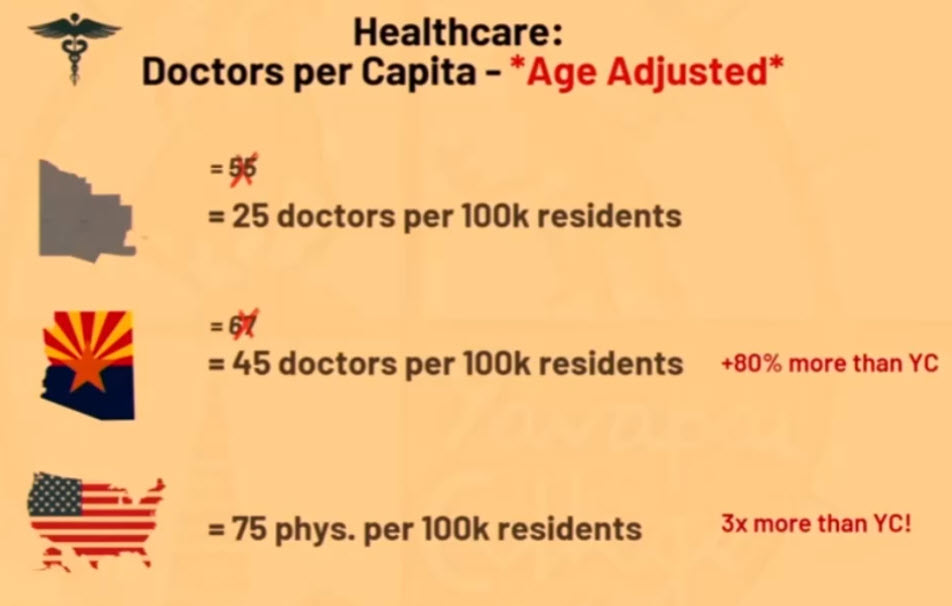
Yavapai County lags significantly behind the rest of Arizona and the nation in the number of doctors and nurses per capita, according to a report presented by Yavapai Community College. The discouraging analysis was shared with the College District Governing Board at its January 28 workshop.
At first glance the report says that the number of doctors per 100,000 residents in Yavapai County may not seem drastically low. However, when adjusted for the County’s older population and its increased healthcare needs, the data paints a much bleaker picture.
For instance, while Yavapai County officially reports having 55 doctors per 100,000 residents, this figure drops to 25 per 100,000 when accounting for the greater medical demand of an aging population. By comparison, under the same adjusted assumptions for age, the state of Arizona has 45 doctors per 100,000 residents—80% more than Yavapai County. Nationally, the number rises to 75 doctors per 100,000, three times higher than Yavapai County’s adjusted figure.
A similar trend is seen among nurses. After adjusting for the County’s older population, Yavapai County has 498 nurses per 100,000 residents. In contrast, Arizona as a state reports 949 nurses per 100,000—91% more that Yavapai County—while the national average stands at 1,014, more than double Yavapai County’s figure.
The analysis was conducted by Yavapai Community College economist and data analytics expert Ryan Jones, with assistance from Vice President of Finance and Administration Clint Ewell. The adjustment for age was based on data indicating that Yavapai County’s population is 50% older than the national norm, leading to significantly higher medical care needs.
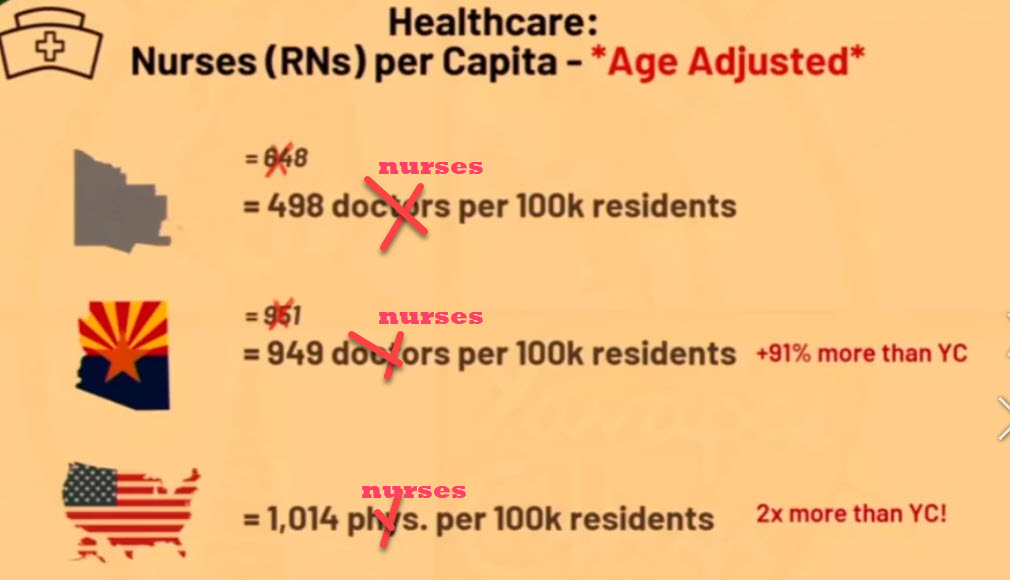
Above slides were prepared and presented by the Community College to the Governing Board at the January 28, 2025 workshop.


 Despite decades of requests, the Prescott-based Community College administrators have consistently ignored the need for proper Verde Valley Campus signage, a significant problem that persists to this day. Notably, the Governing Board allocated half a million dollars for a sign to CTEC near the Prescott airport in the last budget year, highlighting the disparity in attention and resources between the east and west sides of Mingus mountain.
 Unlike the massive financial investments made by the College on the Prescott side of Mingus over the past decades—such as the professional tennis complex, the heated Olympic-sized wading and swimming pool, student residence renovation, the practice soccer field, the recent multi-million dollar purchase of a 42-acre camp with over 60 buildings, and the multimillion-dollar auditorium—this proposal would not require significant financial resources. However, it would mark a meaningful beginning in revitalizing the campus and strengthening ties with the surrounding communities and their residents.