Archive for Politics

BOARD MEMBER PAYNE SAYS HE WAS NOT NOTIFIED OF YAVAPAI COLLEGE CEREMONIES AND DEDICATIONS –BOARD ADMINISTRATIVE ASSISTANT APOLOGIZES

Payne calls for improved communication and more effective response to his requests from Board Leadership
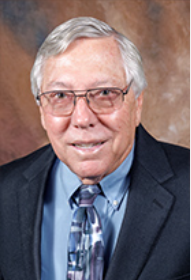
Third District Representative Toby Payne

Yavapai Community College District 3 Governing Board representative Toby Payne says he has been  repeatedly overlooked when it comes to notification about events and his requests for meetings—and he’s calling for improved communication and a more effective response to his requests from the District Governing Board leadership.

Third District Governing Board Toby Payne, who represents Sedona, the Verde Valley, and areas stretching nearly to Camp Verde, raised his concerns during the District Governing Board’s all-day “self-assessment” session on May 29, 2025.

“I’m very concerned about not being invited to various events,” Payne told the board. “When I first joined the Board, we were notified of events and had the opportunity to participate. We’re not getting that anymore.”

Among the events Payne said he was not invited to attend  were all spring graduation ceremonies and the recent dedication of the Prescott Pines campus. “I didn’t even know the dedication was happening,” he said. “I voted for the project. At the very least, I should have been informed of the date. I’m having a real problem with the fact that I’m not being included.”

“Even the graduation on this side of the mountain,” Payne added, referring to the Verde Valley area, “I wasn’t invited to it.”

The Community College’s Administrative Assistant to the Board, Yvonne Sandoval—who also serves as the executive assistant to President Lisa Rhine—took full responsibility for the communication breakdown.

“I want to sincerely apologize,” Sandoval said during the meeting. “The reason you weren’t included in the commencement email was because I misunderstood. I thought you had said you would be on vacation, and that’s why I didn’t send the invitation.”

She also acknowledged failing to notify Payne about the Prescott Pines dedication. “This is not an excuse, but I was a one-woman show when the invitations went out. It was my oversight, and mine only. I am sincerely sorry, sir. The responsibility falls directly and solely on me.”

Payne also indicated his concern with how his request for a Board meeting to iron out difficulties made back in January was ignored. “I tried, I tried to take and say that we needed to get together back in January,  and I really felt that it was important,  and important to me because I’ve done work, study sessions. . . . And I know that’s how the boards come together, but we haven’t been doing that. and it’s important. It’s important for us to be able to work together. . . . I know that’s how the boards come together, but we haven’t been doing that.”

Payne suggested that all future events that could involve a District Governing Board member, be put on a calendar so all members can see them well in advance of their happening.

Payne’s concerns highlight the tensions over communication and inclusion within the Community College’s governing structure, particularly between board members representing Sedona and the Verde Valley and those from the Prescott area. His experience underscores a broader pattern of marginalization that many in the Verde Valley have long suspected but few in power seem willing to address.


 

EFFORT TO RESTRICT BOARD MEMBER KIEL’S BUDGET QUERIES HIGHLIGHTS TROUBLING POWER PLAY AT MAY 27 MEETING

Deeply troubling—if not outright alarming—to witness how Yavapai Community College District 1 Governing Board Representative William Kiel was treated during the May 27 public budget hearing

Robert E. Oliphant

Opinion: It was deeply troubling—if not outright alarming—to witness how Yavapai Community College District 1 Governing Board Representative William Kiel was treated during the May 27 public budget hearing. Rather than an open exchange about questions involving  $120 million in the mostly taxpayer funded budget the Board was being asked to approve, the meeting resembled something like a scripted stage production—where the Chair appeared determined to silence meaningful inquiry and bend the process to her will.

From the outset of the meeting, Chair Deb McCasland unilaterally imposed a five-minute time limit on Board members wishing to raise questions and discuss the budget. This arbitrary cap was never discussed or approved by the full Board—yet Ms. McCasland was determined to enforce the limit with the vigilance of a sentry guarding the walls against unwelcome scrutiny.”

Mr. Kiel, rightly concerned about the limitation, voiced his objection and asked for more time. McCasland offered a vague concession: perhaps there would be a second round of questions “if time allowed.” Unsurprisingly, she later declared there was no need for a second round, thereby eliminating any further opportunity for scrutiny of the budget.

Mr. Kiel at meeting showing time left to speak on stopwatch.

As Kiel pressed forward during his allotted minutes—armed with a stopwatch, no less—McCasland repeatedly interrupted him, declaring his time had expired. Kiel protested, and the Governing Board’s attorney intervened in his defense, affirming that time remained. Even then, McCasland continued to cut him off, only to be overruled by the attorney once again.

This was no mere misunderstanding. It resembled a calculated effort to muzzle a Board member charged with asking hard questions on behalf of the public. The imagery was striking: one lone voice attempting to speak truth in a room determined to turn down the volume.

Equally disconcerting was Mr. Kiel’s assertion that he had reached out prior to the meeting to the College’s Vice President of Finance and Administration for help with budget questions, only to be ignored. When this was raised, College President Dr. Lisa Rhine interjected, denying receipt of such a request. However, Kiel clarified that the request had been sent to the Board Chair. McCasland vaguely acknowledged the request was made at a previous meeting but offered no explanation as to why it was not acted upon. The tone, in my judgment, from both the Chair and the President, in that moment, could only be described as dismissive—if not somewhat overtly hostile.

That a duly elected Board member would be treated in such a fashion—during a public meeting about how to spend $120 million in public funds—should alarm every citizen of Yavapai County. What we witnessed was not transparency. It was a power play—an attempt to micromanage discourse and limit oversight. For some, it bordered on a suppression of free speech. For others, it was simply a disgrace.

In either case, it was a poor performance from those entrusted to lead. Public institutions are not private kingdoms. When dialogue is silenced and accountability sidestepped, it’s not just one Board member who suffers. It’s the public trust that takes the blow.

It is worth noting that during the Board’s regular business meeting, which immediately followed approval of the budget, Representative Kiel requested that the draft minutes of a prior meeting explicitly reflect that Board members were limited to “two minutes” to ask questions. Although the statement was factually accurate, his motion was defeated in a 3-2 vote. The majority contended that the meeting’s video recording sufficiently demonstrated the time constraint, rendering the amendment unnecessary. Mr. Kiel remarked that every motion he has made has been consistently rejected by the same three Board members. (See video clip.)

You may view clips of Mr. Kiel struggling with the time issue at the May 27 meetings below:

THIRD DISTRICT YAVAPAI COMMUNITY COLLEGE REPRESENTATIVE PAYNE EXPRESSES DISMAY OVER REPEATED REFUSAL BY CHAIRWOMAN TO PLACE REQUESTED ITEMS ON GOVERNING BOARD AGENDA

Argues that it is troubling that a single member of Board can prevent discussion on matters of importance

Representative Toby Payne

Editorial: As one of five members serving on the Yavapai Community College District Governing Board, I am both puzzled and dismayed by Board Chair Deb McCasland’s repeated refusal to permit me to place even a single item on the Board agenda for discussion. It is troubling that one individual can block such a request, particularly when it conflicts with existing Board policy and undermines the collaborative nature of our governance.

I began raising concerns as early as January, when I observed a growing lack of harmony among members of the Board. At the center of this discord was what I saw as a troubling conflict: the role of individual Board members as defined by existing Board policy appeared to be at odds with both state statutes governing Board proceedings and guidelines issued by the Higher Learning Commission. This potential inconsistency warranted serious discussion—and needed to be addressed.

On January 19, I sent Board Chair Deb McCasland a written request to place an item on the next Board agenda, as permitted under existing Governing Board policy. I outlined proposed actions and requested a formal discussion. She denied the request.

Since then, I have repeated my request multiple times, only to be ignored. This is despite clear language in Policy #308, which states that if a Board member believes the Chair has not acted appropriately regarding an agenda request, a matter of Board policy “will be placed on the next Board agenda.”

Why the Board Chair continues to disregard the plain language of our own policy is both troubling and difficult to comprehend. Her refusal raises serious concerns about procedural fairness and the integrity of Board governance.

Toby Payne

Third District Yavapai Community College District Governing Board representative

(Reprinted with permission of the author.)

MESA COMMUNITY COLLEGE GUTS NATIVE AMERICAN CONVOCATION TO COMPLY WITH PERCEIVED DEI MANDATE

A decade-long ceremony honoring Native American students is canceled, and Native American clubs like MCC’s Inter-Tribal Student Organization face dissolution. Tribal leaders argue the relationship of Native American Tribes and the federal government is misunderstood and say the college erred in its decision

Arlyssa D. Becenti, writing in the Wednesday, March 12 edition of the  Arizona Republic, reported that the Native American Convocation scheduled for May was cancelled at Mesa Community College (MCC)  because of the perceived DEI mandate issued by President Donald Trump. The event was to be a celebration of the academic  achievements of Native American students attending Mesa Community College.
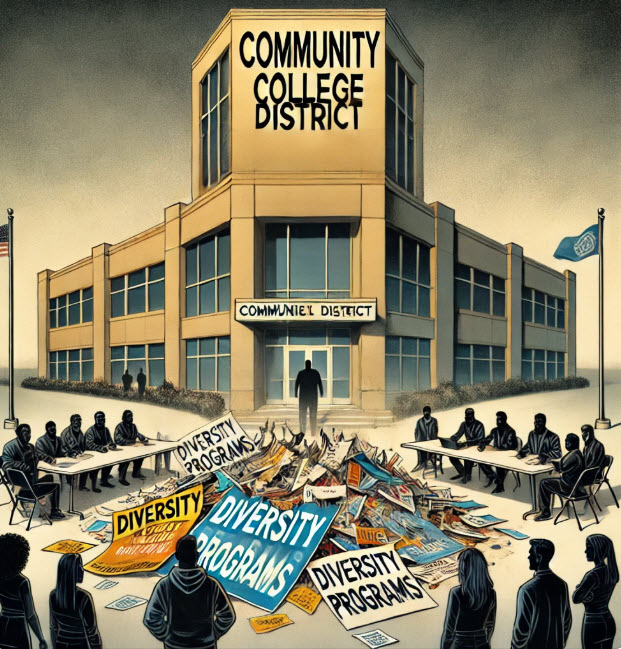

According to the article, Native American students from MCC and the nine other Maricopa County community colleges “received troubling news.” Due to actions by President Donald Trump, their Native American Convocation would be canceled. Additionally, Native American clubs, likely including MCC’s Inter-Tribal Student Organization and others, would be dissolved.

“I am incredibly disappointed to learn that the 2025 Maricopa County Community College District’s American Indian Convocation has been canceled,” Gila River Indian Community Governor Stephen Roe Lewis said in a news release. “This decision concerns me deeply, because it shows fundamental misunderstanding of the federal-tribal relationship which is based on political, not racial status. Today I am calling on MCCCD to immediately correct this error in interpreting the federal Executive Order and to allow the convocation to proceed.”

Maricopa Community Colleges have traditionally held a smaller ceremony to honor Native American students from all 10 community colleges in the Maricopa Community Colleges District. This year, that ceremony, along with similar convocations for other diverse student groups, has been canceled.

Neither Maricopa Community Colleges nor the county community college district responded to The Arizona Republic’s request for comment.

The issue of racial and political classification among Native Americans gained attention after Trump’s Education Department issued a memo on February 14. The memo claimed that Supreme Court decisions prohibit treating students differently based on race to achieve goals like diversity, racial balancing, social justice, or equity. This raised concerns among Navajo leaders and their attorneys.

“The letter doesn’t mention federal funds that are provided to Indian tribes and tribal organizations are not based on race,” said Chris Schneider, principal attorney for the Navajo Department of Justice. “It’s longstanding, its federal case law, you have Morton v. Mancari, which is a United States Supreme Court case … that determine that Indian isn’t always per se going to be a classification according to race. Instead, based upon the history of the United States and Indian tribes, it’s more political classification.”

Many legal experts believe the Trump administration ignores legality, precedent, the Constitution, and tribal treaties. Mel Wilson of the National Association of Social Workers notes this follows the vision of Project 2025. The dismantling of DEI efforts marks a dramatic shift, as colleges and institutions that once honored First Peoples with land acknowledgments have abruptly stopped doing so.

ARIZONA’S LARGEST COMMUNITY COLLEGE DISTRICT CUTS DIVERSITY INITIATIVES AMID TRUMP ADMINISTRATION PRESSURE

No public information about DEI changes at Yavapai Community College 

According to a March 4, 2025 article in the Arizona Republic by Helen Rummel, the Maricopa County Community College District is removing various diversity, equity, and inclusion initiatives from its schools following increasing pressure from the Trump administration. The changes are being made to comply with guidance from the Office for Civil Rights within the U.S. Department of Education. A four-page letter  from the Office required schools to remove race-based programming by February 28 or risk losing federal funding. The letter was said to be an effort to clarify existing legal requirements under Title VI, the Equal Protection Clause, and other federal civil rights principles, but apparently does not carry the force of law.

Maricopa Community Colleges Chancellor Steven Gonzales announced that employee affinity groups, pronouns in email signatures, and all DEI and gender identity-related language will be removed from district materials. More changes may follow to comply with evolving requirements.

Employees are no longer to be able to use money from the district to attend any conferences or events focusing on DEI, including ones that center on race, identity or national origin. Employee groups focusing on race and identity would be removed, like affinity groups and the Diversity Advisory Council.

Websites for groups like HSI EXCELlence and the Black Student Union were removed, though student clubs are not impacted. Many DEI-related pages, including those on convocation ceremonies for diverse cultural backgrounds, were also taken down.

“As a public higher education institution, the Maricopa County Community College District (MCCCD) must comply with all local, state, and federal laws, including recently issued enforcement priorities set forth by the U.S. Department of Education’s Office for Civil Rights,” a Maricopa Community College district spokesperson said in a statement to The Arizona Republic.

“We recognize that these required changes may be disappointing to some of our students and employees. However, we remain committed to fostering a welcoming learning environment for all students as they pursue their educational goals.”

Yavapai Community College has not yet provided the public with any information regarding what action, if any, it has taken in regard to the Trump mandates.

FEDERAL JUDGE TEMPORARILY BLOCKS DOGE FROM ACCESSING SENSITIVE EDUCATION DEPARTMENT INFORMATION – ORDER RUNS TO MARCH 10

Says Trump administration failed to provide sufficient justification for gaining access to the information

Federal judge Deborah Boardman on Monday, February 24, 2025 issued a temporary restraining order saying disclosure of the education department’s sensitive personal information to DOGE affiliates is irreparable harm that money damages cannot rectify.” She also said the Office of Personnel Management can’t disclose the information.

In her opinion, Judge Boardman wrote that “DOGE affiliates have been granted access to systems of record that contain some of the plaintiffs’ most sensitive data — Social Security numbers, dates of birth, home addresses, income and assets, citizenship status, and disability status — and their access to this trove of personal information is ongoing. There is no reason to believe their access to this information will end anytime soon because the government believes their access is appropriate.”

It should be noted that last week a federal judge in a related case refused to issue a restraining order restricting Musk’s team, finding that the group that brought the lawsuit had not shown that a group of students who had lodged similar complaints had suffered clear harm by having their data analyzed by affiliates of Mr. Musk.

FEDERAL FUNDING UNCERTAINTY LOOMS OVER YAVAPAI COMMUNITY COLLEGE WITH POTENTIAL UNINTENDED CONSEQUENCES BECAUSE OF TRUMP/MUSK DOGE INVOLVEMENT

Will existing contracts and grants with the Federal Government be cut? Or eliminated?  Will DOGE cause Hispanic student enrollment to plumet?  Will student loan and the Pell grant programs be reduced or eliminated?

COMMENTARY:  The actions by the Trump administration’s newly created Department of Government Efficiency (DOGE) may have a significant impact on the operations of Yavapai Community College. There is concern because DOGE is already taking away millions of dollars in existing  grants and contracts from various educational institutions. In addition to this concern, the Trump administration has mandated that educational institutions eliminate anything that directly or indirectly might be linked to what are commonly called “Diversity, Equity and Inclusion (DEI)” programs or projects.
Are Yavapai Community College’s  $12 million in federal contracts and grants in jeopardy?

Yavapai Community College’s $126 million annual budget includes $12.3 million in federal grants and contracts for the current academic year. About $7.25 million has already been spent by January 2025. Will these funds be affected? The answer is unclear. 

To date, the administration with the assistance of DOGE unexpectedly cut approximately $1 billion from the U.S. Department of Education’s research office. The impact of those cuts has been immediate in some areas of the country. For example, at St. Thomas University in St. Paul, Minnesota, DOGE canceled a previously approved grant program that was supporting 185 students pursuing careers in special education. The $6.8 million grant to St. Thomas was deemed a DEI initiative and subsequently eliminated as part of the administration’s broader crackdown on DEI-related programs. Students in the affected program had been receiving between $10,000 and $20,000 per year in scholarship aid to help cover tuition costs.

St. Thomas is appealing the decision, noting that a DEI statement was required when applying for the grant funds, even though the training, or at least most of it, did  not necessarily involve DEI.

It remains unclear whether any teacher education programs or other initiatives at Yavapai College might be considered DEI projects and, therefore, subject to similar funding cuts. Major  cuts in federal funds could have  devastating consequences.

Yavapai must also worry about any aspect of its operation that involves race, even tangentially. In a letter sent  Friday, February 14 the New York Times reported that the Federal Education Department warned that colleges risk losing federal funding if they continue to take race into account when making scholarship or hiring decisions, or considered  race in “all other aspects of student, academic and campus life.”

On Monday, February 17  the Education Department said it had canceled $600 million in grants focused on training teachers in “inappropriate and unnecessary topics” such as critical race theory, social justice activism, antiracism and “instruction on white privilege.”

Additionally, the future of federal support for Yavapai Community College is even more uncertain if the Department of Education is eliminated as promised by DOGE.

Concerns Over a Possible Decline in Hispanic Student Enrollment;  23% of Yavapai’s Student Body Hispanic

Another concern among educators is a potential drop in enrollment among Hispanic students created by DOGE.  Yavapai Community College reports that 23% of its student body is made up of Hispanic students.

The possible large drop in enrollment is linked to DOGE gaining access to millions of student records and concern over how this information is used. For instance, there are questions about whether student grant application information, which is completed by almost all students,  could be shared by  DOGE with immigration authorities. It is feared that the information, if shared, could be used to assist immigration authorities in locating a student’s grandparents or other relatives who may be undocumented but have been living  in the country for decades.

As rumors and uncertainty apparently spreads through Hispanic communities, it is already being reported that families are not  sending their children to school. For example, in Memphis, Tennessee,  one person described the climate as one of fear and hesitation in the Hispanic community, stating, “Everybody is terrified. They’re scared to come out.”

The same level of fear was reported in Minneapolis, Minnesota.

That fear has apparently intensified following newspaper reports this past week that DOGE gained access to a federal database containing personal details on millions of students and parents participating in the federal student loan program.

It is unclear whether the rumors and stories regarding  how DOGE might use community college federal student grant and loan applications have reached or will affect  the Hispanic college-eligible community in Yavapai County.  As noted earlier, Hispanic students currently make up about 23% of Yavapai’s student body.

Will DOGE’s policies lead to a significant decline in Hispanic enrollment next fall? While the answer remains uncertain, the concern is real. The consequences could be significant.

The Future of Pell Grants and Federal Student Loans

Another related concern pertains to the federal student loan and grant program. Notably, approximately 20% of Yavapai Community College students depend on Pell Grants, a vital source of financial aid for low-income undergraduate students. Unlike federal student loans, Pell Grants do not require repayment, except under specific circumstances.

There’s concern that DOGE might reclassify the student grant/loan programs as DEI initiatives or change funding and eligibility, limiting student access. Reducing or eliminating these financial support programs would significantly impact Yavapai Community College, which heavily relies on them.

Worst-case scenario.

For now, uncertainty reigns in Washington, D.C. and at educational institutions throughout the nation. With chaos unfolding at the federal level and threats to close the Department of Education, Yavapai Community College—like many institutions—finds itself in a precarious position, waiting to see what will happen and whether it can weather the storm that may be coming.

If Hispanic student enrollment declines sharply and federal contracts and grants are reduced, Yavapai Community College could face a severe financial crisis. To remain viable, the college may need to implement substantial tuition increases, raise Yavapai County’s primary tax rate—an action requiring only three votes from its five-member governing board—and cut costs by increasing class sizes while reducing faculty and staff positions. In a more drastic measure, the college might even revisit the idea of selling the Sedona Center, a possibility it explored around 2014–15.

Ideally, these concerns will subside, the rumors and speculation will prove unfounded, and conditions will stabilize—an outcome that serves everyone’s best interests.

ANALYSIS BY YAVAPAI COMMUNITY COLLEGE SUGGESTS YAVAPAI COUNTY FACES SEVERE SHORTAGE OF DOCTORS AND NURSES

Yavapai County lags far behind the rest of Arizona and the nation when it comes to numbers of doctors per thousand of residents when adjusted for population age

Yavapai County lags significantly behind the rest of Arizona and the nation in the number of doctors and nurses per capita, according to a report presented by Yavapai Community College. The discouraging analysis was shared with the College District Governing Board at its January 28 workshop.

At first glance the report says that the number of doctors per 100,000 residents in Yavapai County may not seem drastically low. However, when adjusted for the County’s older population and its increased healthcare needs, the data paints a much bleaker picture.

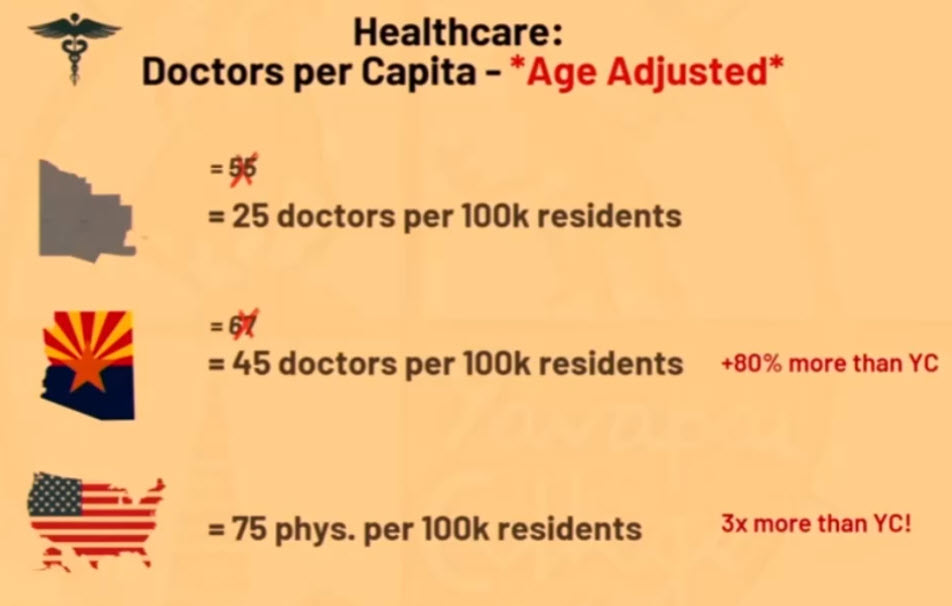
For instance, while Yavapai County officially reports having 55 doctors per 100,000 residents, this figure drops to 25 per 100,000 when accounting for the greater medical demand of an aging population. By comparison, under the same adjusted assumptions for age, the state of Arizona has 45 doctors per 100,000 residents—80% more than Yavapai County. Nationally, the number rises to 75 doctors per 100,000, three times higher than Yavapai County’s adjusted figure.

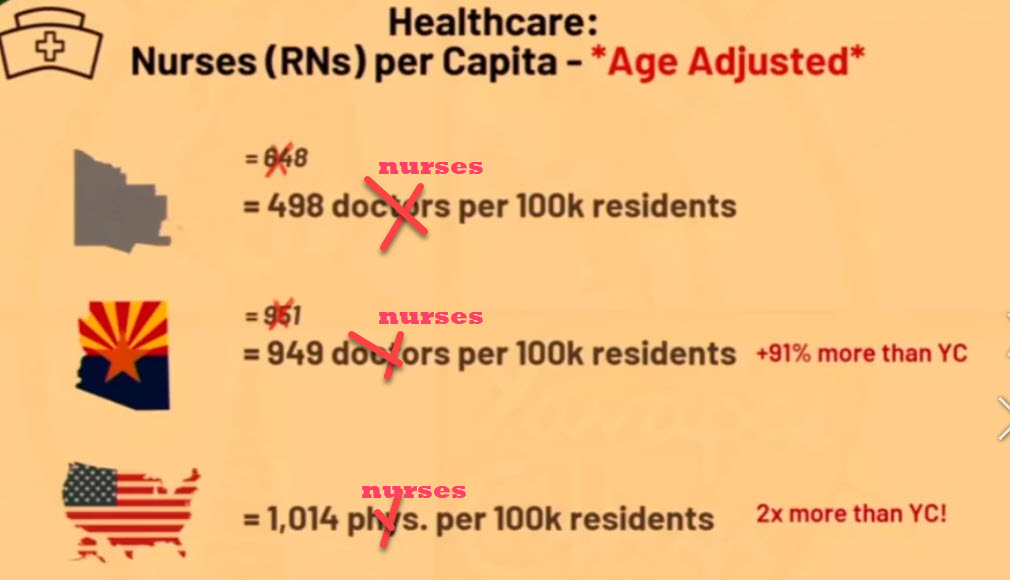
A similar trend is seen among nurses. After adjusting for the County’s older population, Yavapai County has 498 nurses per 100,000 residents. In contrast, Arizona as a state reports 949 nurses per 100,000—91% more that Yavapai County—while the national average stands at 1,014, more than double Yavapai County’s figure.

The analysis was conducted by Yavapai Community College economist and data analytics expert Ryan Jones, with assistance from Vice President of Finance and Administration Clint Ewell. The adjustment for age was based on data indicating that Yavapai County’s population is 50% older than the national norm, leading to significantly higher medical care needs.

Above slides were prepared and presented by the Community College to the Governing Board at the January 28, 2025 workshop.


THIRD DISTRICT REPRESENTATIVE PAYNE SEEKS CLARITY ON CONFLICTS BETWEEN ARIZONA LAW AND COLLEGE POLICIES

Sends letter to Chair McCasland requesting a workshop discussion on policy misalignment—McCasland has yet to respond

Representative Toby Payne

Third District Yavapai Community College District Governing Board member Toby Payne has formally requested that Board Chair Deb McCasland convene a meeting to address potential conflicts between state law and policies adopted by the Board and the Higher Learning Commission (HLC), the institution’s accrediting body. 

As of this writing, it is believed that McCasland has yet to respond to Payne’s request.

In his letter, Payne raises concerns regarding the delegation of authority to the college president and the alignment of state law with existing HLC and Board policies. Normally, state law should take precedence over any Board or HLC policies that directly conflict with it.

Payne has requested a discussion to provide clarification and education on these matters. His full letter is reproduced below.

To: Deb McCasland, YCGB Chair

From: Toby Payne, YCGB Member

Subject: Concerns Regarding Governance and Policy Alignment

I am deeply and sincerely disturbed by the current tension within the governing board and between the board and YC administration. After reviewing Policy 310, Resolution 2024-18, Arizona State Statutes, and the Higher Learning Commission’s (HLC) Criteria for Accreditation, I have identified several critical areas requiring attention, conversation, and deliberation among governing board members.

Key Concerns

l . Delegation of Authority: The subject of “delegation of authority” resulted in Lynne Adams providing copies of Attorney’s opinion letters and related correspondence from 2006 and 2010. However, these documents focus on “appoint and employ” versus “appoint or employ” and contracting. They do not address broader governance implications.

Resolution 2024-18 states: “The President shall be authorized to establish all college operational policies, make all decisions, take all actions, establish all practices and develop all activities.” This language appears inconsistent with HLC Criteria Core Component 5.A.I , which reads “Shared governance at the institution engages its internal constituencies—including its governing board, administration, faculty, staff and students—through planning, policies and procedures.”

2. Policy Development and Approval of Policy 310 was presented to the board as part of a packaged consent agenda, with no prior engagement or shared governance process. As such, it cannot be considered a “board policy” but rather one imposed on the board.

Policy 310 references Policy 401, stating: “ The board acknowledges the difference between governance and administration of the college.” This raises questions about clarity and boundaries between governance and administration. Additionally, the statement that “the board’s primary function is to establish the policies by which the college shall be administered” conflicts with instances where the college appears to develop policies that administer the board.

3. Alignment with HLC Criteria and State Statutes HLC Core Component 2.C underscores the autonomy of the governing board to make decisions and highlights the importance of compliance with its subpoints, particularly l, 3, and 5.

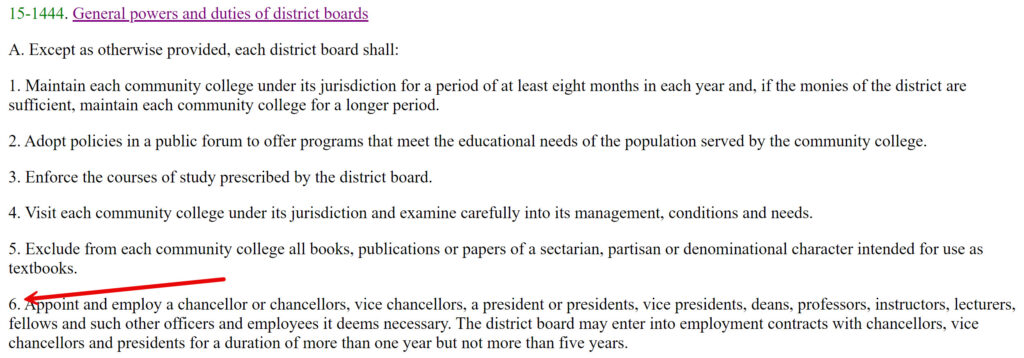
Arizona Revised Statutes 15-1444(A) explicitly state that each district board shall “visit each community college under its jurisdiction and examine carefully into its management, conditions, and needs.” This duty cannot be restricted by the administration and contradicts the Resolution’s assertion that “the Board’s sole official connection to the operational organization, its achievement, and conduct is through the College President.”

Lynne Adams made the point clear in her opinion letter dated March 10, 2006 page 3, that “except as otherwise provided” expressly recognizes that the legislature may make exceptions to the general grants of power found in that statute, as a modifier of the powers of the Board.

Proposed Actions

l . Education on Delegation of Authority: I propose a discussion and education session led by our attorney to distinguish between delegating authority and relinquishing or waiving authority. This will clarify the board’s role as the legally constituted and final authority for the operation of Yavapai County Community College District.

2. Work Session on Governance and Policy Alignment: I request that you, as Chair, schedule an agenda item and a work study session to address the following:

        • Ensuring alignment between state statutes, HLC criteria, and board policies.
        • Clarifying governance boundaries and roles.
        • Establishing a shared governance process for policy development
        •  

3. Preparation for HLC Assurance Review: With the next HLC Assurance Review in two years, now is the time to ensure compliance and alignment at all levels. Addressing these concerns proactively will foster good communication, clear boundaries, and shared understanding between the board and administration.

Conclusion

Chair McCasland, I urge you to prioritize these issues and engage the full board in discussions before adopting any further policies or resolutions. Open communication and collaborative efforts are essential to resolving current tensions and ensuring effective governance that benefits Yavapai College and its stakeholders. I expect that you, Dr. Rhine, David Borofsky and Lynne Adams will discuss this, but precisely the point is that this needs to be discussed with the board.

Thank you for your attention to this critical matter.

Respectfully,

Toby Payne

HIGHER EDUCATION LEARNING CONSULTANT WARNS OF ACCREDITATION RISK FOR YAVAPAI COMMUNITY COLLEGE IF GOVERNING BOARD INTERVENES IN HIRING DESPITE LANGUAGE OF STATE STATUTE

Board lawyer says YCC Governing Board years ago delegated all employee hiring (including vice presidents and deans) to President and that delegation was legal — Board may only hire the president

The meaning of Arizona Statute 15-1444 concerning hiring practices at community colleges was a key topic of discussion at the January 14, 2025, Yavapai Community College Governing Board workshop. The statute, cited below, appears to grant the Governing Board authority over hiring decisions.

Despite the language of the statute, the Yavapai Community College Governing Board was advised by its attorney that it had delegated all hiring authority to the college president several years ago. The attorney explained that she had sought clarification on the legality of this delegation from the Arizona Attorney General through a formal letter. While no official opinion was issued, the Attorney General’s response to her inquiry convinced her that the delegation complied with the law. As a result, she concluded that the Board currently has no role in employment decisions beyond hiring the college president.

The remaining question is whether the Governing Board could revoke its previous delegation and assume some involvement in the hiring process.

Ken Burke who hails from Florida, and a consultant from the Association of Community College Trustees, strongly opposed any suggestion of Board involvement in hiring decisions below the level of the college president. He warned the Governing Board:

“As far as accreditation authorities, I can speak with 100% certainty: if trustees got involved in hiring people below the level of president, you would lose your accreditation.”

Burke’s position was echoed by Yavapai College president Dr. Lisa Rhine and Dr. David Borofsky, Executive Director of the Arizona Association of Community College Trustees.

Yavapai Community College (YCC) is accredited by the nonprofit Higher Learning Commission (HLC), a regional accrediting body that evaluates institutional quality and educational programs. Accreditation by the HLC ensures that YCC meets acceptable standards for higher education delivery.

A portion of the discussion at the meeting can be observed below: