Has also resurrected legislation designed to allow community colleges to offer some four-year degrees
 Most recent reports from Arizona’s legislature is that a bill is moving forward that will set aside $10 million for scholarships designed to assist struggling community college students. The Senate Education Committee on Tuesday agreed to the scholarship assistance without dissent. If approved in the House, it will provide aid to about 3,000 students.
As written, to be eligible, someone would have to qualify for a federal Pell Grant. These are available to anyone with family income less than $50,000 but are generally reserved for those below $20,000.
As to offering some four-year degrees, the House Education Committee, without dissent, resurrected legislation last week designed to allow community colleges to offer some four-year degrees. Reporter Howard Fischer, Capitol Media Services, reported that the newest version of the bill had cleared the House last month on a 57-3 vote. However, it had not gotten a hearing in the Senate Appropriations Committee where it is assigned.
According to Mr. Fischer, “[t]he new version seeks to get around that by taking the language and stripping it on to an unrelated measure on school expenditures that already had cleared the Senate. That means if the now-revised SB 1453 is approved by the full House — and there’s no reason to expect that won’t happen, given the prior vote — it then goes back to the full Senate for up-or-down review, bypassing the ability of any committee or chairman to kill it.”

 A bill is winding its way through the Arizona Legislature that if finally approved will allow Community Colleges in the State to offer some 4-year degree programs. It recently passed in the Arizona House by a 57-3 vote.
 According to a story in the Arizona Republic of November 9, 2020 by Anne Ryman, the Arizona Attorney General’s Office has closed its open meeting law investigation involving Maricopa Community College. It concluded it could not substantiate a violation of state law.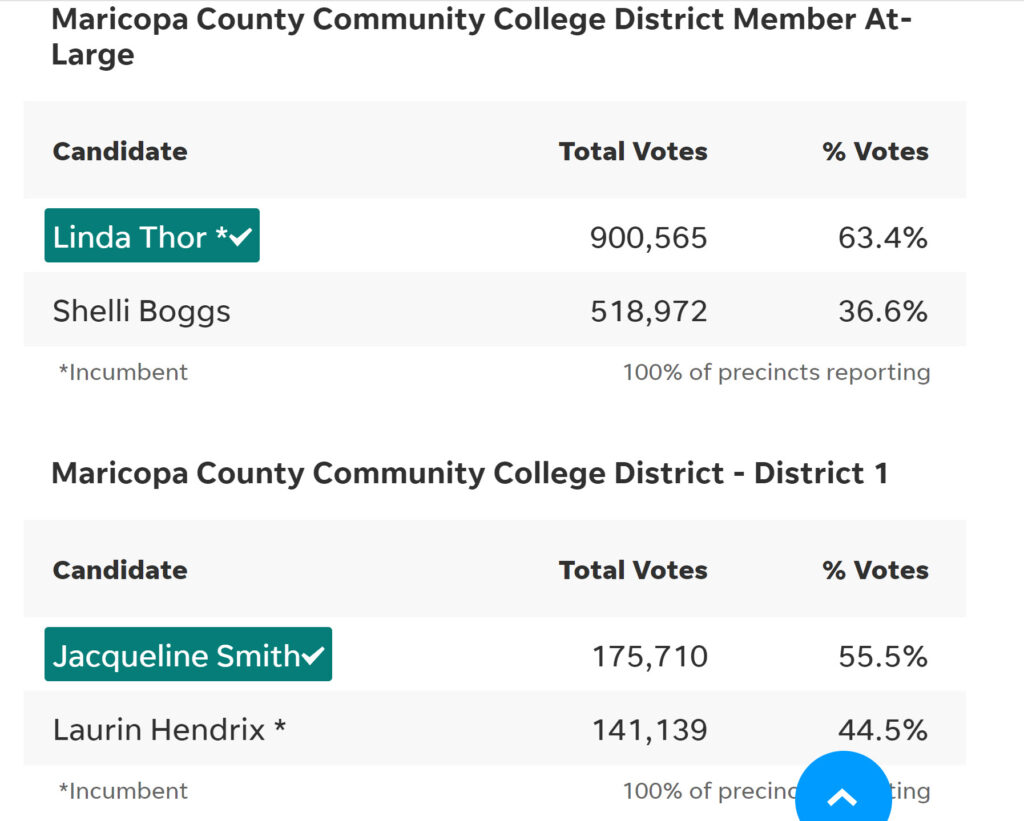
 The Maricopa Community College District Governing Board race has become heated for at least two of the four candidates seeking office this year. In a story written by Anne Ryman in the Arizona Republic on Sunday, October 18, the campaigns of candidate Shelli Boggs and incumbent Laurin Hendrix appear to have become involved in unusual stormy political tactics for these nonpartisan positions.
  The search for a new chancellor at Maricopa Community College was allegedly disrupted and stopped in August because of the actions of a single Governing Board member on the search committee, Kathleen Winn. In an article in Inside High Ed, reporter Madeline St. Amour wrote that an investigation found that Winn, who was a member of the search committee for a new chancellor, tainted the process “by violating a confidentiality agreement and attempting to persuade a candidate to not apply for the position.”
 Third District Paul Chevalier publicly responded to the letter adopted by the Yavapai Community College Governing Board at its Governing Board meeting on September 8 regarding transparency in his individual capacity as the Third District Yavapai Community College Representative. In his response, Chevalier compared the College’s 28 page $84 million budget with entities such as the cities of Cottonwood (budget 310 pages), Prescott (307 pages) and Prescott Valley (309 pages), NAU (187 pages) and others.