Archive for Budget – Page 5

OPEN LETTER TO THE PUBLIC BY REPRESENTATIVE PAUL CHEVALIER URGING GREATER TRANSPARENCY OF COLLEGE BUDGET GENERATES FAMILY SPAT AMONG DISTRICT GOVERNING BORD MEMBERS

Caused Representative Sigafoos to state he would have sued Representative Chevalier for “defamation” except the law doesn’t allow it;  both sought the other to apologize;  Board in 4-1 vote adopts letter responding to Chevalier’s request for greater transparency

An open letter to the public in which Third District Representative Paul Chevalier expressed his view that the Community College budgeting process should be more transparent ruffled the feathers of some members of the District Governing Board.   The letter, a copy of which was published by this Blog July 21, 2020, caused  Governing Board  Chair, Deb McCasland to draft a response  that was adopted in a 4-1 vote.

Mr. Chevalier had attempted to share his views on the need for greater transparency in the budget process by reading his letter at   the July Governing Board meeting. He  was ruled out-of-order.  Following the meeting,  he released the  letter to the public in his individual capacity as a Third District elected represented.  It expressed his view that the Community College’s annual budget was not sufficiently transparent to adequately provide the public with information about the College.

During the discussion about the Board’s response to Mr. Chevalier’s letter at the September meeting, Representative Ray Sigafoos said that he was so affronted by the letter as a CPA, that “absent the Supreme Court in New York v. Sullivan, I might have a case to sue for defamation. But we’re all public officials here. I don’t have a case for defamation because I do not have proof, if you will, of actual malice. I have no proof of that but I think that in terms of those two paragraphs I cited, here in this screed, you owe this Board an apology.”  

Mr. Chevalier responded to Mr. Sigafoos comments and then asked Mr. Sigafoos to apologize  for his comments.  It is noted that during Mr. Sigafoos’ comments, Mr. Chevalier had wished Mr. Sigafoos a “happy birthday.” (It was Mr. Sigafoos birthday.) 

Representative Pat McCarver said she had never read Mr. Chevalier’s letter but voted in favor of the letter brought to the Board by the Chair anyway.  Ms. McCarver indicated  that she never has and never will read the Eyeonyavapai College Blog where Mr. Chevalier’s letter first appeared in July.

The back and forth between Board members and Mr. Chevalier about his open letter to the public took about 24 minutes.  You can view the entire discussion  on the video clip below.

The letter adopted 4-1 by the Board follows below as it appeared in the Agenda for the September 8 Governing Board meeting.  There were  no amendments to the letter during the meeting prior to the vote.

Item# 2.4

I am writing on behalf of the Yavapai College District Governing Board (DGB) and in response to the Eye on Yavapai posting entitled Third District Representative Paul Chevalier Wants Yavapai College to Produce a More Transparent Budget July 31, 2020. The DGB believes that the community deserves to have complete and accurate information about the College’s budget reporting processes, and as detailed below, we believe that the budget and the process by which it is prepared and approved is transparent.

Let me first address the preparation and approval of the budget. The budget preparation process starts in October each year and ends with the adoption of a budget in May, giving the DGB ample opportunities to ask detailed questions and the public ample opportunities to observe how the budget is prepared. In October, the process begins with a discussion and presentation from the College on revenue assumptions. In November, the College provides information from environmental scanning that may impact budget assumptions and decisions. The DGB holds a more in-depth budget workshop in January, and that is followed by a presentation and discussion regarding capital expenditures in March. After months of discussion and information sharing, the president presents a detailed preliminary budget in April, with opportunity for DGB and community input before the budget is approved in May.

This multiple month process provides the DGB with the information it needs to understand and develop an appropriate budget, and it provides the public with insight and understanding about all of the budget components. The DGB goes well above and beyond the legal requirements of public notification regarding the budget.

Now let me turn to the presentation of information in the College’s budget. The DGB is responsible for governing on behalf of and is accountable to the taxpayers of Yavapai County. As members, we fulfill this accountability by developing policies that govern the operations of the College. All operational decisions are delegated to the president of the College, and the president is then held accountable for the delegated areas through our structured and transparent monitoring process.

It is extremely important that we as DGB members respect and adhere to our delegated structure for a number of reasons, including to maintain good standing with our accreditation body. We also must respect the leadership of our president. We are very proud of what our president, Dr. Rhine, has accomplished in a very short period of time. She came in and listened to our students, staff, faculty, DGB and community. She has taken that information and made significant changes in both operational structure and fiscal management and reporting.

There is truly transparency in her approach and leadership style. Under Dr. Rhine’s leadership the institution has incorporated significant changes in the way the College’s budget is structured and reported. The report now includes budgetary data by department outlining every expenditure, including employee information by classification and information related to our auxiliaries, including the College’s performing arts center (PAC). In addition, the budget classifies expenditures according to the two sides of the county. We asked for these changes, and the president quickly delivered.

As a long term DGB member, I believe that the budget process and the budget reporting structure are thorough, detailed, transparent and effective. It is not about how many pages we have, it is about the consistent transparency, and I want to commend Dr. Rhine for her fiscal responsibility, leadership and business acumen.


GOVERNING BOARD UNANIMOUSLY APPROVES COMMUNITY COLLEGE 2021 $82.6 MILLION BUDGET

No property tax increase, 3% faculty/staff compensation increase, no layoffs or furloughs (earlier approved 5% tuition increase)

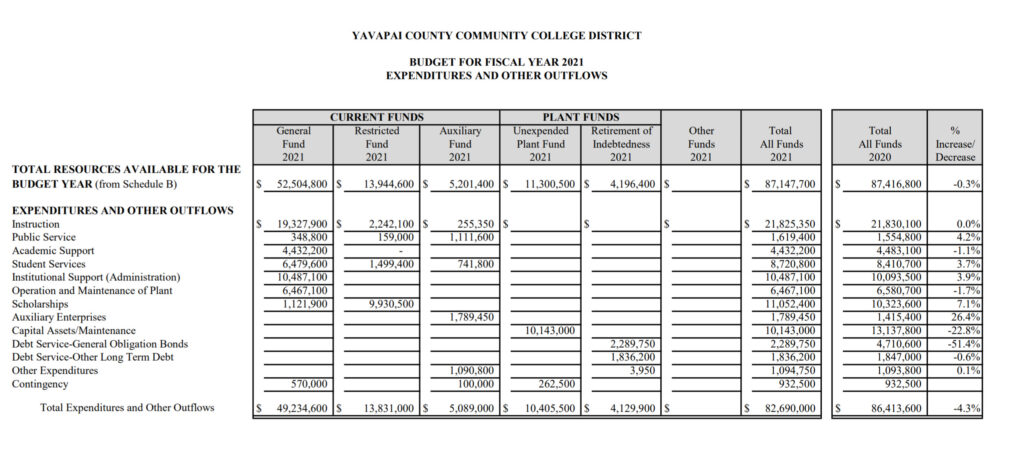
The Yavapai Community College District Governing Board met on-line for its monthly general meeting and a public budget meeting Tuesday, May 12.  It unanimously approved the fiscal year 2021 budget, which  was proposed by the Community College administration.  The budget totals $82.7 million.

The adopted budget  is 4% less than the current fiscal year 2019-2020 budget. The smaller budget is due to a reduction in capital expenses and early payment on a portion of secondary taxes that were generated by a 2000 bond issue.

GOVERNING BOARD TO VOTE ON BUDGET FOR 2020-21 AT TUESDAY’S MEETING

College proposes no increase in property tax, 3% faculty/staff compensation increase, no layoffs or furloughs (earlier approved 5% tuition increase), Board has final word

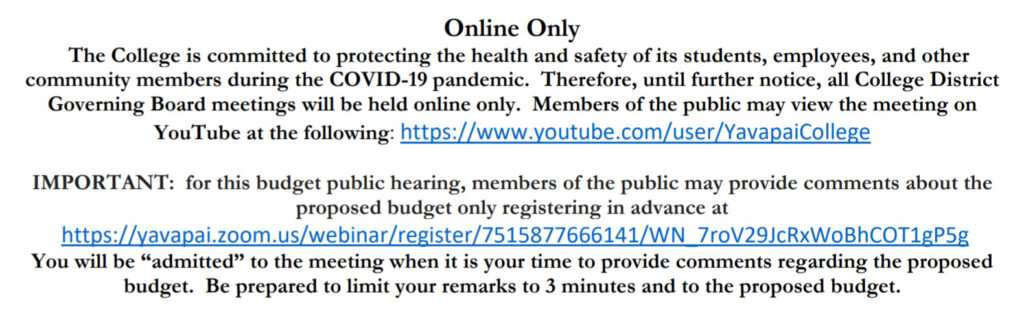
The Yavapai Community College District Governing Board will meet on-line for its monthly general meeting and a public budget meeting this Tuesday, May 12 beginning at 1 p.m.  The first order of business will involve presentation of the College’s proposed 2020-2021 Budget. (See earlier Blog post with  links to meeting and how to register if you want to participate.)

Other than additional Property Tax revenues from new construction, the College is not requesting an increase in the property tax levy for the coming fiscal year. The Budget is posted on the Yavapai College website (www.yc.edu/budget ), which you can reach by clicking here

Earlier in the year the Governing Board approved a 5% increase in student tuition.  The proposed budget anticipates a 3% increase in faculty/staff compensation.  It also anticipates no faculty/staff layoffs or furloughs.  The Board will vote on the final budget at this meeting.

YAVAPAI COMMUNITY COLLEGE TO SPEND $5 MILLION IN MAINTENANCE ON PRESCOTT CAMPUS IN 20-21

Performing Arts Center needs $2.7 million for new roof and HVAC

The draft maintenance budget for 2020-21 was unveiled at the March Community College District Board meeting.  In total, the College will spend about $5 million in maintenance projects in the District. Almost all of the maintenance will occur on the Prescott Campus.

The most expensive project is the Performing Arts Center on the Prescott Campus.  It is estimated the College must spend an estimated $2.6 million to replace a failing HVAC system and put a new roof on the facility.  It appears that most of  this cost will be the responsibility of  County taxpayers via their annual  primary property taxes paid to support the Community College.

The second largest project involves the residence halls on the Prescott Campus. Maintenance on those facilities is estimated to cost about $1.2 million.

You may view Dr. Clint Ewell’s report to the Governing Board on this project below.

COMMUNITY COLLEGE BUDGET FOR 2020 ACADEMIC YEAR APPROVED UNANIMOUSLY

Includes 5% tuition hike but no primary property tax increase; secondary tax levy drops by 14.2 percent

The Yavapai Community College Governing Board unanimously approved the budget for the 2020 academic year at its meeting May 14.  This was the last meeting for three months of  the Board.

The budget included a 5% tuition increase but no primary tax increase.  Because the Community College applied $4 million dollars it received from selling its facilities in the Prescott Valley Town Hall, it was able to reduce the secondary primary property tax levy by 14.2 percent.  (Recall that the secondary property tax is used to pay off the 2000 $69.5 million bond issue approved by voters that year.)

There was no serious public opposition to the budget. Only three persons spoke at the call to the public about it.

Funding in the approved budget included revenue for Building “L” on the Verde Campus to  expand the nursing and allied health programs, while adding new programs in emergency medical services, paramedicine, and home health care. Building “L” is expected to be finished by the fall 2020 semester.


DECLINE IN NUMBER OF CREDITS BEING TAKEN BY STUDENTS IN 2017-18 ACADEMIC YEAR WORRYING

Figures issued by College suggest decline of $624,000 in tuition revenue in 2018 when compared to four years earlier despite tuition increases every year

The tuition data released by the Community College at the March 2019 Governing Board meeting should be worrying to the Governing Board and Administration.  According to the data, the College took in about $624,000 less in tuition than it did four years ago.  This is despite tuition increase in every year over the past decade.

According to the data, four years ago students on the west side of the County took 35,504 credit hours in the fall.  However, in the 2017-18 academic year they took only 32,737, a decline of 2,767 credits.  Students in the east region took in the same period took 8,900 credit hours four years earlier and 9,603 credit hours in the 2017-18 academic year; an increase of 703 credit hours.  The net loss to the College in the fall was 2,064 credit hours.

In the spring semester four years ago, students on the west side of the County took 36,568 credit hours.  However, in the 2017-18 spring semester they took only 32,345 credit hours.  This was a decline of 4,225 credit hours.  Students in the east region took 8,897 credit hours four years and 8,938 in the spring 2018.  This is an increase of 41 credit hours.  The net loss to the College in this period (4225 – 41 =.4,184.)

The overall loss of credit hours in 2018 when compared to four years earlier appears to be 6,248 credit hours.  If these figures are correct, the Community College tuition revenue in the past academic year was down by $624,800 dollars when compared to four years earlier (using $100 tuition x 6248 credit hours) (tuition runs from $87, $100, $110, market).

A few years ago, the College announced it has lost about a million dollars in revenue from problems with enrolling students in its aviation program.  The College has not recently reported the status of that program or compared it with years earlier. That information should be included in the next tuition report.  It may have skewed this data, to some extent.

COLLEGE WARNS BOARD THAT DISTRICT WILL NEED $19 MILLION IN NEXT THREE YEARS FOR FIXED MAINTENANCE PROJECTS

With 769,000 gross square feet and 51 buildings, College fixed maintenance costs over next ten years may reach $32 million dollars

Community College Vice President of Finance and Administrative Services, Dr. Clint Ewell, outlined in detail to the Governing Board at the March meeting the anticipated maintenance costs the Community College was facing in the District over the next three to ten years.  According to information supplied Dr. Ewell by consultants, the College will need at least $19 million dollars over the next three years to maintain and repair existing facilities.

The District currently has 769,000 of gross square feet in 51 buildings.  Most of the $19 million will go into maintaining the Prescott Campus because it has the largest number of  buildings.  The greatest needs are in the electrical and HVAC areas.

Dr. Ewell also reported that the consultants anticipated the College will need at least $32 million over the next ten years to ensure proper maintenance of the buildings on its campuses and centers in the District.

You may view Dr. Ewell’s five minute report to the Board on this subject below.

COLLEGE SPENDS $225,000 FOR DESIGN/COST ESTIMATES OF MULTI-USE (SOCCER) FIELD

Tells Board at January meeting that funds for this project have been spent–where does such a project sit in terms of educational priorities?

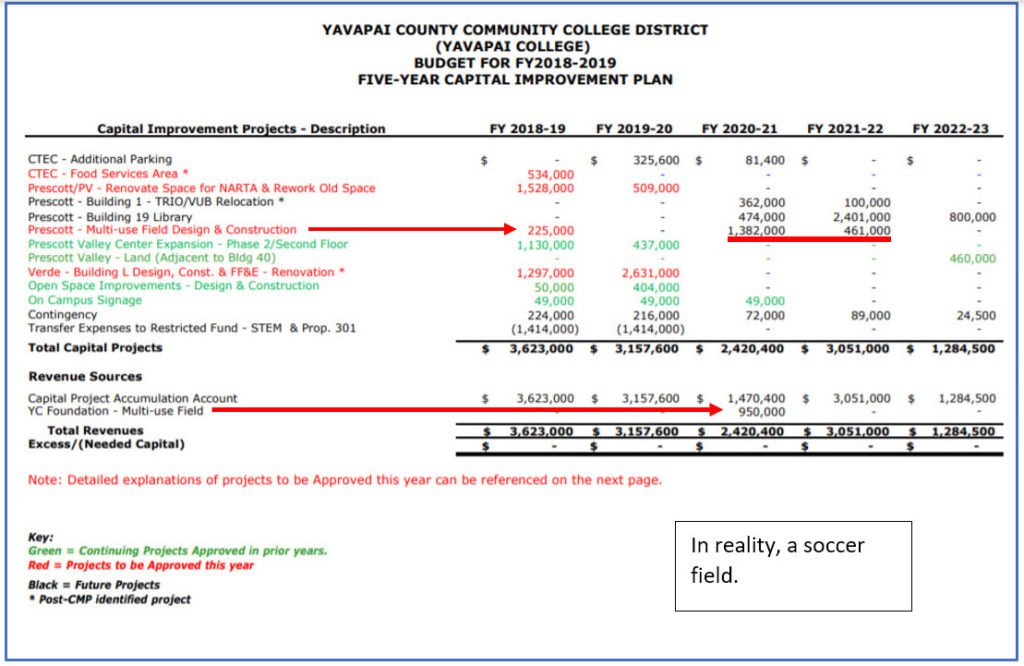
 Vice President Dr. Clint Ewell reported at the morning workshop January 8 that Yavapai Community College had spent up to $225,000 to initially decide whether it wants to build a multi-purpose field on the Prescott Campus. This amount was approved 4-1 by the Governing Board in last year’s budget.

 Most observers are aware that the primary purpose of such a field is to replace the two leased fields now used by the boys soccer team and provide the soccer team with a field on the Prescott Campus. Critics argue that it is a needless expenditure of limited funds and unnecessary because the present leased soccer fields cost the College very little. Moreover, the current soccer fields have been used successfully for years and were selected for two national Junior College final championship events.

In addition to spending the funds for design, etc., last year the College moved over a million dollars from its capital construction fund for a parking lot adjacent the proposed soccer field to what it calls its “deferred maintenance fund.”  In essence, the move took the spotlight somewhat off the project and placed it in a less contentious area of the College budget.

Finally, the College Foundation has indicated it is willing to put almost a million dollars into the soccer field.

Neither the College nor the Governing Board has at any time indicated where such a project like this sits in the list of educational priorities for students in the District.  Wouldn’t it be nice to see a list of priorities?

COLLEGE ANTICIPATES RAISING TUITION BUT NOT TAXES IN 2019 BUDGET

Also assumes it will receive $1 million from the County’s new construction tax; big jump from past years

Yavapai Community College unveiled its assumptions about the 2019 budget in its meeting with the Governing Board last Tuesday.  In a short presentation, Vice President Dr. Clink Ewell explained that the College anticipated it would receive about $1 million in revenue from the Yavapai County new construction tax.  This is a substantial jump in revenue from this source when compared to the last several years.

Dr. Ewell also told the Board that the Administration did not anticipate asking for a property tax rate increase.  He said that the Administration would most likely ask the Governing Board to increase student tuition by about $4.00 per credit.

Dr. Ewell’s short presentation and explanation to the Governing Board regarding this aspect of the 2019 budget appears in the video clip below.


COLLEGE PURCHASES EXPENSIVE ELECTRIC TRANSPORTATION VEHICLE(S) FOR PRESCOTT CAMPUS

Is this another example of unnecessarily wasting taxpayer money rather than using it on educational programs? Or faculty salaries? (See photo below.)

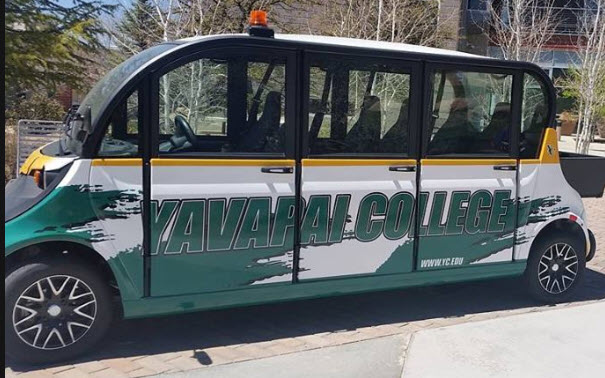
Yavapai College has purchased expensive electric van(s) to transport the president and others to meetings and events on the Prescott Campus.  The College has not reported on the cost or the number of vans purchased. 

The vehicle(s) apparently replace the use of the far less expensive golf carts that have been used for years.  The purchase of expensive vehicle(s) for such limited purposes raises questions about the necessity of such an expenditure and whether using taxpayer revenue on fancy vehicle(s) is a waste of scarce educational resources.