Archive for Budget – Page 6

REPRESENTATIVE MCCASLAND SPEAKS OUT IN “MY TURN” COLUMN

Challenges need for property tax rate increase; increased spending on wasteful projects; tuition increase and Board ignoring voters

Second District Yavapai Community College representative Deb McCasland listed her concerns with the actions of the Governing Board at the May meeting in the Verde Independent  newspaper “My Turn” column May 15.  Among the many concerns was the majority on the Board essentially snubbing the public who spoke, all of whom opposed the increase.  She wrote that it was difficult for her to understand “how the other board members can disregard the numerous comments from concerned citizens.”  

 She also wrote of her concern that the tax rate was increased at a time when the College really didn’t need the funding.  Among other reasons a tax increase was not needed is the fact the College just received over $4.4 million in the sale of property to the town of Prescott Valley.

McCasland lamented the huge decline in student enrollment and the use of primary property tax money to fund capital projects.  She observed that in the next few months the 70,000 residents of the Verde Valley will have an opportunity to bring about change with the appointment of a new College president.

You may read her entire column in the Verde independent by clicking here

WHY SHOULD COLLEGE BANK WINDFALL OF $4 MILLION FOR FUTURE SOCCER FIELD OR SIMILAR PROJECT?

Why not use it in a manner that will create $4.4 million in student scholarship aid?  Or, give faculty a one-time bonus?  No one in the administration is talking about those kinds of alternatives

Commentary

Yavapai Community College has received back $4.4 million from the town of Prescott Valley pursuant to an agreement made in 2007.  Rather than apply the money to the 2018-19 budget to cover capital costs (the $4.4 million must be used for capital), the College has announced it intends to bank the money and use it for future capital projects.  (See Video.)

Wouldn’t a better use of the windfall to apply the $4.4 million to the 2018-19 capital budget and use the primary taxpayer $4 million now linked to capital expenses to establish student scholarship aid?  Or, provide staff with a one-time bonus?  So far, the Board has shown no inclination to do anything more than to bank the $4.4 million so it can build the future soccer field or some other similarly wasteful project.

The history of the $4.4 million begins February 26, 2007 when the College entered a memorandum of understanding with the Town of Prescott Valley and agreed that it would provide money to build in the Prescott Valley Library facilities to be used for “a wide range of educational services, including library services, classroom instruction, administration, and cultural performances.” In January 2008 the College and the Town of Prescott Valley broke ground on a joint use facility for the stated purpose of providing classrooms, administrative offices and a library complex at the Prescott Hall library.  A combination of bond proceeds and funds from the districts Future Capital Projects Accumulation Fund were used for the project.

The Community College joined with Northern Arizona University around 2010 to provide an experimental three-year full college degree granting program at the facility.  The idea was apparently that the Community College would teach two-year courses and NAU handle upper division courses.  The arrangement fell through a couple of years ago and the College asked for its money back.  The Town of Prescott Valley agreed.  Finally, the money has been returned to the College.

The College explains how it is handling the $4.4 million in the short video below.


REVENUE FROM CONSTRUCTION TAX FLOWING TO COLLEGE JUMPS 32.4% in 2018-19

Special tax adds $903,100 to College Revenue Stream

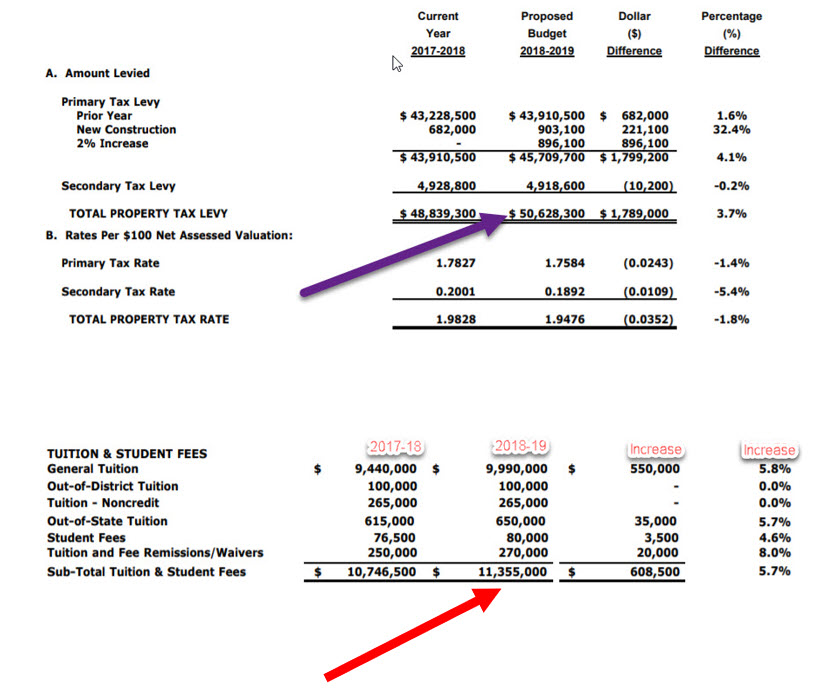
The special construction tax levied on County builders is estimated to generate $903,100 in the 2018-19 academic year for the Community College.  According to data issued by the College, this represents an increase of 32.4% over last year.

————————————–

GOVERNING BOARD PREPARED TO INCREASE PROPERTY TAX RATE BY 2% IN MAY

Although enrollment flat, College to receive $896,100 in new tax revenue and $608,500 in new tuition revenue ($1,504,600) –– Total tax revenue going to the College next year is $50,628,300; total tuition is $11,355,000; $4 million windfall to be banked

After surveying the Yavapai Community College Governing Board members at the April 2018 meeting, the College Administration has enough votes to increase the County property tax rate by at least 2%.  In February 2018 the Board had voted 4-1 (McCasland dissenting) to increased tuition by 5%. The increases will generate at least $1,504,600 in new revenue flowing to the College. 
The increases will be approved despite the fact that the College received a windfall of $4 million from the sale of its teaching facilities at the Prescott library.  It was once hoped that Yavapai College and Northern Arizona University would jointly operate the three-year experimental degree program at the library.  However, those plans evaporated when NAU hired a new president.  Per an agreement with the town of Prescott Valley the $4 million investment by the College in the town library is being returned.

YAVAPAI COLLEGE ADMINISTRATION SEEKS 2% PROPERTY TAX INCREASE AT MAY 8 MEETING

After resistance from three members of the Governing Board (Sigafoos, McCarver, McCasland) at January 2018 meeting when 4% increase suggested, Administrators moving forward with 2% rate increase request

The Yavapai Community College formally has announced that it will seek a 2% property tax increase at the May 8, 2018 Governing Board meeting.  It made the announcement in the news media April 13, 2018.  (See, for example, The Verde Independent, dated Friday, April 13, 2018.)  The Governing Board representatives have not held public meetings in their districts to discuss the proposed rate increase and apparently do not intend to do so.

The College will ask for a 2% increase in primary property taxes, which will produce revenue of about $896,100 annually.  The College indicated in January 2018 it wanted a 4% tax rate increase to accompany a 5% tuition increase.  Chair Ray Sigafoos, and Board members Deb McCarver and Deb McCasland indicated a proposed 4% property tax increase was not acceptable.  However, the Board approved a 5% tuition increase at its February 2018 meeting 4 – 1 (McCasland dissenting). 

The Governing Board last approved a tax rate increase in 2015 (3 – 2).  There was unanimous opposition from the two Verde Valley representatives (Al Filardo, Deb McCasland) to that property tax rate increase.  There was also unanimous opposition from the Verde Valley Board Advisory Committee, which had representatives spread throughout the East side of the County.  The opposition made no difference to West-County Board members Sigafoos, McCarver, and Steve Irwin.

A video summary of the Board reaction in January 2018 to the proposed 4% property tax increase follows.

NEW FINANCIAL ESTIMATE SUGGESTS VERDE VALLEY (INCLUDING SEDONA) TAXPAYERS AS COLLEGE EQUITY OWNERS SHOULD RECEIVE UP TO $24 MILLION ANNUALLY FOR DEVELOPMENT, MAINTENANCE & OPERATIONS

Unfortunately, College spends only $7.5 million — not $24 million — in the Verde Valley leaving millions on the table for West County use

A new in-depth financial estimate conducted by accountant and realtor Mr. Rob Witt suggests that the Verde Valley (including Sedona) as equity owners of the College should receive about $24 million annually for development, maintenance, and operations of the Verde Campus in Clarkdale and the Sedona Center. He says that the Blog report showing that the Verde Valley property taxpayers provide $14.7 million in property taxes is correct. However, he argues that this figure is far below what the Valley taxpayers should receive as equity owners in the College. He puts that figure at $24 million. 

Recall that the College annually collects $14.7 million in property taxes in the Verde Valley and there is general agreement the College spends only $7.5 million of that money in the Verde Valley. This leaves $7.2 million left over in property taxes alone.  (Note that over a two-year period 2016-17 the College invested about $2.5 to $3 million in capital improvements in each of those two years to renovate the Sedona Center.) Mr. Witt points out that there are millions of dollars in non-property tax revenue flowing to the College that are generated by Verde Valley students and families such as tuition, state aid, federal aid, grants and gifts.

Here is Mr. Witt’s equity argument: “When you summarize the property tax estimate from the East Valley, the Blog’s percentage is correct, however, by leaving off the East Valley’s percent of other revenue sources the Blog is significantly undervaluing the East Valley contribution. From an accounting standpoint, I look at the College budget like equity ownership. East County taxes fund 30% of the College Special District. This equates to 30% of the revenues and 30% of the expenses. The budget revenue is $82 million so the East County’s return should be 30% of that figure or $24 million.”

Mr. Witt has written to the College asking for a response to his detailed analysis with a spreadsheet in support of it. His spreadsheet is not included in this Blog. So far, he has not heard from the College.

NEW TAX LAW BENEFITS YAVAPAI COMMUNITY COLLEGE

Extends Proposition 301 sales tax due to expire in 2021 to 2041

Yavapai Community College breathed a sigh of relief when Governor Doug Ducey signed into law a bill extending for 20 years the education sales tax rate that generates about $667 million annually for Arizona schools. For the past several years, Yavapai College has indicated concern that it would lose the annual State contribution from proposition 301 when it sunsetted in 2021. That concern is now gone.

The College annually receives state assistance in three categories: First, it receives about $640,000 based on enrollment. Increased enrollment means increased state aid. This is called “maintenance support.”

Second, the College has been receiving about $639,000 pursuant to a special Science, Technology, Engineering, and Math (STEM) grant.

Finally, it receives about $700,000 from the State as its “State Shared Sales Tax.” Because of the new law, the sales tax revenue flowing to the College is no longer in danger of evaporating.

It was almost 20 years ago when Governor Jane Hull and Arizona voters passed Proposition 301.

———————————————————————-

COLLEGE PROVIDES DETAILS REGARDING NEED FOR $2.7 MILLION MORE IN REVENUE FOR 2018-19

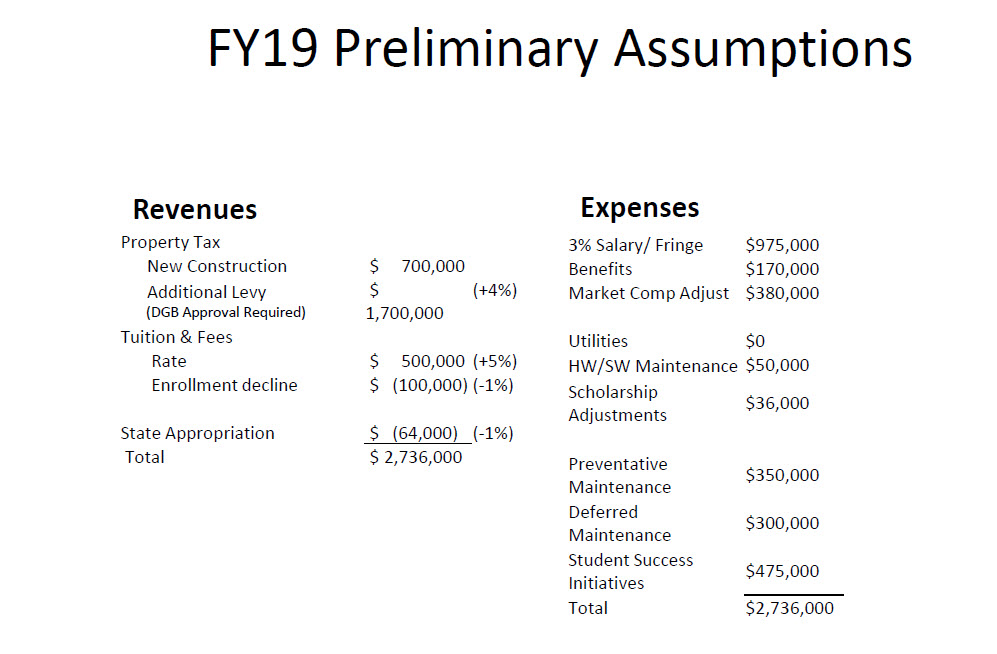
Fears 1% decline in student enrollment; Increases in compensation estimated at $1.52 million

The Community College has provided details of its preliminary assumptions for the 2018-19 academic year.  Among the data furnished the College District Governing Board, about  $1.52 million of new revenue will be used as additional compensation for faculty and staff.  The remainder of the $2.7 million in new revenue will be allotted to maintenance and programmatic initiatives.

The College Administration projects that a 4% increase in the tax rate will bring in an additional $1 million in revenue and the 5% increase in tuition will yield about $500,000 in new revenue.  The preliminary assumptions appear below as they were presented to the Governing Board.

———————————————————

COLLEGE PRESS RELEASE ABOUT GOVERNING BOARD MEETING SAYS NOTHING OF 4% TAX RATE INCREASE

Best to keep taxpayers in the dark; No newspaper accounts so far

It is of interest that when Yavapai Community College released its press report explaining what took place at the January 16, 2018 Governing Board meeting there was no mention of Wills’ request for a 4% tax rate hike (or 5% tuition increase).  But for the Blog and the videotape of the meeting, Yavapai residents would be completely in the dark about her  tax rate request. As of this date, there have been no local newspaper accounts of the tax rate request and the Governing Board reaction to it.

You may view the Community College press release about the meeting by clicking here.

You may view the entire Board meeting including the videotape where the Wills’ Administration asked the Governing Board to consider a 4% property tax rate increase by clicking here as soon as it is posted.

—————————————————————

VIDEO SHOWS GOVERNING BOARD UNEASE WITH 4% TAX RATE INCREASE; OPPOSITION TO 5% TUITION HIKE UNCLEAR

Tax hike appears to have more opposition than tuition increase

The video below shows the Community College Governing Board discussing Dr. Clint Ewell’s tentative budget increase suggestions for 2017-18. The discussion took place January 16 during the regular Board meeting on the Prescott Campus.

It appears that at least three members were uneasy with the Administration’s suggestion that it consider approving in February a 5% tuition increase  and in May a 4% property tax increase.  (Representative Connie Harris was seen occasionally nodding, which suggests she may have also been concerned.) 

Chair Ray Sigafoos seemed most concerned with the property tax rate hike.  Representative Deb McCasland pointed out that there was a questionable need for more money to increase deferred maintenance and alluded to the College’s large reserves.  Representative Pat McCarver seemed concerned with both the tuition and tax rate hike. The video is about four minutes in length.