
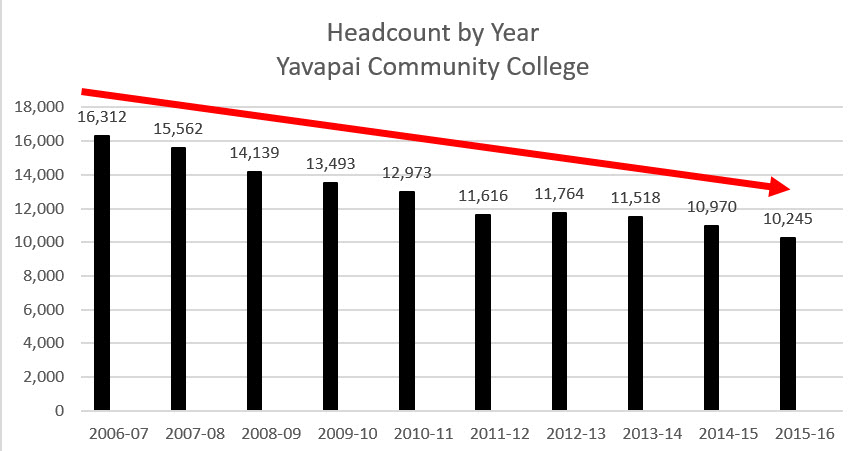
College has declined by over 6,000 students in last ten years
The Yavapai Community College continues its enrollment slide that began in 2006-07. Since then, using District-wide headcount statistics, it has fallen by 6,067 students. In the 2015-16 academic year the headcount dropped by 725 students from the previous year.
The most recent headcount number was received by the Blog from Mr. Tom Hughes, Yavapai Department of Institutional Research on August 3, 2015. In order to obtain the data, a formal public document request was made by the Blog. An email to the Verde Campus Executive Dean could not provide the information.
It is to be noted that the information supplied the Blog is not the audited headcount, however, it is thought to be accurate.

 The College uses the adoption by the District Governing Board of the Carver™ model of governance as a shield to protect it from providing information to the public. The Carver model says all operations are in the hands of the College President. It tells Governing Board members they cannot interfere in any way with operations. They are forbidden from talking with students, faculty or staff about the College. The Administration tells faculty and staff they cannot talk to Board members about any problems they may have. It is a part of a curtain of a calculated secrecy surrounding the College’s operation.
 Dr. Waak was a finalist in the College’s national search a year ago for this position. The Blog was informed that she was second to Dr. Kelly Trainer in the selection process, her predecessor in this position. If correct, is there really a need for another costly national search? Why waste the money?


 District Governing Board member Al Filardo suggested that if the members followed the example set by Sedona they would be successful in gaining notice from the College. Chair Bill Regner replied to Mr. Filardo and suggested that Sedona has been successful in moving the College only because the Administration created a “public relations nightmare” when it announced the closing the Sedona Center and once it became known that the Sedona Taxing District paid somewhere around $6 million a year to support the College.
 Although the official agenda has yet to be published, the Verde Independent said in an article written by Mr. Bill Helm on July 10, 2016 that the following items were possibly on the agenda: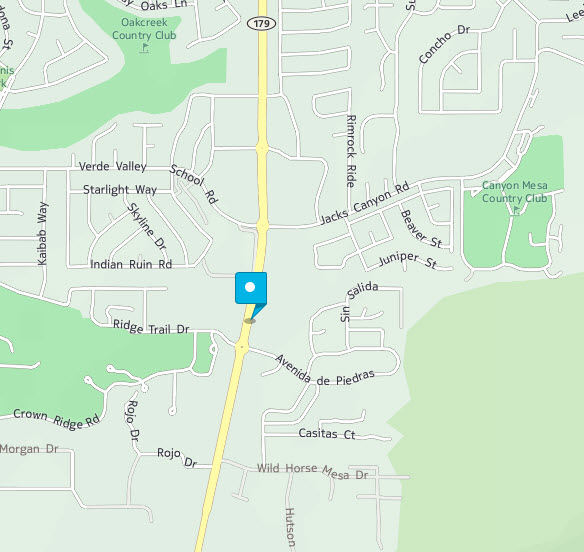
 According to Weir, “Students who start the program in their junior year have the chance to graduate high school with their FMA Production certificate become AVID-certified and be well on their way to obtaining their animation certificates in the program,”
 According to the College, the average starting salary for its graduates was $24.00 per hour. Five of the line-worker graduates were hired by Arizona Public Service (APS) in various parts of the state including Yuma, Douglas, Paradise Valley, and Phoenix. Other lineworker graduates were hired by subcontractors around the state.