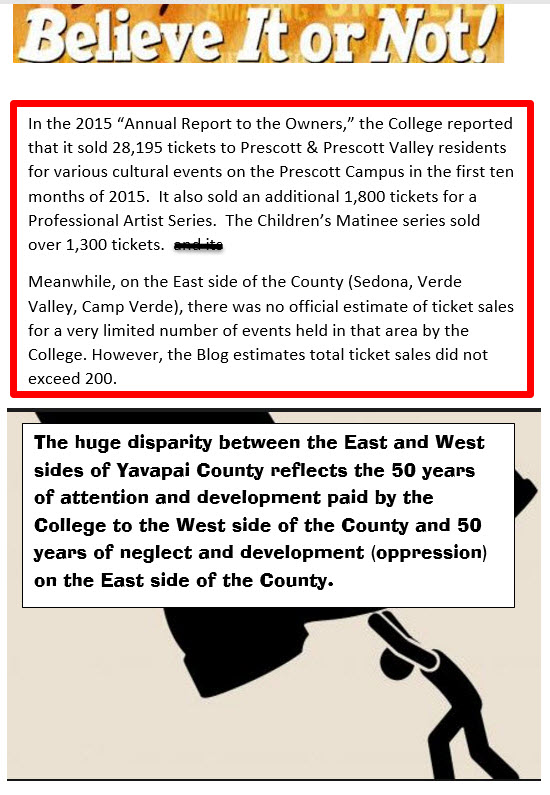
2015 Annual Report shows impact of 50 years of neglect on the Verde Valley in terms of cultural events


Commentary
The Community College claims it is losing enrollment and desperately needs to increase student tuition while slapping a $10 per credit student fee to be paid by taxpayers for some community college classes now being taught in high schools. It says it will lose around $2 million in the coming year. Despite this claimed desperate need, it spent thousands of dollars on staff time and on printing costs, all paid by taxpayer dollars, to produce a self-congratulatory 16 page glossy catalog. (Like Macey’s) It looks little more than like a very, very expensive political handout.
This is the second time the Administration has put together such a hand-out. The first was in 2014 when I believe it was created to help two board members in contested elections. It failed. The present catalog is designed to coax Board members to find shelter under the wing of the administration via photos and self-congratulatory rhetoric. It’s a political tool.
The claim it can be using it for marketing the college; if so, it misses that mark by a mile. There are only smatterings that would interest a prospective student or the student’s family.
Astonishingly, there is almost nothing in detail in the catalog about faculty, faculty accomplishments, and a commitment “excellence” (if there is any such commitment). And no faculty photos per se. From my perspective, it is a pithy piece of self-congratulatory mush.
There is a full-pager letter to the “College owners” signed by the Chair. I doubt anyone considering enrolling as a student would bother to look at it. (Who is this thing being marketed to? To residents so they will vote for Board members at the next election?)
A full page is devoted to the Governing Board photos and resumes. A student considering enrolling at the College would find this page of no interest. Moreover, Board member photos dominate the report with the Chair’s various photos, who most see as the hand-maiden of the administration, most prominent.
There’s a full page devoted to “Board ends,” which would be foreign to most prospective students and their families. The height ridiculousness is a full-page devoted to trying to explain “Policy Governance,” with an appropriate copyright notice to John Carver attached to it. Just incredible!
The College administration no doubt believes that this document will help it cement relationship with Governing Board members. Well, maybe it will. But for taxpayers, it is a an example of how the current administration simply wastes scarce financial resources while crying out for more.
The catalog can be found by clicking here.
A much shorter catalog, that was also produced, can be found by clicking here.
The self-congratulatory statements made by the Board Chair about the material can be seen by clicking here.

Al Filardo, 3rd District Representative
At the March 1, 2016 Board meeting, Third District Representative Al Filardo used a typical corporate business model when questioning the administration about whether the five percent tuition increase being sought was justified. He questioned whether a tuition increase should be considered in isolation from the expense budget for the coming year, which to most people makes a whole lot or sense. (But not the College.)
Filardo explained that he had no matrix to apply to the requested increase. By that he meant that there are no set goals for the President to increase enrollment or accurately assess student satisfaction. Moreover, the Board had yet to consider expenses and where they might be cut.
Mr. Filardo also said that he was not an enemy of the faculty when it comes to such things as a salary increase; he was simply trying to find a way to justify the tuition increase to the residents of the County. But he observed that from a corporate perspective, when sales are down, you must ask whether such increasing employee salaries is justified.
Filardo was joined in his criticism of the request by Ms. Deb McCasland. The vote was 3-2 to increase tuition by five percent. The three member West side majority voted together to approve the increase. Mr. Filardo and Ms. McCasland, representing the entire Verde Valley, voted “no.”
A portion of Mr. Filardo’s inquiry can be seen in a short two-minute clip by clicking here.
On March 1, 2016 the three-member voting block from the West side of Yavapai County voted to once again increase student tuition. The increase is necessary if the College is to continue its building blitz on the West side of the County, which takes up $8 million or more on average a year. The increase will be around $4 per credit hour.
Representatives Al Filardo and Deb McCasland, representing Verde Valley interests, voted against the proposal. Ms. McCasland argued there were many opportunities for the College to find ways to cut expenditures. Mr. Filardo questioned the efficacy of increasing tuition to pay for such things as increased salaries when enrollment was continuing to fall.

The College has increased tuition in some form every year for the past ten years—even during all of the recession. The College almost never talks about the fact that it has put in place a three-tier tuition fee structure; rather, it hypes a claim that student fees are $75 per credit hour per semester. Almost half of the enrolled students pay much higher fees—although the College has not released the exact percentage for obvious reasons. Tier 2 students pay $86 per credit hour; tier three students pay $96 per credit hour. Furthermore, there are a number of so-called “market tuition based” courses that charge from $105 to $161 per hour. Finally, some aviation courses charge as much as $662 an hour. Click here to see the 2016 in-state fee schedule.
No students spoke for or against the proposed increase.
Yavapai College has announced the three finalists for the of Vice President of Instruction and Student Development. The College Governing Board will play no role in making the final selection.
Although the College has not posted who will make the final decision (although it is clear the Governing Board will not do so), it apparently rests with President Penelope Wills. This is in keeping with the corporate model that the administration now operates under, which seeks to remove input from County residents and the Governing Board. It vests almost total power and control in the unelected president of the College.
The finalists are: Dr. Christopher C. Ezell, who has served as the Vice President of Academic and Student Services (and chief academic officer) for the past ten years at Danville Community College (DCC) in Danville, Virginia. Before that, Dr. Ezell worked for twenty-five years with Vincennes University (VU) in Indiana.
Dr. Ron Liss is the second candidate and was the Western Campus President for Cuyahoga Community College (Tri-C) from July 2013 to July 2015. He was Vice President for Academic Affairs at Santa Fe Community College (SFCC) in N.M., where he served from 2007 to 2013. Liss held numerous positions at Montgomery College in Maryland, including Dean of Business, Management, Chemistry, and Information Sciences; Director of Distance Learning and Academic Innovation; and Director of Academic and Student Affairs. He spent 15 years at the Community College of Baltimore County as faculty, department chair, division chair and director of instructional technology.
Dr. James Perey, the third candidate, has been the Executive Dean of the Verde Valley Campus and Sedona Center since 2012. He is generally viewed as the “fall-guy” for Wills’ in the Verde Valley. Dr. Perey has served as an Associate Dean for Career and Technical Education overseeing the Chino Valley Agribusiness Center and programs throughout the district. Before his administrative assignments, Dr. Perey served as a full-time faculty member in the Agribusiness department teaching a variety of classes in agriculture and agribusiness. In addition, he has served in numerous other leadership roles at Yavapai College, including outcomes assessment coordinator and faculty senator.
Prior to coming to Yavapai College in 2002, Dr. Perey served as a lecturer and professional development coordinator at the University of Arizona, Department of Agricultural Education, where he assisted in preparing new teachers by both teaching classes and providing professional development. His academic career began in the classroom as a high school instructor where he spent four years teaching in a small, rural farming community in Arizona.
For much more background on the candidates, please click here.
The recently retired Verde Valley Assistant Dean of Student Services, Ms. Barbie Duncan, pleaded with the Yavapai College District Governing Board at its March 1 meeting to return what Prescott has taken from the Verde Valley. Unfortunately, her plea was futile as demonstrated by a 3-2 vote against hiring a consultant to examine various community college models.
 She asked that the authority taken away six years ago from the Verde Valley and placed in Prescott supervisors be returned.
She pointed out that six years ago, eleven full-time and part-time student services positions (60%) were either cut or reassigned to the Prescott Campus. She said that the cuts and reassignments correlate to the decline in enrollment on the Verde Campus.
Course offerings and faculty have been reduced “so dramatically” on the East side of the County that students can “rarely find enough classes to fill a full-time enrollment in their study,” she said.
She asked that East County taxes be returned to East County facilities rather than spent on the West side of the County. The three members of the West County voted as a block to reject hiring a consultant to objectively examine the isssue.
You may listen to her entire three minute presentation by clicking here.
A motion by Verde Valley District #3 Governing Board representative Al Filardo made at the March 1, 2016 District Governing Board meeting to consider hiring a third party consultant to study the College’s current administrative structure was shot down by the West County voting block.

The West County representatives realize that right now that side of the Mountain is in line for $100 million dollars of taxpayer money to finance various building projects while the East side may get about $5 million in development. They no doubt fear that an independent consultant might recommend a much more equitable distribution of funds and a fairer distribution of power between Prescott and the Verde Valley. That is something the those in control on the West side of the County absolutely do not want to do, that is, share equitably in anything with the East side of the County.
The vote to hire an independent consultant to examine many models of College structure was 3-2, with all the Prescott/Prescott Valley representatives voting against the motion. Ms. Deb McCasland and Mr. Al Filardo, the East representatives, voted for the motion.
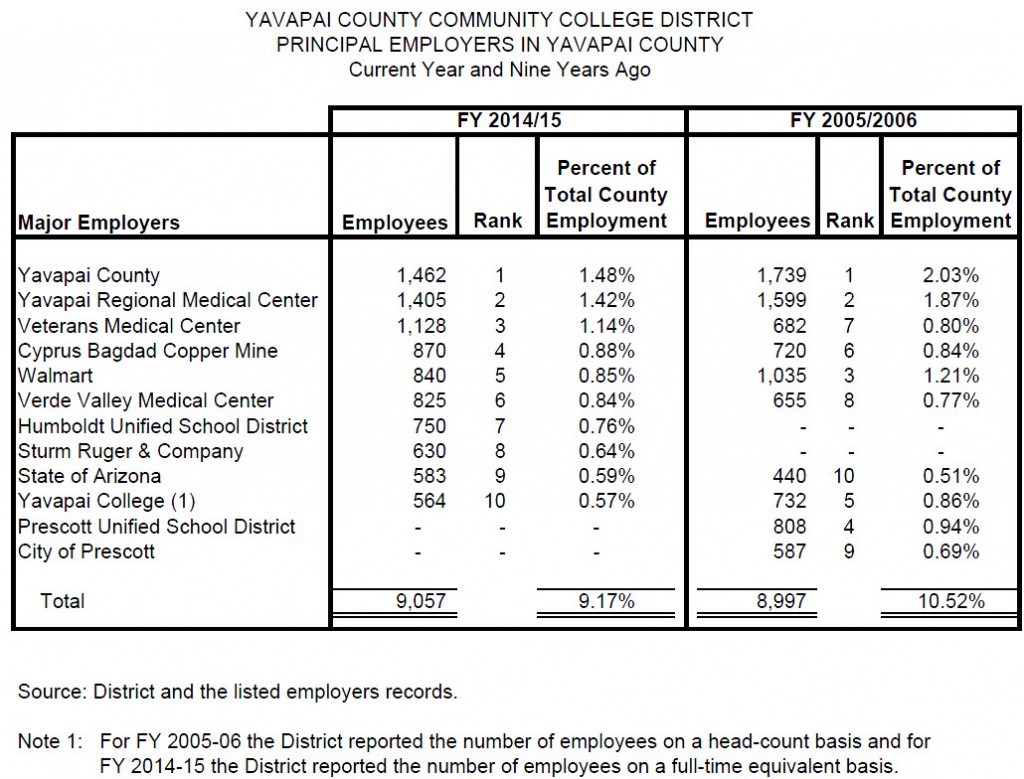
Yavapai College is now the tenth largest employer in Yavapai County. In a February, 2016 report given to the Governing Board, there was the equivalent of 564 full-time employees working for the College.
It has become a major economic engine on the West side of the County and is pumping millions of dollars into the economy over there.
Alth0ugh the College has not released the data, it is estimated that from 85 to 90 percent of the full-time employees work on the campuses located on the West side of the County.
The regular Board meeting of the Yavapai College District Governing Board will take place on the Verde Campus Tuesday, March 1, 2016.
 The meeting begins at 1 p.m. and will be held in Building “M”, room 137. The Verde Campus is located at 601 Black Hills Rd, Clarkdale, Arizona.
The public is invited to attend. A member of the public may address the Board on any topic for three minutes during the call to the public portion of the meeting.
OLLI Sedona/Verde Valley is presenting a series of three talks by Fenfen Ni, a teacher from China who is spending a semester at Mingus Union High School. The first presentation, Chinese Festivals and Celebrations, will be held on Monday, February 29 at 2:00 in Room M-137 on the Verde Campus, and on Friday, March 4 at 2:00 pm in Room 34 on the Sedona Campus. These presentations are free and open to the public.