Image
  • Home
  • Contact

THE CONSEQUENCES OF YAVAPAI COMMUNITY COLLEGE DISTRICT GOVERNING BOARD MEMBERS FAILING TO ASK SIGNIFICANT QUESTIONS ABOUT PROJECTS AND THE BUDGET: HOW THAT MAY IMPACT YAVAPAI COUNTY RESIDENTS AND THE DEMOCRATIC PROCESS

By R. Oliphant
Thursday, June 22nd, 2023

A short essay by Robert Oliphant

Introduction:

Editor: Robert Oliphant

In a democratic society, officials, such as those members elected or appointed to the Yavapai Community College District Governing Board, play a vital role in representing the interests and concerns of the public. One crucial aspect of this responsibility is to ask meaningful and relevant questions when presented with important items presented by the Community College President and her staff. Failing to do so can have profound effects on the citizens of Yavapai County, impacting transparency, accountability, decision-making, and public trust. In this  short essay I explore the consequences of such failures by the Yavapai Community College District Governing Board, which failures appear obvious to a close observer, and emphasize the importance of these politicians actively engaging with their constituents and the executives who run Yavapai Community College.

Transparency and Accountability:

When Yavapai Community College District Governing Board members  neglect to ask significant questions about an item presented to them during a business meeting by the Yavapai President or her staff, as they do so often, it hampers the transparency and accountability that are vital to a functioning democracy. The Board members are accountable to the people they serve, and by not questioning the details and implications of an item presented to them by the Community College executives, they fail to fulfill their oversight role. A concern with this behavior by Board members in this regard is that the lack of scrutiny can lead to potential abuses of power, corruption, and, just as important,  the erosion of public trust in the system set up to govern the Community college.

Impaired Decision-Making:

Significant decisions often require a thorough understanding of the complexities involved. By not asking pertinent questions, Yavapai Community College District Governing Board members miss the opportunity to gather essential information, perspectives, and expert opinions. As a result, decision-making processes can become compromised, potentially leading to flawed policies, inadequate resource allocation, and missed opportunities for improvement. Ultimately, this failure to ask important questions diminishes the quality and effectiveness of governance, negatively impacting the  well-being of the residents of Yavapai County.

Public Trust and Confidence:

Public trust in the members of the Yavapai Community College District Governing Board  is essential for the functioning of a democratic society. When the members fail to ask significant questions, it creates an impression of complacency, negligence, or a lack of genuine concern for the public’s interests. This can erode public trust and confidence in the oversight system as a whole. The public expects their elected or temporary appointed District Governing Board representatives to be diligent, knowledgeable, and engaged. When they fall short of these expectations, it can lead to disillusionment, apathy, and a diminished sense of civic participation.

Missed Opportunities for Public Input:

Asking important questions allows the Yavapai Community College District Governing Board to engage in meaningful dialogue and seek public input on critical issues. When they fail to do so, they miss the opportunity to involve the public in decision-making processes. The public’s diverse perspectives, experiences, and expertise can provide valuable insights and ensure that policies reflect the needs and aspirations of the broader population. Without these perspectives, decisions risk being disconnected from the realities of the public, further undermining democratic principles.

Conclusion:

The failure of members of the Yavapai Community College District Governing Board  to ask significant questions about items presented by unelected officials in the guise of the College President and her staff  has far-reaching consequences for the public. It diminishes transparency, weakens accountability, impairs decision-making, and erodes public trust. Members of the Governing Board should recognize their responsibility to be diligent, inquisitive, and engaged representatives of the people. By actively asking important questions, they can foster transparency, ensure accountability, make informed decisions, and strengthen public trust in the democratic process. Only through such proactive engagement can the Board members themselves effectively address the complex challenges facing the residents of Yavapai County  and create policies that genuinely serve their interest.
Categories : Editorials/Essays

EXTRAORDINARY TURNOVER IN YAVAPAI COMMUNITY COLLEGE’S ATHLETIC DEPARTMENT CONTINUES WITH RESIGNATION OF ATHLETIC DIRECTOR BRAD CLIFFORD, WHICH WAS ANNOUNCED JUNE 15; IS RECRUITING “MANDATE” AFFECTING THE PROGRAMS?

By R. Oliphant
Thursday, June 22nd, 2023

Mr. Clifford’s resignation follows the hiring of new head coaches in volleyball, baseball, softball, basketball over the past two year, the apparent resignation  of Academic Administrator Scott Farnsworth months ago, and the firing of long-time tennis coach Chris Howard this spring

Yavapai Community College Athletics Department’s Hall of Fame Director of Athletics, Brad Clifford, has announced his resignation after dedicating over 35 years to the institution. The news was revealed in a press release issued on June 15. (You may read the entire press release by clicking here.) Clifford’s departure comes in the wake of significant changes within the athletic department, including the hiring of new head coaches for volleyball, baseball, softball, and basketball, as well as the resignation of Academic Administrator Scott Farnsworth several months ago and the firing of long-time tennis coach Chris Howard this spring. 

Yavapai Community College boasts an array of head coaches overseeing various sports, including women’s softball, volleyball, men’s basketball, women’s basketball, women’s soccer, men’s soccer, baseball, and E-sports. Notably, on August 29, 2022, Chelsey Lucas was appointed as the 11th head volleyball coach, followed by Kali Pugh on September 20, 2022, as the 11th head softball coach, and Patrick Woods on September 21, 2022, as the seventh head baseball coach. Jay Joiner assumed the position of head men’s basketball coach in November 2022 but announced his departure on March 30, 2023. Ken Davis was subsequently hired in May 2023 as his replacement.

Alongside these new coaching hires, Academic Administrator Scott Farnsworth left the college a few months ago under undisclosed circumstances. Furthermore, earlier this year, the Community College decided to part ways with long-time tennis icon Chris Howard, terminating his employment.

In a commentary in the Verde Independent newspaper dated September 7, 2022,  Yavapai Community College District Governing Board Chair Deb McCasland explained that the athletic coaches were asked five years ago “to focus more attention on recruiting local student athletes (county/state).” A “mandate” was  instituted “that required 25% of all student athletes recruited had to be from local high schools,” she said.  Furthermore, the coaches were told “that the support for out-of-state and international students will decrease as we increased the scholarship support for local student-athletes.” (Click here to read the full Blog story.) 

“Those three coaches who decided to leave the college ignored those mandates,” wrote McCasland. The Blog believes the three coaches Ms. McCasland is referring to but not identified by name in her commentary are Ryan Cougill, Miles Kizer, and Doug Eastman.

During the October 2022 Yavapai Community College Governing Board meeting, Rodney Jenkins, Vice President of Community Relations at the Community College, made a statement that appeared to insinuate that the previous coaches had actively worked to undermine the mandate. Jenkins said that the previous coaches “did everything they could to sabotage our program.” Jenkins’ remarks seemed to reference the mandate mentioned by Chair McCasland in her commentary published in the Verde Independent.        program.” Jenkins was apparently alluding to the mandate Chair McCasland wrote about a month earlier in the Verde Independent.


Categories : Athletics

IN SECRET EXECUTIVE SESSION HELD JUNE 8 GOVERNING BOARD AUTHORIZES TWO NEW MAJOR PROPERTY PURCHASES IN PRESCOTT WITHOUT REVEALING ANTICIPATED PURCHASE PRICE TO COUNTY RESIDENTS – RECALL BOARD ALREADY AUTHORIZED PURCHASE OF LAND IN PRESCOTT VALLEY FOR EXPANSION

By R. Oliphant
Friday, June 16th, 2023

Blog believes one parcel of land  located “west” of the Prescott airport is for CTEC expansion;  Board says  second parcel of land is for “student” housing project; recall Board had previously approved construction of faculty housing village of 10 units  in Prescott Valley

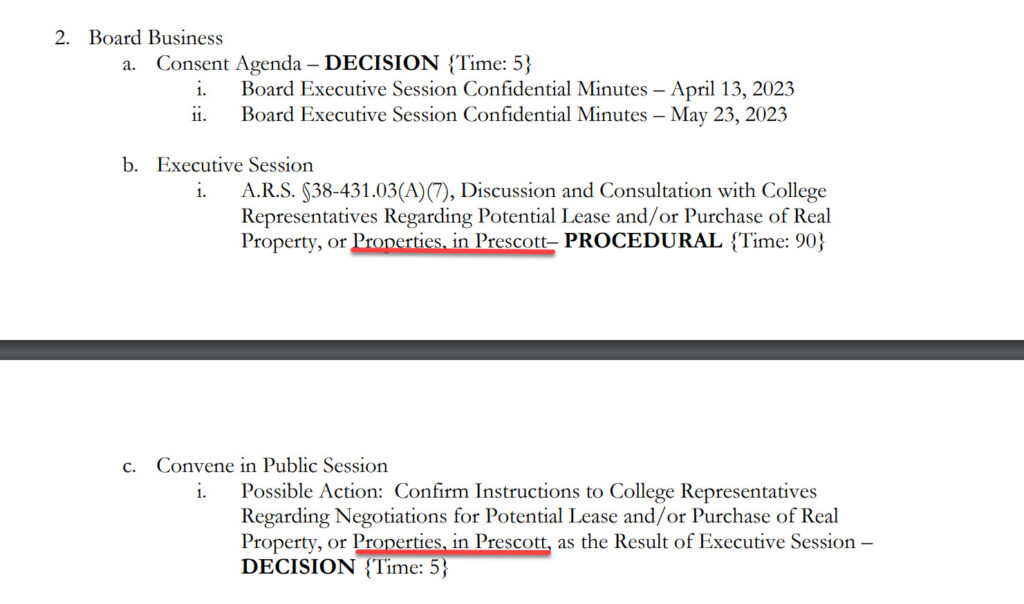
On June 8, 2023, the Yavapai Community College District Governing Board met in secret executive session to approve more land purchases on the west side of Mingus mountain.  The  additional land will continue the expansion of the footprint of the College on that side of the County.  An excerpt from the formal June 8 agenda, which appears below, shows both pieces of land as located in Prescott.

At the conclusion of the confidential executive session, two motions were presented. The first motion involved the acquisition of property located in Prescott to the “west of the airport.” Following a second to the motion, no further discussion took place that could have enlightened residents about the expenditure. The Board unanimously voted in favor of approving the motion. (See video clip by clicking here.) 

It is suspected that the aforementioned motion pertains to the expansion of the Career and Technical Education Center (CTEC) at the Prescott airport. It is worth recalling that executives from the Community College discreetly included a last-minute request for ten million dollars in the 2023-24 budget for a vaguely worded project at CTEC. Despite the substantial nature of this request, it proceeded through the budget process in May with minimal public discussion or explanation. Remarkably, the Board members failed to pose any meaningful public questions regarding it.

The second motion on June 8, presented after the secret meeting closed and the Board returned to the public, was focused on pursuing the purchase of property designated for “student housing,” according to a comment by Board Chair Deb McCasland made just before adjourning..  Once again, after a second to the motion, no discussion occurred among the Governing Board, and the vote on the motion was unanimous. (See video clip by clicking here.)   

Unfortunately, during the public portion of the June 8 meeting, no questions were raised, depriving the public of the opportunity to gain insight and clarification about the purchases from their elected representatives. Consequently, community members are left to engage in speculation concerning the amount of taxpayer funds being allocated to these projects and whether there exists any substantiating data to support such expenditures. The lack of transparency in this regard leaves the public in a state of uncertainty and unable to make informed judgments regarding the use of their tax dollars.

A  notable observation is that these land acquisitions were not clearly deliberated upon during the public budget hearing held in May. This omission raises concerns about the transparency and inclusiveness of the budgetary process. The absence of any discussion or mention of these specific purchases during the public forum further fuels the public’s curiosity and skepticism regarding the decision-making behind these expenditures. It highlights the need for greater accountability and disclosure to ensure that the public’s voice is heard and that their concerns are adequately addressed in matters of budget allocation.

Categories : ADMINISTRATION, Housing

COLLEGE SAYS THE MONEY FOR TEN ADJUNCT FACULTY ON THE VERDE VALLEY CAMPUS WAS MOVED OUT “TO OTHER SCHOOLS” BUT WERE THOSE SCHOOLS ON THE VERDE VALLEY CAMPUS?

By R. Oliphant
Friday, June 16th, 2023

Vice President Clint Ewell comments on moving funds during  June 2, 2023, interview with Sedona Red Rock News; question remains what was meant by the use of  “to other schools”

Due to its strict operational confidentiality policy, determining the exact allocation and utilization of the funds for the 10.6 adjunct positions that were removed from the budget of Yavapai Community College’s Verde Campus in the 2023-2024 fiscal year, and purportedly reassigned to “other schools,” has posed significant challenges. However, the Blog has managed to uncover some information thus far.


Dr. Clint Ewell, Vice President of Finance and Administrative Services, addressed the issue of reduced teaching staff at the Verde Campus during an interview with the Sedona Red Rock News. The newspaper’s front-page article on June 2, 2023, which discussed the increase in property tax rates, featured Dr. Ewell’s explanation.

As a reminder, the Blog initially disclosed in its April 21, 2023, post the perception that a significant reduction of 10.6 teaching staff positions at the Verde Valley Campus was evident in the College’s 2023-2024 budget, based on a public discussion between Dr. Ewell and Community College Governing Board member Ray Sigafoos.

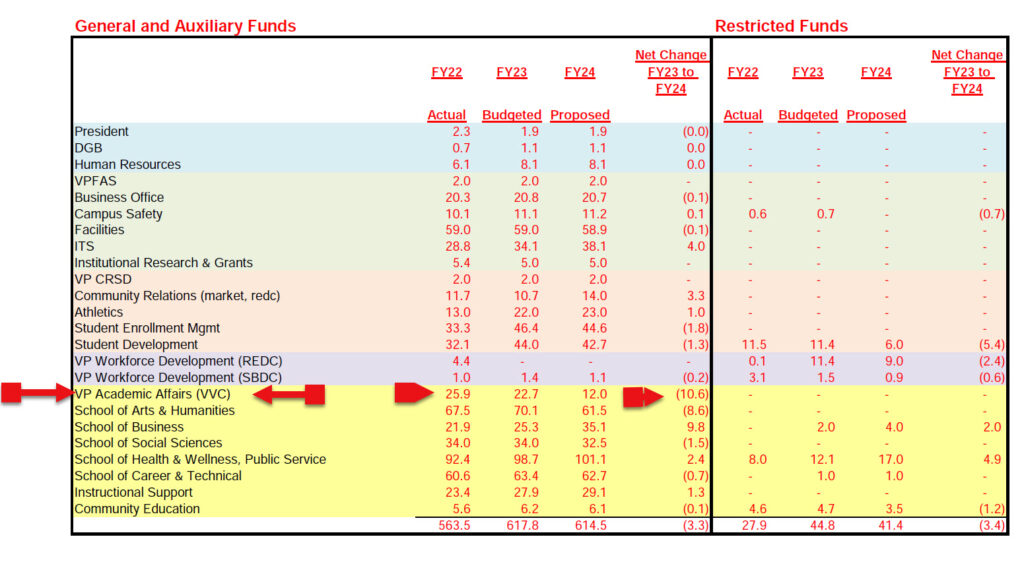
The issue was brought up during the April 11 Governing Board meeting in a discussion between Ewell and Governing Board member Ray Sigafoos. Sigafoos sought clarification regarding a reduction that seemed to be indicated by a chart provided by the College (refer to the chart below). Based on the discussion, many observers came to the consensus that it was reasonable to assume that 10.6 positions had been eliminated at the Verde Campus. (Click here to view that discussion.)

However, in response to the Blog story concerning the reduction, Dr. Lisa Rhine made an effort to address any potential misunderstandings. During the District Governing Board and Tax and Budget hearing on May 16, 2023, she provided a brief statement emphasizing that there had been no reduction in faculty at the Verde Campus. Dr. Rhine clarified that the funds were instead transferred to the budget allocated for the dean or deans. (Click here to see the video clip of Dr. Rhine making this statement.)

In a recent article published on June 2, 2023, in the Sedona Red Rock News, Dr. Ewell provided his explanation regarding the 10.6 adjunct faculty reductions. He is quoted as follows:

“We had budgeted  for some adjunct faculty  in the vice president of academic affairs, which also includes Verde Valley campus administration.  What we decided to do is move some of the adjunct faculty budget out to the different schools within the college, where the assets are actually being used.  When you look at that table and our budget, it looks like vice president of academic affairs, the number of positions went down 10.  But in reality, those 10 positions were simply moved to other schools within academic affairs.” 

Despite the provided explanations, some lingering questions remain. Firstly, it is unclear how many adjunct faculty were teaching on the Verde Campus in 2021 and 2022, and whether that number has decreased. Secondly, when Dr. Ewell mentions moving funds to “other schools,” it is uncertain whether he is referring to schools located specifically on the Verde Campus or elsewhere. Thirdly, upon careful examination of the table that supposedly demonstrates a reduction of 10.6 adjunct positions on the Verde Campus, it also indicates that 9.8 positions were added to the school of business, 2.4 to the school of health and wellness, and 1.3 to instructional support (resulting in a sum of 9.8 + 2.4 + 1.3 = 13.5). Furthermore, the table suggests an overall reduction of 21.5 positions across various schools (10.6 + 8.6 + 1.5 + 0.7 + 0.1 = 21.5). However, with the increase in some schools and reduction in others, this would seemingly leave a net reduction of eight positions overall (21.5 – 13.5 = 8). Please refer to the table below, highlighting the schools and Verde Campus in yellow.

It seems doubtful that residents of the County will ever obtain the complete story behind this fund reallocation. 

Categories : ADMINISTRATION

TINY YAVAPAI COMMUNITY COLLEGE RV PAD WILL HAVE TO MEET STATE AND LOCAL REGULATIONS IN ORDER TO OPERATE

By R. Oliphant
Wednesday, June 14th, 2023

Water and sewer connections will add to cost of construction on Verde Valley Campus

Yavapai Community College’s tiny 10 pad RV park will have to invest a considerable amount of money into providing sewer and water.  It will also have to meet Clarkdale’s general and specific regulations regarding its operation. 

Here are a few of the general regulations the RV park is expected to meet:

RVs must be properly licensed and registered with the Arizona Department of Transportation.

RVs must be hooked up to a sewer system and have a working water supply.

RVs must be hooked up to a sewer system and have a working water supply.

RVs cannot be used as a permanent residence.

Here are a few of the specific regulations regarding operating an RV park the pad is expected to meet:

      • Water and sewer: RV parks must be connected to a public water and sewer system. If a public water and sewer system is not available, the RV park must have its own water and sewer system that meets all applicable standards. (Note. Cottonwood’s sewer system is adjacent the College.)
      • Electricity: RV parks must be connected to a public electric system. If a public electric system is not available, the RV park must have its own electric system that meets all applicable standards.
      • Fire safety: RV parks must meet all applicable fire safety standards. This includes having fire hydrants, sprinkler systems, and fire alarms.
      • Waste disposal: RV parks must have a system for disposing of waste water and sewage. This system must meet all applicable standards.
      • Parking: RV parks must provide adequate parking for all guests.
      • Maintenance: RV parks must be maintained in a clean and sanitary condition.


Categories : RV PARK ON VERDE CAMPUS

TINY 200 SQUARE FOOT HOMES TO BE PLACED ON CHINO VALLEY CENTER TO HOUSE EMPLOYEES AND STUDENTS

By R. Oliphant
Saturday, June 10th, 2023

Houses built by students at the Verde Valley Campus will be transported to Chino Valley Center where it is anticipated they will have water, electrical and sewer hookups

With Yavapai Community College’s executives maintaining a high level of secrecy regarding their operations, the residents of Yavapai County and the College’s District Governing Board are left with limited information about the College’s plans and actions. Therefore, the announcement of the tiny house project during the May 16 District Governing Board meeting came as a surprise to most people.

While the available information is limited, it seems that according to the gathered information, the current plan of the College is to relocate three student-built tiny homes from the Verde Campus carpenter shop to the Chino Valley Center. These tiny homes, with an area of 200 square feet, will be made available for rent to employees at a monthly rate of $700, which includes utilities. In the event that employees do not rent them, the houses will be offered to students.

The May 16 Governing Board meeting briefly mentioned the project, but the majority of detailed information about the tiny house project became public knowledge through a news story aired on Phoenix TV Channel 3 on May 31. During the report, journalist Casey Torres provided additional details, stating that the tiny homes would be 200 square feet in size and constructed by students. Torres also mentioned that the rental cost for these houses would be $700.00 per month, inclusive of utilities.

During an interview with Channel 3 on May 31 regarding the project, Clint Ewell, the Vice President of Finance and Administrative Services, appeared to prioritize the needs of students over employees. Ewell emphasized that there are students who wish to enroll at Yavapai Community College but face challenges due to the lack of affordable housing options available to them.

Channel 3 also reported that the Community College’s goal is to have at least three tiny homes for rent at the Chino Valley Center by the spring 2024 semester.

Although not clear, it appears the three tiny houses will join three 3D cement printed houses that may eventually be completed at the Chino Valley Center.  So far though, after expending hundreds of thousands of dollars on the 3D home printing project over the past several years, the College has yet to produce one fully completed 3D house at the Chino Valley Center.  It is still working on the first one.

Yavapai Community College’s annual budget does not clearly indicate the estimated cost of the tiny house  project.

You may view a clip of the report by Ms. Torres by clicking here.  

Categories : Housing

AS ANTICIPATED, YAVAPAI COMMUNITY COLLEGE CUTS DEAL WITH PRESCOTT VALLEY’S FAIN SIGNATURE GROUP TO RENT APARTMENTS FOR VERDE CAMPUS/SEDONA CENTER STUDENTS AND EMPLOYEES AT COMPLEX NOW UNDER CONSTRUCTION ADJACENT HIGHWAY 89A IN COTTONWOOD

By R. Oliphant
Friday, June 9th, 2023

The College released few details about numbers of apartments it anticipates leasing and subsidizing or the amount of the subsidy in its June 8, 2023, press release. The background and history of the Government subsidized 192 apartment mostly HUD financed project, which was first approved in April 2018 by Cottonwood’s City Council, has been added to this story by the Blog 

On June 8, 2023, Yavapai Community College announced it had partnered with Prescott Valley’s Fain Signature Group to rent apartments for Verde Campus/Sedona Center students and employees at a complex now under construction adjacent Highway 89A in Cottonwood.  The College released no other details regarding the number of apartments it anticipates leasing or any estimate of the amount of subsidy it would provide for those who leased them.

In the College’s press release, Brad Fain, CEO of the Fain Signature Group, was quoted as follows:  “We are excited to work with Yavapai College to design housing options for our educational institutions, their employees and students. The college and its leadership have been immensely helpful in helping us understand their challenges and how we can work together to find attainable housing solutions. The college’s collaboration in this regard will benefit all employers in the region as we begin to collaborate with industry, trades, first responders, medical professionals, as well as cities and towns to create solutions that makes sense for our communities, residents, and environment.  We are also grateful to have strong partners in the City of Cottonwood, Arizona. At every turn and every challenge, the City of Cottonwood has worked with us to find solutions to help bring housing to their community.”

Yavapai Community College President, Dr. Lisa Rhine, was also quoted in the press release. She said that “the housing availability and affordability situation in our county has reached a point where Yavapai College is losing valuable faculty, staff, and prospective students. YC will continue to identify and invest in solutions for this issue. We are thankful for the Fain Signature Group’s vision and willingness to partner with the College to create solutions.ai College. The Inspiration Apartments in Cottonwood will provide another housing option for employees and students who work at or wish to attend the College’s Verde Valley Campus or Sedona Center.”

The Blog has researched the history of the project, including funding, which appears directly below.

The idea of building an apartment complex on land adjacent highway 89A only a block or so from the Northern Arizona Health Center in Cottonwood began in April 2018. That month  the Cottonwood City Council unanimously approved a plan to rezone 9.01 acres of land situated adjacent State Route 89A from Commercial and Industrial to Planned Area Development. The Council approval allowed for the construction of a new housing development, which was called “Inspiration.”

There were initial problems  in getting the project going because of  COVID and obtaining approval from the Federal Government for funding from the Housing and Urban Development agency.  The builder, Sedona developer Bob Porter, needed a substantial amount of federal loan assistance to support construction. After struggling with HUD and COVID delays,  Mr. Porter resubmitted his development plan and partnered with the  Fain Signature Group in Prescott Valley, to begin the project. The Fain Group  had  completed a project using similar HUD funding on the west side of Mingus Mountain.

The project got underway almost three years after the area was rezoned when a groundbreaking ceremony was held in Cottonwood  on December 7, 2021. Initially it was hoped the first apartments would be ready by the spring of 2022.  However, as of June 1, 2023, the complex remains under construction and the occupancy date as yet is uncertain.  At least one set of apartments in the complex appear from the outside as nearing completion and the developer says he hopes to have occupancy of some of the apartments by July 1, 2023.

The planned development is currently described as featuring 192 units, all for lease, ranging from 694-square-foot one-bedroom apartments to 1,181-square-foot three-bedroom apartments, with the most common size being two-bedroom units. There will be garages in some of the units, and each unit will have its own balcony.

Prices for the apartments are advertised as ranging from $1,575 to $2,235.

The apartments are described as “workforce” housing.  Porter has told the local media that  the housing development is “affordable, but not in the way of capital `A’ affordable.” Porter hopes to keep prices down to make the units usable for working and middle-class tenants. He has said that the project is not classified as Affordable Housing in the official way used by the U.S. Department of Housing and Urban Development, which has strict regulations on certain housing for rental to low-income tenants.

“It’s affordable, but no tests, no subsidies,” Porter said in interviews last year.

According to local media, Porter is receiving millions in assistance from the Federal Housing and Urban Development agency (HUD). The press has reported he is receiving a 221(d)(4) loan from HUD for $37 million, representing 82% of the cost of the $45 million project.

Based on Blog research, Section 221(d)(4) is a federal program that refers to a specific provision of the United States Housing and Urban Development (HUD) Act of 1968. This section pertains to the mortgage insurance program administered by the Federal Housing Administration (FHA) under HUD.

In general, HUD insures lenders against loss on mortgages for the construction or substantial rehabilitation of multifamily properties with at least five units. The properties can be market rate, low-to-moderate income, subsidized, or single-room occupancy (SRO) housing. The loans are interest only during the construction period and have a fixed rate. The program has eligibility criteria for the properties, the borrowers, the contractors, and the third party reports. The program also requires adherence to prevailing wage standards, annual audit of operations, and limitations on commercial use and occupancy.

Porter has said that dealing with HUD added to the delays in the project. “In late 2018 and early 2019,” he said, “before we could make our final HUD submittal, we had to do quite a bit of ‘value engineering’ to reduce costs. That entire process added four to six months to our schedule. When we finally received our initial HUD approval in the spring of 2019, we were approved at a 4.65% interest rate, and interest rates were dropping sharply. So, we made the decision to resubmit to HUD in order to achieve a lower interest rate, which we were ultimately successful in doing.”

In an interview with Verde Independent reporter Vyto Starinskas published June 11,  2023, Vice President of Finance and Administrative Services  Clint Ewell provided the following additional information:    The Community College will rent 10 units, five 2-bedroom and five 3-bedroom apartments.  “We plan to sublet these apartments to our employees, and will offer them to YC students if there is not enough employee demand.”

Ewell also said the Community College is concerned about the lack of attainable housing for the workforce near the median-salary range. “We are exploring many options and would be happy to discuss possible long-term public servant housing solutions with city and town leaders,” he is quoted as saying. “We are especially concerned about public servants including college employees, K-12 teachers, firefighters, police, health care providers, etc..” 

Categories : Housing

AT OCTOBER 2022 BOARD MEETING, FORMER THIRD DISTRICT REP PAUL CHEVALIER OPPOSED USING AN RV PARK FOR EMPLOYEE LIVING QUARTERS ON VERDE CAMPUS; BOARD CHAIR MCCASLAND APPROVED OF THE IDEA; CHEVALIER’ CONCERNED IT WOULD LOWER THE QUALITY OF THE LOOK OF THE CAMPUS

By R. Oliphant
Thursday, June 8th, 2023

Chevalier’s view, in whose district the campus resides, did not prevail

What kind of RV will the College purchase?

The Yavapai Community College District Governing Board held a general discussion about housing  employees at its October 18, 2022 meeting.  During the meeting, it became clear that Third District Representative Paul Chevalier opposed using recreational vehicles for employees and possibly student housing on the Verde Valley Campus.  Board Chair, Deb McCasland, fully supported the idea.

Doubtful College will purchase an RV like this.

Chavlier evinced a concern that using RVs for housing stating that in his opinion they would “lower the quality of the look of the campus. So I would be opposed to RVs.” 

Chair Deb McCasland said “the idea of RV pads is excellent.  Because all we’re investing in is cement and utilities.” 

Vice President of Finance and Administrative Services Clint Ewell said at the meeting that an RV park is “fairly affordable in the scheme of things.  But you have to have an RV.”  However, subsequently the College announced it would purchase four RVs for the park and rent them out at $500 a month while leaving six spots open for RV owners.

Obviously, Third District Representative Chevalier’s view, in whose district the Verde Valley Campus is located,  did not persuade the College executives.

You may view a view clip of the exchange at the October meeting by clicking here.

Categories : RV PARK ON VERDE CAMPUS

PLANS FOR TINY RV PARK FOR EMPLOYEES (AND POSSIBLY STUDENTS) ON VERDE CAMPUS SLOWLY LEAKING OUT

By R. Oliphant
Thursday, June 8th, 2023

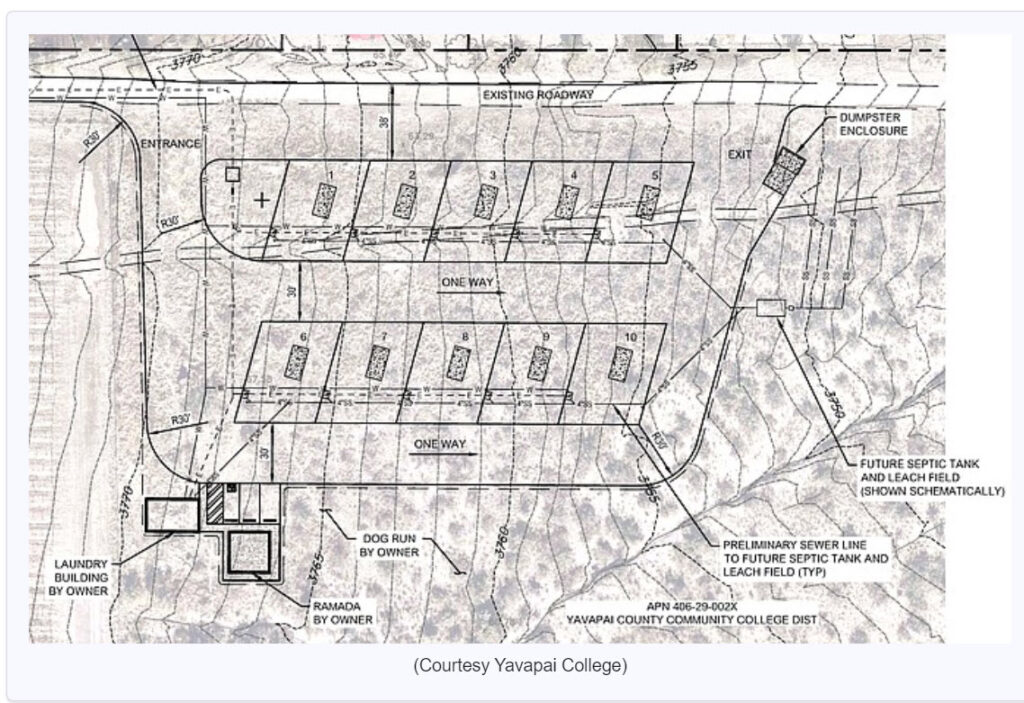
Will have electrical hookups, laundry, dog run; sewer system will consist of  two large septic systems with leach fields draining into  the land adjacent the park (although Cottonwood sewer system borders College); rental of RVs to be purchased by College said to be set at $500 a month

Gathering precise details about the employee (student) RV park at Yavapai Community College is a formidable task due to the institution’s deliberate approach of maintaining a tight lid of confidentiality regarding its internal operations. Nonetheless, as information gradually surfaces from various sources, a more comprehensive understanding of the project is beginning to take shape. Here is what the Blog has found out about the project so far.

First, Yavapai Community College announced on May 17, 2023, through a press release, its decision to construct a 10-space Recreational Vehicle Park on the Verde Valley Campus. According to the press release, the College aims to purchase four RV units and initially offer them for rent to employees. Additionally, the remaining six pads will be exclusively reserved employees  who already possess their own RVs. If all ten spots are not filled by employees, it appears they will then be available to students.

The press release listed some of the amenities that the RV park will provide, including a patio area,  gazebo, and a dedicated dog run. Unfortunately, access to the park will be facilitated by a gravel road, deviating from the conventional asphalt pathways typically found in such settings. It is worth mentioning that the gravel road may be shared, at least partially, with homeowners living adjacent to the facility.

Second, in an article dated May 17, 2023, which  appeared in the Verde Independent,  the College revealed the facility would have  an onsite laundry facility. The Independent also reported the RV park  would have electrical hookups and a sewer system. 

According to the information shared by the Community College with the Verde Independent, it appears that the decision has been made to forgo the connection of the RV park’s sewer system to the neighboring Cottonwood (or Clarkdale) sewer system. It would be costly. The article in the newspaper, accompanied by a diagram provided by the College, reveals that the sewer infrastructure for the park will involve the use of two large septic tanks. These tanks will be supported by two leach fields, allowing for draining sewage into the field situated behind the park. (See sketch above.)

Third, and finally, on May 31, 2023, in a story carried on  Channel 3 News, Phoenix, reporter Casey Torres reported the College will rent the RVs on the Verde Campus for $500 a month for “RV owners.” 

It is noteworthy to observe that during his interview with Channel 3 News about the RV park and tiny house projects, Yavapai Community College Vice President of Finance and Administrative Services, Dr. Ewell, appeared to emphasize the projects as being aimed at  students rather than employees. (Make you own judgment by viewing the clip by clicking here.)  

All three news stories agreed that the RV park is intended to be completed by the fall 2023 semester.

The College has not indicated in any of its budgets the estimated total cost of constructing the RV park on the Verde Valley Campus. There is no explanation for the reason it is not hooking its sewer system either to the Clarkdale sewer system or Cottonwood sewer system. Speculation is that cost is a factor.

Sources:  Yavapai Community College press release:  (Click here to view video clip.)
Verde Independent newspaper: (Click here to view video clip.)  
Channel 3 Phoenix news: (Click here to view video clip.)
Categories : RV PARK ON VERDE CAMPUS

YAVAPAI COMMUNITY COLLEGE’S REDC OFFERS FREE COURSES WITH SIGNIFICANT FUNDS TO SUPPORT THOSE ATTENDING FROM THROUGHOUT THE COUNTY

By R. Oliphant
Friday, June 2nd, 2023

Funds are provided as part of the Workforce Innovation and Opportunity Act

Yavapai Community College announced in a June 1, 2023 press release that the Regional Economic Development Center has received funding from a federal grant that provides free course  certificates and support for those attending the programs.  The Community College press release authored by Tim Diesch is set forth in full below.

TIM DIESCH 01 JUNE 2023

Starting June 1, 2023, the Regional Economic Development Center (REDC) at Yavapai College is offering a wide range of free certificates and support programs through its QUEST grant.

The REDC has secured funding to support qualified learners for needs related to travel, technology, childcare, tuition assistance, stipends for internships, and removing other barriers for dislocated workers.

To learn more and apply, go online to ycredc.com.

In September 2022, Arizona received a $15 million grant from the U.S. Department of Labor (DOL). The grant is part of the DOL’s QUEST Disaster Recovery Dislocated Worker Grant (DWG) program, and it was awarded to the Arizona Commerce Authority (ACA) in partnership with six Arizona community colleges, including Yavapai College.

Arizona’s statewide QUEST efforts will form a direct pipeline for workers in the industries of Healthcare, Information Technology (IT), and Manufacturing.

The REDC has pathways for qualified individuals to:

Take advantage of wraparound student support to make the process of earning certifications more attainable.

Earn industry-recognized certifications through Yavapai College.

Earn industry-recognized certifications through Coursera.

The grant is applicable to those who:

Have been temporarily or permanently laid off because of the COVID-19 pandemic disaster.

Have been unemployed long-term.

Are considered dislocated workers as defined by the Workforce Innovation and Opportunity Act Section 3(15).

The courses are meant to certify and support learners seeking a well-paying career in the IT field, with programs related to data engineering, analytics, cyber security, software development and engineering, digital sales, marketing, and more, with average annual salaries ranging from $50,000 to $200,000.

The REDC at Yavapai College is a resource center dedicated to building strong communities and increasing opportunities for local residents through economic development.

Yavapai College operates six campuses and centers throughout Yavapai County and offers over 100 degrees and certificates, a baccalaureate degree, student and community services, and cultural events and activities.

You may also view the press release by clicking here.

Categories : Regional Economic Development Ctr
« Previous Page
Next Page »

Topics

  • Academic awards
  • accreditation
  • ACT
  • ADMINISTRATION
  • Administrative College
  • Admnistrative turnover
  • Advisory Committees
  • Allegations
  • Allied Health Campus
  • Alumni
  • Arizona technical college
  • Art Gallery Event
  • Art programs
  • Asbestos
  • ASU
  • athletic camps & clinics
  • Athletics
  • Attorney fees
  • Audit
  • Aviation program
  • B.A. DEGREES
  • Baseball team
  • Basketball program
  • Basketball program
  • BEAVER CREEK
  • Beer projects
  • Black History Month
  • Bonds
  • Booklets
  • Budget
  • Bus service
  • Butterfly Garden
  • Camp Verde
  • Campaign 2018
  • Career and Technical Education
  • CARES GRANT
  • CARVER MODEL
  • Child Care
  • Chino Valley campus
  • CLOTHING STORE ON PRESCOTT CAMPUS
  • Coconino Community College
  • College for Kids
  • Commencement
  • Communication
  • Community College Citizen Advocates
  • Community colleges outside yavapai
  • COMMUNITY EDUCATION
  • COMMUNITY EVENT NOT PAC
  • Complaints
  • Construction
  • COTTONWOOD COMMUNITY SCHOOL
  • COVID 19
  • Crime
  • CTEC
  • Culinary Arts
  • Cultural Events for the Public
  • CURRICULUM
  • DAKA
  • Detention Academy
  • District Governing Board
  • DK RANCH
  • DOG CERTIFICATES
  • Dropout rate
  • Drug investigation
  • Dual enrollment
  • EARLY COLLEGE ACADEMY
  • Economic Development
  • Economic impact of College
  • Editorials/Essays
  • Educational material references
  • Election 2018
  • Election 2023
  • Embry-Riddle
  • EMPLOYMENT
  • Employment issues
  • Enrollment data
  • Event
  • Executive meetings
  • Faculty
  • Family Enrichment Center
  • FILM
  • Film School
  • Fire Academy
  • Fitness Center
  • Flight school
  • FOOD PANTRY
  • Food Service
  • Forum for Public Affairs
  • Foundation
  • Free speech
  • Fundraising events
  • GED
  • Gift of ranch
  • GOVERNING BOARD
  • Graduation
  • Grants
  • Greater Verde Valley Chapter
  • Health Science Building
  • Health Summit
  • History
  • Hotel Restaurant Management
  • Housing
  • Late class offerings
  • Lawsuits
  • LEAD program
  • Learning Centers
  • Lifelong learning
  • Loan repayment
  • manzanita
  • Maricopa Community College
  • Maricopa Community Colleges
  • marketing
  • Master documents
  • MASTER PLAN
  • Mayer High School
  • McCASLAND
  • Meeting Notice
  • Memorials
  • MENTAL HEALTH
  • METAVERSITY
  • Mingus Union High School
  • Mountain Institute
  • Movie
  • MULTI PURPOSE FIELD VERDE CAMPUS
  • Multi-use Field
  • Music
  • NARTA
  • Nature trail
  • New Courses
  • Newsletter
  • Non credit courses
  • Northern Arizona University
  • Nursing
  • OER
  • OLLI (Osher Lifelong Learning)
  • On line classes and accreditation
  • Open Meeting Law
  • OPINIONS
  • Paramedic
  • Performing Arts Center
  • Policy Governance Indoctrination
  • Policy Manual
  • Politics
  • Polling data
  • Population
  • POVERTY
  • Prescott Campus
  • PRESCOTT PINES CAMP
  • Prescott Valley Campus
  • PRINTER 3D
  • Prison program
  • Property purchase
  • Rad Tech
  • Rankings
  • Regional Economic Development Ctr
  • Residence halls
  • RV PARK ON VERDE CAMPUS
  • Salaries
  • Scholarships
  • Search Committee
  • Secret meetings
  • Sedona Arts Center
  • Sedona Campus
  • Sedona land settlement
  • Small Business Development
  • Small Business Development Center
  • Soccer team
  • Softball team
  • SOFTWARE UPGRADES
  • Solar projects
  • Southwest Wine Center
  • Sports in General
  • STAFF
  • Strategic Plan
  • Student achievements
  • Student Organizations
  • SUMMER CLASSES
  • Survey results
  • Surveys
  • Taxes
  • Ten year plan
  • Ten Year Plan Construction
  • Tennis Court
  • TINY HOME PROJECT
  • Trail
  • Transportation
  • Truth in advertising
  • Tuition
  • UNDERSERVED
  • Underserving the Verde Valley
  • Univ of Arizona
  • University of Arizona
  • VACTE
  • Verde Campus
  • Verde campus events
  • Verde Tech High School
  • Verde Valley Forum for Public Affairs
  • Veterans Administration
  • Video
  • Videotape
  • Virtual Reality
  • Viticulture
  • Vocational Education
  • Vocational training
  • Volleyball team
  • WAKE UP VERDE VALLEY BOOK ED 1
  • WAKE UP VERDE VALLEY FIRST EDITION
  • Waste
  • Web sites
  • Weight room
  • Wills salary
  • Wine Center
  • WORKFORCE DEVELOPMENT
  • World War I symposium
  • Yavapai Community College
  • Yavapai-Apache Nation