Image
  • Home
  • Contact

YAVAPAI COMMUNITY COLLEGE SAYS TUITION WILL BE WAIVED FOR ONE SEMESTER FOR STUDENTS ENROLLING IN CLASSES AT THE NEW CAREER AND TECHNICAL EDUCATION CENTER LOCATED ON THE VERDE CAMPUS

By R. Oliphant
Friday, June 25th, 2021

Tuition waiver covers all CTE classes for the entire fall semester, which begins August 16

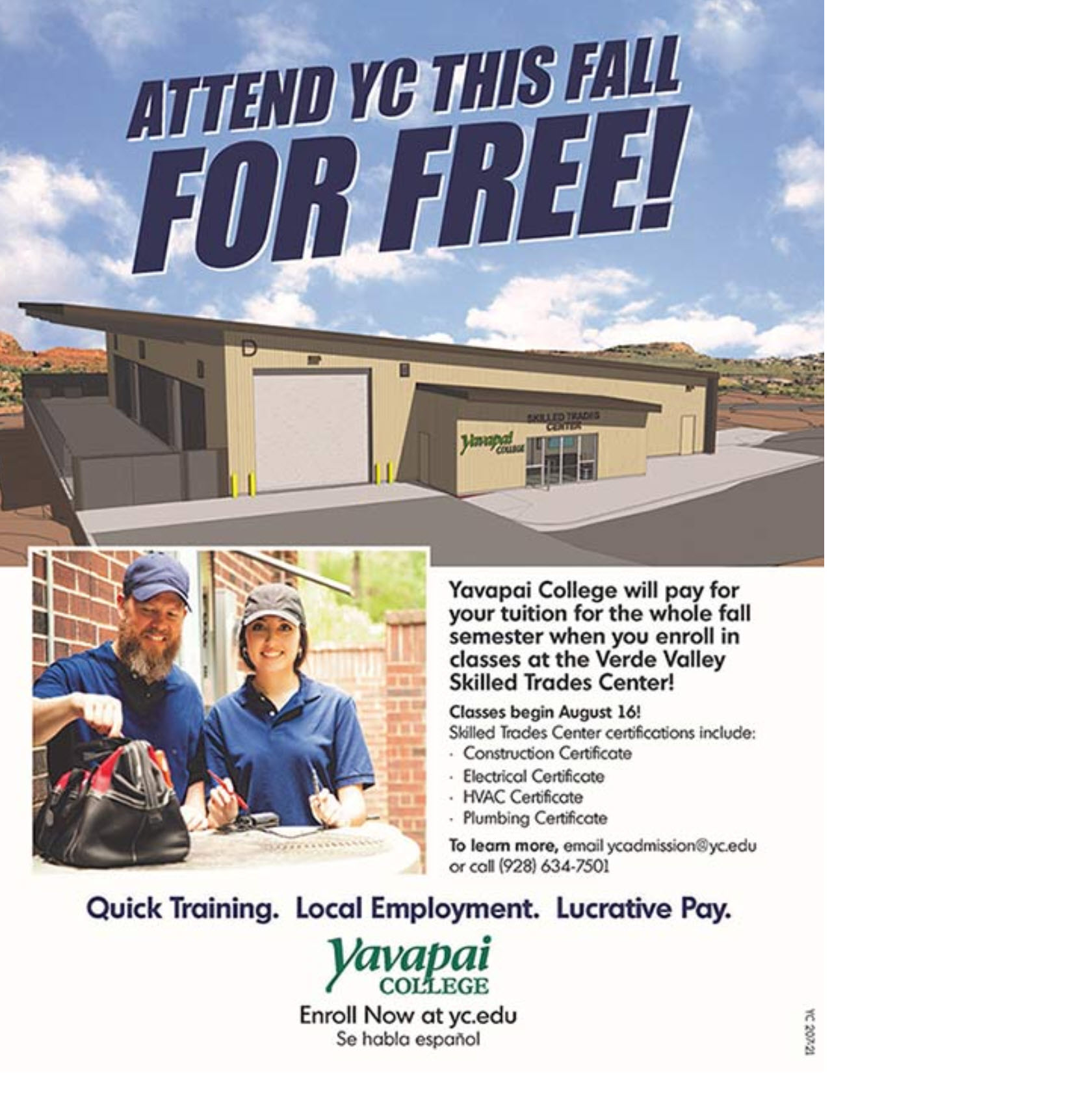
Yavapai Community College announced in a short press release on Wednesday, June 23 that it will waive fall semester tuition for all students enrolling in classes at the Verde Valley new Skilled Trade Center.  The 10,000 square foot Center is currently under construction but is expected to be ready by August.

The College has identified  four trade areas as crucial to the needs of  the Verde Valley and Yavapai County. They are:  Construction, Electrical, HVAC, and Plumbing.  Ironically, these are among the areas the Community College was going to provide training in back in 2004 when it opened its ambitious CTE program on the Verde Valley Campus in Building “L.”  The effort collapsed after 3-4 years following the College’s purchase in 2006-07 of the 108,000 square foot Ruger builder at the Prescott airport. This is where it located  the Career and Technical Education Center for the west side of the County. As that CTE program thrived, the Verde Valley CTE program withered.

The College promises  that the Verde Valley Skilled Trades Center, located on the Verde Campus,  will be a  state-of-the-art facility.  Students who take classes in the Skilled Trades Center will receive hands-on training in essential career and technical trade programs.

Certifications inside the new CTE center include:

  • Construction Certificate
  • Electrical Certificate (can be completed in two semesters)
  • HVAC Certificate (can be completed in two semesters)
  • Plumbing Certificate (can be completed in two semesters
Categories : Career and Technical Education

COMMUNITY COLLEGE FOCUSES ON ENSURING MOST PROGRAMS LEAD TO LIVING WAGE

By R. Oliphant
Thursday, June 24th, 2021

Goal: “Leave them better off than when they came to us”

Dr. Lisa Rhine

Yavapai Community College president Dr. Lisa Rhine addressed the College District Governing Board in June on concerns she has about courses and programs that might not lead to a living wage.  Furthermore,  she informed the Board that she is directing efforts at the College to ensure, as much as possible, that students who enroll at the College at don’t end up in a worse position when they leave the institution than they were when they entered.

 Dr. Rhine  addressed her  concern about  students who begin College but for a variety of reasons drop out and leave without a degree or certificate. However, they may be  left  with a student loan debt and a possible feeling of unworthiness.  She said the College had a “responsibility” to not let that happen.

She also addressed her concern with programs and courses that do not necessarily lead to a living wage.  She said she has linked  her business division with  some of those programs to encourage entrepreneurship.  For example, she envisions students taking  jewelry courses also learning how to successfully open their own jewelry shops.  Or those at the Culinary school in Sedona gaining the skills of a chef while  also  learning how to build a successful restaurant business..

You may view her presentation to the Governing Board at the June workshop on this topic below. 

Categories : ADMINISTRATION

WHAT YOU SEE WHEN YOU LOOK BACK TWENTY YEARS AT THE SEDONA CENTER ― FILM SCHOOL WAS SO SUCCESSFUL THAT COMMUNITY COLLEGE BEGAN SEEKING LAND TO EXPAND

By R. Oliphant
Saturday, June 19th, 2021

Considered adding up to  80 acres of Coconino National Forest land adjacent the Center; Zachary Gordon Independent film  program overflowing with  a two-year student waiting list; However, film school training collapses following  2011 dust up between Institute Director and Community College president over curriculum and control with Independent Film Institute fleeing to a private university

The Yavapai Community College Sedona Center had been open only one year when in June 2001 the Administration began looking to purchase up to 80 acres of land of the Coconino National Forest adjacent the Center. The purpose was to expand the facility to meet the unexpected huge number of students seeking admission to the Film Institute.

The Red Rock News of June 13, 2001 reported that when Keith Harwood of the special projects office of the Community College president’s office was interviewed about the lack of space to accommodate applicants to the film program, he said, “we’re bursting at the seams.  In the short term, we expected to have 100 in our Sedona multimedia program and we have 500.”  The 20,000 square foot Center had only six classrooms.

The Red Rock News also reported that the “success of film-making and other programs has shocked school officials.“  It indicated that the Administration was in the process of putting  together a report supporting its decision to seek the additional land. 

However, the Community College  never succeeded in its efforts to purchase additional land from the Forest Service.

The Sedona Center as a film school was a smashing success from 2000 to 2011.  Here is how Helen Stephenson, currently the  Managing Director, Yavapai College Performing Arts Center Operations & Director, YC Film & Media Arts Program, described the Sedona program in a December 2007 article in the Prescott News.

“People from Thailand, Japan, Brazil, Canada, England, and all over the U.S.” come to the school. Typically, “Half of the class is usually from out of state.” Hawkes says, students range in age from 17 to 65 years old. The older students bring great stories with them and the younger students generally have the advantage with technology. On the other hand he says that a person’s age in no way stands in the way of them learning the technology. “We’ve had people who’ve never turned on a computer but they’ve become the best editors we’ve ever had.” The one thing the students have in common is a passion to learn the latest technology in the digital filmmaking world and put that knowledge immediately into practice.”

The film school received national and international recognition and honors. It flourished. However, in the summer of 2011 the Community College administration and the  main supporter of the Zaki Gordon Institute for Film Making got into a very public “dust up.”  Following their strong disagreements, Mr. Dan Gordon, the president of the Institute,  moved the Institute out of the Sedona Center  to Liberty University in Lynchburg, Virginia.  Gordon charged in a subsequent newspaper editorial that:

“. . . [T]he current director of the school and the President of Yavapai College violated their contract with the Institute by unilaterally changing course content.

“As president of the Institute, I cancelled their right to use our name or our copyright-protected methodology and I ceased providing my services, which were offered gratis for twelve years, as lead instructor. The result speaks for itself. Their enrollment dropped 44 percent and the college is dropping the program. When you cut the heart and soul out of something, you cannot expect the body to survive.”

Many months later, during a radio interview on KAZM in Sedona, Dr. Penelope Wills provided the Community College’s side of the dispute with Dan Gordon. She said: “[H]e wanted to go ahead and evaluate faculty and run the entire program.  It was not a partnership. . . . the advisory committee was very upset with what he was dictating and he wasn’t working as a peer with that advisory (committee).”

The Community College Director of Marketing and Communications, Mike Lange, was quoted on August 9, 2012  in the Sedona RedRock News as  stating:  “The Yavapai College film program is continuing and is being enhanced. It is not being dissolved.” 

In December the College said it was “expanding [its] relationship with the renowned Sedona International Film Festival (SIFF) and planning for a special series of technical workshops during the 2013 Festival.”  It also stated that it had “launched a significant recruiting campaign and doubled its enrollment this year! In these tough economic times, that is a significant achievement. . . . The community truly banded together this past year to show support for the Film School and make a unanimous statement that ‘We love our film school’ and want to keep it in Sedona.’”

But the Community College film school without the Institute may have been  staggering to survive. Or, was it?  No one knows for certain given the public statements issued by the Community College regarding its bright future in Sedona and increased student enrollment.

Then the biggest surprise of ever came in  October 2013 on the Verde campus in Clarkdale. At a public meeting the administration, led by then president Dr. Penelope Wills, announced a new $103 million  ten-year capital development plan it had decided to implement pending Governing Board approval. (It was approved.)  Residents from Sedona and the Verde Valley were aghast as Dr.  Wills’ outlined to them the sudden  decision to close  the Film School by the end of 2014.  Wills’ said that  the Community College’s ten-year $103 million development plan (with over 95% dedicated to west county improvement) contemplated  closing the Sedona facility for good and putting it up for sale. Once the Sedona Center was shuttered and sold,  Wills  promised to lease other facilities in the area for OLLI and any other programs. 

Outrage from citizens in Sedona and throughout the Verde Valley was immediate and vocal.    After several months,  the Governing Board and Administration eventually backed away from the idea of selling the facility and leasing property for OLLI and any other programs it might develop.  However, by 2015 the Center had only two small courses and was being essentially closed down.

Under enormous pressure from the community, the Community College administrators and Governing Board decided to repurpose the Center into primarily a culinary school.  It would not continue as a film school.  After two years of renovation,  on August  21, 2017, the Sedona Center reopened for the  fall semester. It announced it would feature Culinary Arts Fundamentals certificate classes in two state-of-the-art teaching kitchens. The Center housed a Sedona Culinary Institute and offices for the OLLI program.

Today, the Culinary Institute and OLLI continue in the Sedona Center.  What a difference 20 years makes.

Sources:  Sedona Red Rock News, June 13, 2001, Vol 38, No. 77;  Sedona Red Rock News, June 16, 2021, p. 5A. Original research.
Categories : Film School

COMMUNITY COLLEGE FACES HISTORIC CHALLENGE IN DEVELOPING CTE ON VERDE VALLEY CAMPUS

By R. Oliphant
Saturday, June 19th, 2021

Valley residents believed  a major project started  20 years ago on the Verde Campus would provide world class CTE training to its residents and high school students; sadly, it  collapsed after about four years as CTE  training fled to the west side of County; can this happen again?  

 The following essay is about the efforts of Yavapai Community College to establish a major Career and Technical Education (CTE) program on the Verde Valley Campus on the east side of Yavapai County two decades ago.  The effort  would have a half-life of about four years before it was essentially swallowed up by the CTE interests on the west side of the County or otherwise abandoned.

― Verde Campus Regional Skills Center, Year 2000 —

An ambitious Verde Valley CTE effort was kicked off  over 20 years ago when Yavapai Community College teamed with the United States Department of Commerce to provide the funds to construct the Northern Arizona Regional Skills Center ( NARSC) on the Verde Campus in what became known as Building “L.”  Yavapai Community College invested approximately $1.3 million from the 2000 voter approved  $69.5 million Community College General Obligation Bond  into the CTE project while the federal government provided an additional $1.2 million.

As you might expect, back in 2000 Verde Valley  residents were excited at the prospects  NARSC portended.  They envisioned  NARSC as  bringing badly needed  enhanced Community College  CTE  learning opportunities to high school students and residents throughout  much of Northern Arizona.

Faculty on the Verde Campus were likewise excited as the prospect of NARSC and its future development.   For example, Professor Paul Kessel, the chief operational officer for the Verde Campus at the time, when interviewed in 2002 about the Northern Arizona Regional Skills Center,  said this:   

“[T]he (Center) will provide much-needed educational space and resources to further develop job training programs to benefit residents of northern Arizona. This is an exciting and unique opportunity for northern Arizona residents to gain specific work related skills that will allow citizens to seek immediate employment or increase their level of income in a current or new position.” (Daily Courier, December 11, 2002.)

According to interviews given to the local media, the Community College was committed to developing an extensive  CTE curriculum that, at least in part, would be based on recommendations from business owners in Northern Arizona who sought  training for existing and future employees. The College announced that it had already identified a number of programs that were in the developmental stage. The programs,  so far, according to the College,  included the following:

  • Nursing Assistant
  • Direct Patient Care Provider
  • Medical Assistant- Front and Back Office
  • General Office, Customer Service, Receptionist
  • General Accounting, Receivable, Payable and Payroll
  • Computer Repair
  • Facilities Maintenance-Plumbing, Carpentry, Electrical, Grounds keeping, Air Conditioning
  • Automotive Technician
  • Welding
  • Heating, Ventilation, Air Conditioning, Refrigeration
  • Cottage Industry and Small Business Operations
  • Commercial Drivers’ License Training, Truck Driving, Bus Driving.

Harry Swanson, General Manager of the newly created Center, said that the basic vision for the Center was to provide opportunities for jobs paying livable wages that were already   available in Northern Arizona. The Center would also  identify new job opportunities in areas  such as in higher technology and provide upgrade job-skills training. Swanson  said the  Center intends to improve skills training for the jobs that are already here saying “we’re going to get more involved in the building and construction trades.” Bugle, February 11, 2004, http://cvbugle.com/news/2004/feb/11/ college-dedicates-job-skills-center/ (last visited November 2016).

“This skill center is part of the master plan project of Yavapai College,” Swanson said.

“Part of that plan is to provide education and training to a broad-based population in  Northern  Arizona,  especially  in  Yavapai,  Coconino, Navajo and Apache counties. The bottom line of the project is to help rural Arizonans find good jobs.” Bugle, February 11, 2004, http://cvbugle.com/news/2004/feb/11/ college-dedicates-job-skills-center/ (last visited November 2016).

In February 2004, the Northern Arizona Regional Skills Center on the Verde Campus was dedicated as Building “L.” The Comprehensive Annual Financial Report published and distributed by the College on June 30, 2004, summarized the progress of the Center. It reads as follows:

The construction of the new 15,000 square foot Northern Arizona Regional Skill Center on the Verde Valley Campus was completed this year. The building was formally dedicated at the February 2004 District Governing Board meeting. Programs at the Center will focus on six key areas – business and office technology, basic health-related occupations, construction and building maintenance, hospitality and tourism, information technology management, and manufacturing/engineering technology. The new Center will serve the workforce training needs of residents living in Apache, Coconino, Navajo, and Yavapai counties. Partial funding for the Center was provided by the U.S. Department of Commerce – Economic Development Administration. Construction continued on the Academic Resource Center on the Verde Valley Campus.

― Verde Campus CTE Collapses; West side invests heavily in creating CTE Center —

It was only  after a little more than  three years of operation, that the concept of the Northern Arizona Regional Skills Center began to fade  into the Community College background.  By 2008 the Center as originally envisioned appeared to have  all but disappeared.  What happened?

Although some will attribute the collapse and failure of the CTE effort to an inability to attract students, the main reason may be that the Community College Administration and Governing Board became so enamored with creating a large CTE project funded in part by the Phelps-Dodge corporation on the west side of the County in 2006-2007 that they lost focus and any real interest in putting in the hard work and vast amount of time needed to properly develop  the east side  CTE center.

 Back in 2006,  the College Administration and the  Phelps-Dodge corporation  (later Freeport-McMoRan Copper & Gold), a Phoenix-based global mining company,  began to meet and discuss  a   handsome proposal coming from the company. 

 The company  made it known that it wanted  a training program for  its workers operating its huge diesel equipment in Arizona. The proposal it made to the Community College involved, among other things, setting up a  two-year College apprenticeship program in diesel, industrial and electrical mechanics. The Phelps-Dodge proposal also came with a promise of substantial funding  to support the training. 

In return for the College setting up the training programs it needed, Phelps-Dodge agreed to build classrooms and pay faculty salaries for the first three years of the program.  Material contained in the February  2007 Community College District Governing Board Agenda outlines what the Administration  anticipated Phelps-Dodge would contribute  to the training program  from 2006 to 2008. The figure was $717,000. There was also an indication that Phelps-Dodge might provide more than  $300,000 in 2007-08 for Community College operations.

When the talks with Phelps-Dodge began, the College Administration could have chosen to attempt to persuade the company  to place this well-funded program on the Verde Campus as a part of  the fledgling Northern Arizona Regional program.  The nature and extent of the early discussions between Phelps-Dodge and the Community College are not recorded anywhere. However, some suspect that  east County selfish opportunism raised its head and may  explain why the Phelps-Dodge proposal failed to  make it to the east side of the County.   

Once the Phelps-Dodge offer was in firmly in hand, with Governing Board approval, Community College administrators began scouring the west side  of the County seeking a  facility where a CTE Community College Center could be developed to meet the Phelps-Dodge needs.

In their quest for a  new CTE facility, the College Administrators came across  a large building at the Prescott airport for sale by the Ruger corporation. Despite its huge size and the fact there were few programs ready to occupy the space, the Administrators  decided  this  would be a perfect site for a CTE Community College Center and recommended its purchase to the Community College District  Governing Board.  The Board  approved the Administration’s proposal enthusiastically.

 A funding scheme to purchase the building from Ruger was quickly arranged by the Governing Board.  In April 2007, the College purchased the 108,000 square foot building under a lease purchase financing scheme for $5 million. An additional $750,000.00 was added for future renovations. (Recall the Northern Arizona Regional Skills Center was only 15,000 square feet.)

The materials in the District Governing Board Agendas for February and May 2007, describe how the purchase of the building at the Prescott airport would be financed. The District Governing Board formally approved a lease-purchase financing agreement for the acquisition of the building “to expand occupational and technical career programs for our citizens.” The lease/purchase agreement indicated that an annual payment would continue until the lease/purchase agreement was fulfilled. The new Career and Technical Educational Center (CTEC) on the west side of Yavapai County was born and set to become fully operational in time for the fall 2007 semester.
― Impact of decision on high school CTE training in the County —

The decision to create a CTE center on the west side of the County in 2006-07 had a devastating impact on CTE training for residents and high school students on the east side of the County. While the west side set a goal of  providing the very best CTE training opportunities for west-side residents and high school students, the east side program collapsed.  With the Phelps-Dodge initial impetus, the District Governing Board and  Community College Foundation began to annually invest ever increasingly large sums of money for  faculty, facilities, and equipment  into west side CTE development.  Simultaneously, they turned  a blind eye to the similar CTE educational needs of residents and high school students on  the east side of the County.

The result is that for more than a decade, east side residents and   high school students have been  denied  reasonable  access to enhanced  Community College CTE training opportunities that were only reasonably available and enjoyed by residents and  high school students on the west side of the County.

Once the east side CTE NARSC project collapsed, Building “L,” which was originally intended as the center for the hoped for CTE program,  was renovated and repurposed but always with an eye to keeping some CTE in it to comply with the original federal grant request.  During the past  two years (2019 – 2021)  the Community College and the District Governing Board began to somewhat grudgingly, some might say,  turn  their attention back to the widespread  lack of CTE Community College training opportunities on the east side of the County. Building “L” was completely renovated at a cost of several million dollars in 2019 and is now intended  primarily for nursing training with some space allocated for CTE training.  A small 10,000 square foot structure dedicated to CTE training is being constructed and will open in the fall of 2021. 

For comparison’s sake, recall that the west side purchased a 108,000 square foot vacant  building to establish its CTE training.  Since its purchase, the west side has worked diligently and  successfully to eventually fill the space.  Given the approach to the  east side CTE by the Community College, the east side will most likely have to work much harder to meet future expansion needs when exciting new programs become available. Most likely, there will be little available space to expand in a 10,000 square foot building. It offers a programmatic expansion scheme much different that the one presented to the west side when it purchased the  108,000 foot building for its center.   

― West side ensures a future supply of high school students —

There is another aspect to the development of CTE on the west side of the County that should not be overlooked.  That is developing a goal of providing an annual flow of high school students to the west County CTE facility to help supplement normal college enrollment.  This is how the west side accomplished this.

While the Community College Governing Board was nailing down the details for the CTE project for  the west side of the County in 2006-07, it was also searching  for ways to ensure its future success.  Politically, the West side of the County was savvy and to some extent, lucky .  Politicos understood the value of linking  arms in a cooperative CTE effort with all the high schools on the west  side of the County.  Back in 2006  a high school vocational training district called a “Joint Technical Education District” (JTED)  did not exist on the west side of the County. However, one had been  approved around 2000 on the east side of the County.  (Once approved, a JTED received state funding for high school CTE training, among other things.) 

Luckily for the Community College, voters on the West side of the County were to decide in a 2007 election whether a JTED  should be created.  If voters approved the JTED district, it would  encompass all the west county high schools. If the Community College played its political cards right, there would be a potential  future supply of high school students to supplement college students and County residents at the west side CTE center.

The advantage the Community College had in this scheme is that it had more money to invest in sophisticated CTE training equipment than did a single high school.  It could in fact reduce the costs associated with purchasing the expensive equipment by ensuring enrollment of students in its programs from high schools on the west side of the County in addition to its own students.  It also had the advantage of being able to raise the property tax rate annually by a simple majority vote of its Governing Board. 

The Community College District Governing Board obviously recognized  the future opportunity presented by a west County JTED and jumped in politically to support it. At the February 2007 District Governing Board meeting, the need for a West County JTED was placed on the agenda for discussion. This is also the meeting where the new CTE Center  at the Prescott airport was approved. The idea of a West County JTED received accolades from the District Governing Board. In fact, the Board was so excited at the potential of a West County JTED it adopted Resolution #2007-02 encouraging its development. The Board Resolution made the political case for a West side JTED.

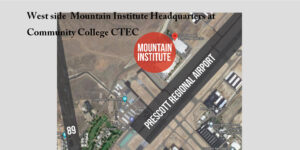
The JTED was approved by west County voters.  The relationship between the Community College and the West side JTED blossomed and was solidified at the October 8, 2009, District Governing Board meeting. At that meeting, the Board unanimously and no doubt enthusiastically approved an Intergovernmental Agreement between the Mountain Institute Joint Technical Education District No. 02 and Yavapai College.

Mountain Institute high school students from west County high schools began taking classes jointly at the Community College’s CTE  with Community College students  and local residents.  The idea of a ready supply of high school students to supplement the Community College regular CTE enrollment had worked. 

Later, the central west County JTED office would be moved to the Community College west side CTE facility.  It afforded the closest cooperation and coordination between the Community College CTE training programs and the high school JTED.

Note, however, that there was little, if any, close cooperation between the east County JTED and the Community College.  The current Dr. Lisa Rhine administration is now fostering such a relationship.

― Conclusion —

The Community College has an outstanding senior administration that is housed in Prescott, works most of the time in Prescott, and occasionally may  pay a  visit to the east side of the County.  Its officers are involved in west side civic activities, own homes on the west side of the County, and commune and party with west side politicos and other important figures over there. It would be natural for them to possess a west side bias, despite their best efforts.

The Yavapai College District Governing Board is dominated by west side representatives who have carefully  protected and diligently approved the west side Community College educational development.  These are politicians who purportedly are to act  in the best interests of all the County and hypothetically (wink wink) function in a nonpartisan manner.  However, history makes clear that when it comes to actual serious educational CTE development, the Governing Board over the past decade or more has mostly  ignored the east side of the County while carefully sculpting  a Community College on the west side that now rivals any small four-year college in the nation. Its CTE Center is a model for the nation.

The question, given that the  east side of the County  may at times be  viewed by the Community College decision makers in Prescott as somewhat of  a colony controlled by  the west side empire, or that is at least a perception among some, is will there be sufficient long-term support and investment in east side CTE training by the Administration and the Governing Board?  Can the west side actually function in a nonpartisan fashion and vigorously support east side CTE development, or will it find excuses for limiting and eventually closing down CTE training once again in the Verde Valley?

This is the challenge.  Only time will tell whether the Community College can meet this challenge.


Categories : Career and Technical Education

GOVERNOR ORDERS PUBLIC HIGHER EDUCATION INSTITUTIONS TO DROP CERTAIN COVID-19 SAFETY PROGRAMS

By R. Oliphant
Wednesday, June 16th, 2021

Regardless of risk to public and students from unvaccinated persons, Governor Ducey cracks down on higher education institutes trying to stay safe; Yavapai escapes Governor’s  wrath by only encouraging distancing and mask wearing among the unvaccinated

Arizona’s Governor Doug Ducey, whose business experience was  in ice cream management, but who has become the State’s health czar,  issued an executive order on Tuesday, June 14  to prevent Arizona State University and other public higher education institutions from implementing requirements for unvaccinated students on campus this fall.


According to press reports, ASU officials were not requiring college students to get vaccinated to return to its campuses, however, they  said they “expected” them to do so before classes resume Aug. 19. This statement seemed to rile the Governor, or at least that is the impression one gets from the news reports. (Some suspect this order is a part of an as yet unannounced campaign for higher  office, which Ducey denies.)

Once learning of ASU’s plan, the Governor almost immediately issued an executive order quashing it.

Ducey’s executive order prohibits all public universities and community colleges in Arizona from requiring a COVID-19 vaccination or information from students about their vaccination status prior to their arrival on campus. It also blocks requirements for mask usage and distancing  for the unvaccinated.

The order declares  that institutions  like Yavapai Community College cannot “place any conditions on attendance or participation in classes or academic activities, including but not limited to mandatory testing and mandatory mask usage, if a person chooses not to obtain a COVID-19 vaccine or disclose that they have been vaccinated against COVID-19, unless such requirement has been mandated by law in the State of Arizona.”

The executive order from Ducey provides exemptions for the institutions for students participating in medical or clinical training. Nursing students, for example, can still be required by supervisors to wear masks when treating Covid-19  patients.

The order does not  prevent institutions from encouraging students to get vaccinated so they don’t become ill and possibly perish.  It also  does not  prevent institutions from providing testing or asking for voluntary mask usage, consistent with CDC guidance.

A public university will be permitted to require testing due to a significant COVID-19 outbreak in a shared student housing setting, but must receive approval from the Arizona Department of Health Services before doing so.

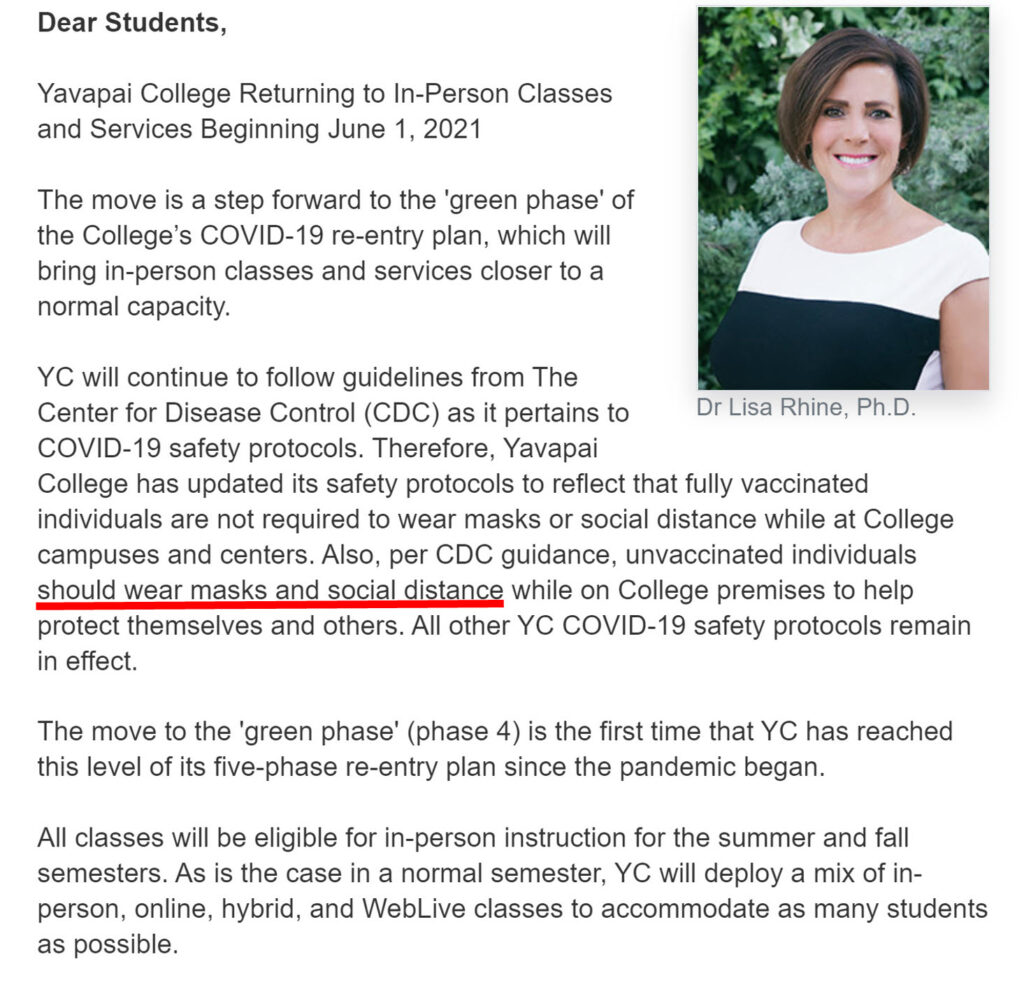
Below is  the gist of the announcement from Yavapai Community College about distancing and mask wearing that was put in place June 1.

Categories : COVID 19

INDIVIDUAL BOARD MEMBERS’ VIEW OF 2021-22 $92.3 MILLION BUDGET (PART 5 OF 5)

By R. Oliphant
Saturday, June 12th, 2021

Fifth District Representative Pedilla  expresses concern for taxpayers, finds budget sufficient to provide opportunity to examine various areas and approve  it;  lauds Dr. Rhine for handling Community College during Pandemic and says she must deal with inequity issues between the East and West sides of the College  

Fifth District Governing Board member Mitch Pedilla

Fifth District Yavapai Community College Governing Board representative Mitch Pedilla voted to approve the  Community College’s $92.3 million budget at the May Board meeting. The budget  included a 3% across the board increase for faculty and staff.

In his comments to  the Governing Board,  Representative Pedilla made it clear  that he always has concerns about taxpayers when it comes to budgets.  Local taxpayers should “never be taken for granted,” he said.

In response to Representative Paul Chevalier’s list of the Community College’s inequitable educational and cultural activities gap between the East and West sides of the County, he said that resolving that issue should be in the hands of the Community College president Dr. Lisa Rhine. He also said that he would be “shocked” if all the inequities listed by Mr. Chevalier would be addressed with any great change over the next ten to 20 years.  He observed that in education “it is always balance against the greater good of the community and how education is supposed to be delivered.” 

Mr. Pedilla lauded Dr. Rhine for her work in operating the Community College during the Covid-19 pandemic.

He said the Community College has done a great job of reaching out to the community in a variety of ways.  He reflected on the excellent experience of his two daughters who had graduated from high school in Prescott and their positive experience with Yavapai Community College and its dual enrollment program. 

In regard to the budget and its details, he found the presentation by the Community College a “great readout” and applauded Dr. Clint Ewell and his staff for their work on it.  He was satisfied that the numbers provided him and other Board members the opportunity to “go deeper” into various areas and ask relevant questions. He noted there is always the potential in a budget for greater transparency but the numbers presented by the Community College were “very good.”

In closing, he said he would vote to approve the Budget.  As an afterthought, he wondered why Yavapai College did not call itself “Yavapai Community College.”

You may view a video clip of Mr. Pedilla’s comments on the budget below.  You may also view the entire Workshop by going to the District Governing Board website.

Categories : Budget

COLLEGE NOW IN COVID-19 CODE GREEN MODE—PHASE 3 of 4 PHASES

By R. Oliphant
Saturday, June 12th, 2021

Some restrictions remain; unvaccinated should wear masks and social distance

Based on Governor Ducey’s Executive Orders, CDC metrics for school reopening, and the success of the Community College’s implementation of CDC mitigation strategies, it has now moved to Code Green mode.  This is the third of a four-phase plan to combat Covid-19.

Under Code Green, Yavapai Community College  will continue to follow guidelines from The Center for Disease Control (CDC) as it pertains to COVID-19 safety protocols. It  has updated its safety protocols to reflect that fully vaccinated individuals are not required to wear masks or social distance while at College campuses and centers. Also, per CDC guidance, unvaccinated individuals should wear masks and social distance while on College premises to help protect themselves and others. All other YC COVID-19 safety protocols remain in effect.

Categories : ADMINISTRATION

YAVAPAI COMMUNITY COLLEGE FOCUSES ON OFFERING COURSES LEADING TO A “LIVING WAGE”

By R. Oliphant
Friday, June 11th, 2021

Twenty-five percent of Yavapai County residents  live only slightly above the  poverty level; Estimated 49% of high school students (median) in County  are on free and reduced lunch because of poverty or near poverty

Dr. Lisa Rhine explained to the Yavapai Community College Governing Board at its June retreat that an estimated one in four county residents live just barely above the  poverty level. These are individuals who are  working full-time at sometimes two and three jobs. They are  living paycheck to paycheck and struggling to make ends meet. They are in a group Dr. Rhine refers to as ALICE (Asset limited, income restrained, employed). 
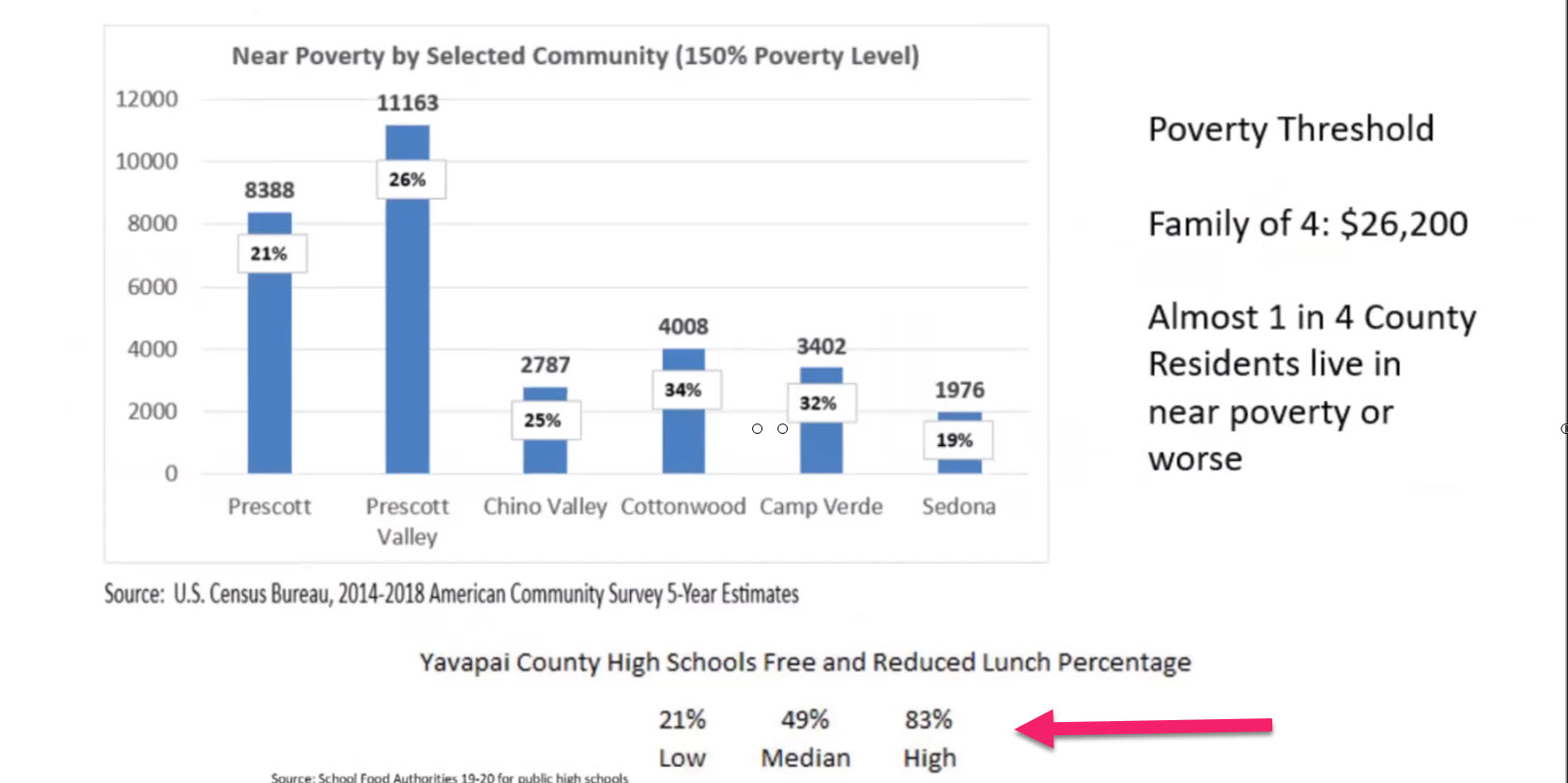
Cottonwood led the municipalities in Yavapai County with the highest level of near poverty ALICE citizens, an estimated 34%.  It was followed by Camp Verde with a 32% of its population living in near poverty.  Sedona came in at 19%, Prescott at 22% and Prescott Valley at 26%.

She also said that an estimated 49% of high school students (median) in the County  are on free and reduced lunch because of poverty. There was an indication that in some schools the lunch program had an enrollment of 83%.

To meet the challenge of trying to move thousands of residents out of near poverty (the ALICE group), Dr. Rhine told the Board that she  has set out three objectives:  First, to ensure that the Community College’s curriculum and programs are focused on imparting skills needed to secure living-wage jobs in a new economy highlighted by growing artificial intelligence and automation.

Second, to create a one-stop-shop at the Community College for workforce training.

Third, to align transfer programs so that associate’s graduates can enter Arizona universities as juniors. You may view all of her report on living wage in the video clip below or visit it at the June Governing Board web site. 

Categories : POVERTY

CAMPUS CONSTRUCTION PROJECTS MOVING AHEAD

By R. Oliphant
Sunday, June 6th, 2021

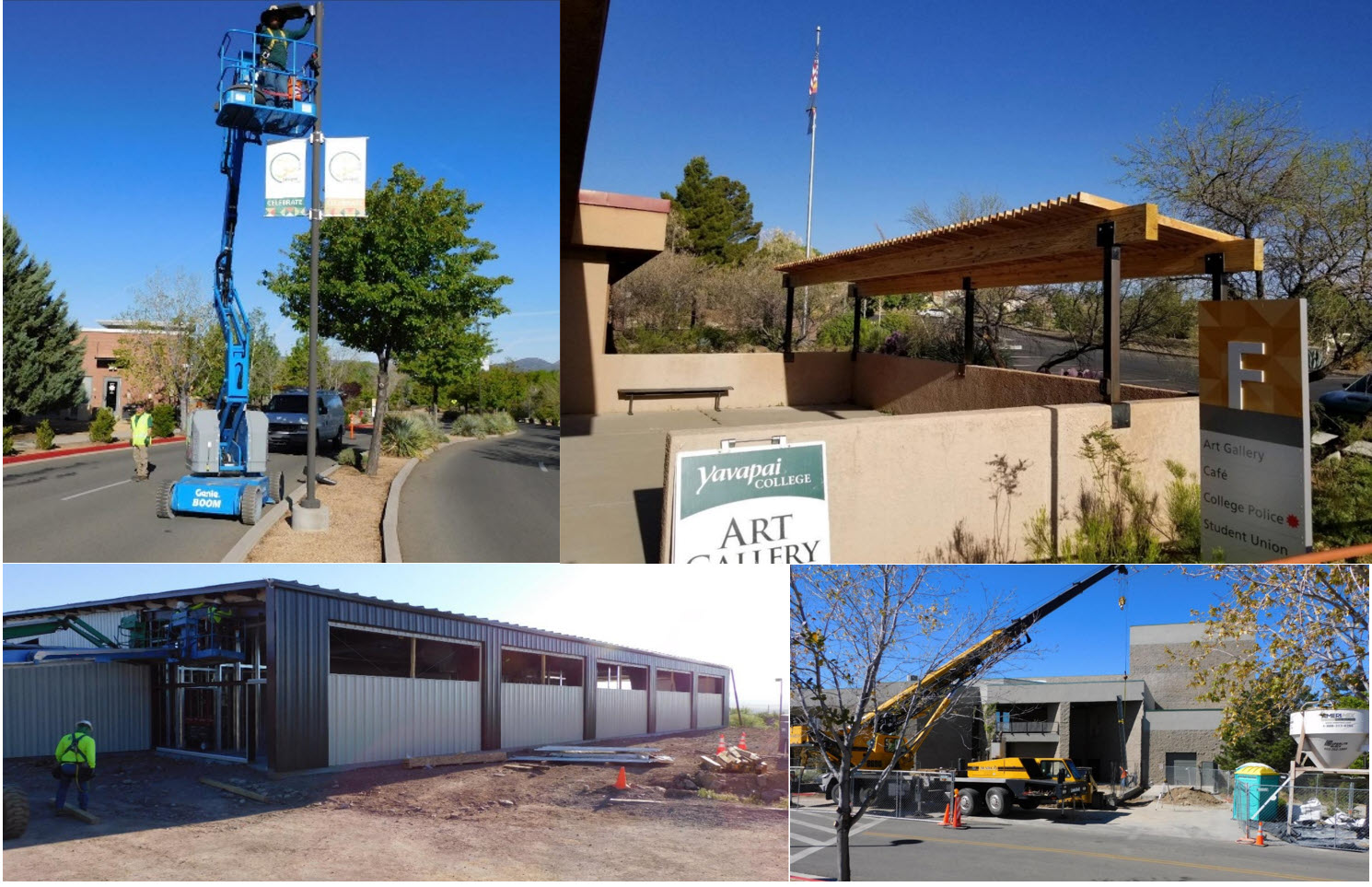
New LED lighting being added to reduce costs by 80%,  Verde Valley Campus Art Gallery Pergola complete, CTE Verde Campus building construction continues, Building 16 Technical Theater going up

A number of construction projects in the Yavapai Community College District are completed or nearing completion.   On the Prescott Campus, the LED installation of outside lights is about complete.  It is anticipated that the new lights will reduce by  80% energy consumption after replacement of the existing metal halide and high-pressure sodium lights. The new lights will also be much brighter than the old.

The Pergola, which was added to the small Verde Valley Campus Art Gallery, has been completed.  Construction on the 10,000 square foot Career and Technical Education building continues with completion expected by the fall 2021.

Finally, construction of the Technical Theatre addition to the Performing Arts Center is on track. It is expected to be completed in time for the fall 2021 classes.

Photos taken by Community College and found in monthly Facilities Management Newsletter.

Categories : Construction

GOVERNING BOARD ADJOURNS UNTIL SEPTEMBER WHILE APPROVING A HOST OF POLICY GOVERNANCE CHANGES; MAKING SPECIAL NOMINATIONS; ADOPTING NEW POLICY MANUAL

By R. Oliphant
Friday, June 4th, 2021

Carver governance policy approach replaced (at least in part) with streamlined structure that uses more understandable language and reduces  amount of staff time needed to provide Board with information

Goodbye Carver model of policy governance–at least in part.

The Yavapai Community College Governing Board met at the Sedona Center on June 3 for a workshop.   After working throughout the day, it had accomplished the following:

  1. Received one-hour update from President Dr. Lisa Rhine on the “State of the College.”
  2. Unanimously approved sending nomination letters on behalf  of President Lisa Rhine and faculty member Andrea Schaben to the Association of Community College Trustees. The letters are  for consideration for the annual Chief Executive Officer Award and the annual William H. Meardy Faculty member award.
  3. Approved 4-1 a new President’s Evaluation tool.
  4. Approved 4-1 Board Self-Assessment tool that will be administered by the Association of Community College Trustees at a cost of about $3,000 per assessment.
  5. Unanimously approved a completely revised District Governing Board Policy Manual with the understanding that beginning in the fall the Board will hold workshops to possibly revise any portion of the Manual.
  6. Unanimously approved an Advocacy and Community Relations Plan.
  7. Approved 4-1 a temporary plan to divide the monthly public meeting into two segments: One two-hour session called a “Study Session” and a third one hour session called a “Business Meeting.”

A major advantage of the new policy governance approach, it is claimed,  is to reduce the enormous amount of time the Carver model of governance placed on staff to fulfill all of its various reporting requirements.  

However, many of the changes raised controversial questions about the language used to describe  the Board’s governance and the effectiveness of a particular provision. More discussions about the new model will be provided  in later Blog postings. 


Categories : ADMINISTRATION
« Previous Page
Next Page »

Topics

  • Academic awards
  • accreditation
  • ACT
  • ADMINISTRATION
  • Administrative College
  • Admnistrative turnover
  • Advisory Committees
  • Allegations
  • Allied Health Campus
  • Alumni
  • Arizona technical college
  • Art Gallery Event
  • Art programs
  • Asbestos
  • ASU
  • athletic camps & clinics
  • Athletics
  • Attorney fees
  • Audit
  • Aviation program
  • B.A. DEGREES
  • Baseball team
  • Basketball program
  • Basketball program
  • BEAVER CREEK
  • Beer projects
  • Black History Month
  • Bonds
  • Booklets
  • Budget
  • Bus service
  • Butterfly Garden
  • Camp Verde
  • Campaign 2018
  • Career and Technical Education
  • CARES GRANT
  • CARVER MODEL
  • Child Care
  • Chino Valley campus
  • CLOTHING STORE ON PRESCOTT CAMPUS
  • Coconino Community College
  • College for Kids
  • Commencement
  • Communication
  • Community College Citizen Advocates
  • Community colleges outside yavapai
  • COMMUNITY EDUCATION
  • COMMUNITY EVENT NOT PAC
  • Complaints
  • Construction
  • COTTONWOOD COMMUNITY SCHOOL
  • COVID 19
  • Crime
  • CTEC
  • Culinary Arts
  • Cultural Events for the Public
  • CURRICULUM
  • DAKA
  • Detention Academy
  • District Governing Board
  • DK RANCH
  • DOG CERTIFICATES
  • Dropout rate
  • Drug investigation
  • Dual enrollment
  • EARLY COLLEGE ACADEMY
  • Economic Development
  • Economic impact of College
  • Editorials/Essays
  • Educational material references
  • Election 2018
  • Election 2023
  • Embry-Riddle
  • EMPLOYMENT
  • Employment issues
  • Enrollment data
  • Event
  • Executive meetings
  • Faculty
  • Family Enrichment Center
  • FILM
  • Film School
  • Fire Academy
  • Fitness Center
  • Flight school
  • FOOD PANTRY
  • Food Service
  • Forum for Public Affairs
  • Foundation
  • Free speech
  • Fundraising events
  • GED
  • Gift of ranch
  • GOVERNING BOARD
  • Graduation
  • Grants
  • Greater Verde Valley Chapter
  • Health Science Building
  • Health Summit
  • History
  • Hotel Restaurant Management
  • Housing
  • Late class offerings
  • Lawsuits
  • LEAD program
  • Learning Centers
  • Lifelong learning
  • Loan repayment
  • manzanita
  • Maricopa Community College
  • Maricopa Community Colleges
  • marketing
  • Master documents
  • MASTER PLAN
  • Mayer High School
  • McCASLAND
  • Meeting Notice
  • Memorials
  • MENTAL HEALTH
  • METAVERSITY
  • Mingus Union High School
  • Mountain Institute
  • Movie
  • MULTI PURPOSE FIELD VERDE CAMPUS
  • Multi-use Field
  • Music
  • NARTA
  • Nature trail
  • New Courses
  • Newsletter
  • Non credit courses
  • Northern Arizona University
  • Nursing
  • OER
  • OLLI (Osher Lifelong Learning)
  • On line classes and accreditation
  • Open Meeting Law
  • OPINIONS
  • Paramedic
  • Performing Arts Center
  • Policy Governance Indoctrination
  • Policy Manual
  • Politics
  • Polling data
  • Population
  • POVERTY
  • Prescott Campus
  • PRESCOTT PINES CAMP
  • Prescott Valley Campus
  • PRINTER 3D
  • Prison program
  • Property purchase
  • Rad Tech
  • Rankings
  • Regional Economic Development Ctr
  • Residence halls
  • RV PARK ON VERDE CAMPUS
  • Salaries
  • Scholarships
  • Search Committee
  • Secret meetings
  • Sedona Arts Center
  • Sedona Campus
  • Sedona land settlement
  • Small Business Development
  • Small Business Development Center
  • Soccer team
  • Softball team
  • SOFTWARE UPGRADES
  • Solar projects
  • Southwest Wine Center
  • Sports in General
  • STAFF
  • Strategic Plan
  • Student achievements
  • Student Organizations
  • SUMMER CLASSES
  • Survey results
  • Surveys
  • Taxes
  • Ten year plan
  • Ten Year Plan Construction
  • Tennis Court
  • TINY HOME PROJECT
  • Trail
  • Transportation
  • Truth in advertising
  • Tuition
  • UNDERSERVED
  • Underserving the Verde Valley
  • Univ of Arizona
  • University of Arizona
  • VACTE
  • Verde Campus
  • Verde campus events
  • Verde Tech High School
  • Verde Valley Forum for Public Affairs
  • Veterans Administration
  • Video
  • Videotape
  • Virtual Reality
  • Viticulture
  • Vocational Education
  • Vocational training
  • Volleyball team
  • WAKE UP VERDE VALLEY BOOK ED 1
  • WAKE UP VERDE VALLEY FIRST EDITION
  • Waste
  • Web sites
  • Weight room
  • Wills salary
  • Wine Center
  • WORKFORCE DEVELOPMENT
  • World War I symposium
  • Yavapai Community College
  • Yavapai-Apache Nation