
By a vote of 4-1, Governing Board says all the College need do is to meet minimal requirements set out by state statutes in public budgetary reporting

Paul Chevalier
Third District Yavapai Community College Representative Paul Chevalier’s efforts to require a much more detailed, transparent College budget that is open to the public showing how taxes and other revenue supporting the $80 million operation are used was rejected in a 4-1 vote at the October meeting. Chevalier has urged the College on several occasions to provide much greater detailed information about its operation to the public. However, it was the will of the Governing Board that the only public budget document the public need see is that set out by Arizona statutes.
Chevalier pointed out that the Arizona statutes set out the bare minimum requirements in terms of public information that must be provided. They do not prevent a College, if it chooses to do so, to include additional information for the public. The majority on the Governing Board appeared satisfied with keeping budgetary details away from a more robust public requirement.
Chevalier has consistently used as illustrations of better public budgetary documents those that are prepared by the cities in Yavapai County and the budget published by the Yavapai County Supervisors. He has also cited Coconino Community College’s financial reports on its web site as another illustration of a community college providing greater public transparency and budgetary details. The Community College budget in contrast to those budgets is sparse in terms of detailed information.
Yavapai Community College is not alone in Arizona in formally hiding detailed budgetary information from the public. In fact, it appears that most of the Community Colleges in Arizona, with the exception of Coconino, provide even less information about how they spend public funds than does Yavapai. Chavlier argued that this should not be a justification for Yavapai following the same path.
You may view a video clip of the approximate 15-minute discussion by the Governing Board on this issue below. You may view the entire Board meeting by clicking here.
 Yavapai Community College will not increase student tuition for the 2022 fiscal year. It also anticipates not asking for a County tax levy increase in the 2022 fiscal year. This information came from Vice President Clint Ewell at the October Governing Board hearing when the question of tuition for the 2022 fiscal year was discussed and voted upon. The Governing Board approved his recommendation that tuition not be increased.
  The Yavapai District Governing Board approved a change to the existing budget at its October monthly meeting by adding $750,000 to begin repairs to the roof of the Performing Arts Center (PAC). The total cost for repair is estimated at $2 million. The additional $1.25 million to complete the repair and replace HVAC machinery will come from next year’s budget.
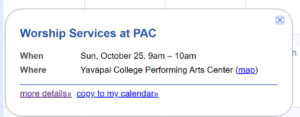 The Yavapai Community College Governing Board voted 4-1 to allow regular Sunday church services to be again held by the Cornerstone Evangelical Free Church in its 1,100 seat Performing Arts Center. The Church had been holding services on a regular Sunday basis until insurance liability issues caused the Community College to withdraw permission to use the facility. The College did not report on what it was charging the Church to use the facility every Sunday morning.
 The Maricopa Community College District Governing Board race has become heated for at least two of the four candidates seeking office this year. In a story written by Anne Ryman in the Arizona Republic on Sunday, October 18, the campaigns of candidate Shelli Boggs and incumbent Laurin Hendrix appear to have become involved in unusual stormy political tactics for these nonpartisan positions.
  The Yavapai Community College District Governing Board will hold a general meeting on zoom on Tuesday, October 20, 2020 beginning at 1:00 p.m.

 The Yavapai Community College Foundation has awarded twelve two-year full tuition scholarships to students in the College’s healthcare program. Ten of the scholarships went to nursing students and two of the scholarships were awarded to radiologic technology students.